Group B Strep: What the Test Means for Your Labor
A positive GBS swab is common, not an infection, and not your fault. It changes one thing: you get IV antibiotics during labor, ideally a few hours before delivery.
Of all the routine tests in the third trimester, the Group B Strep swab probably causes the most alarm relative to what it actually means. The word "strep" does a lot of unhelpful work there, and so does the word "positive."
What follows is educational background on what the test measures, what a positive result changes about your labor, and why the clinical attention lands on antibiotic timing rather than on the bacteria themselves. Your provider is the right person to apply any of it to your situation.
What Group B Strep Actually Is
Group B Streptococcus, sometimes written GBS or Streptococcus agalactiae, is a bacterium that colonizes the gastrointestinal and genital tracts of many healthy adults. Commonly cited figures put colonization somewhere in the range of 10% to 30% of pregnant people, depending on the population studied and the sampling method.
Three things are worth being clear about:
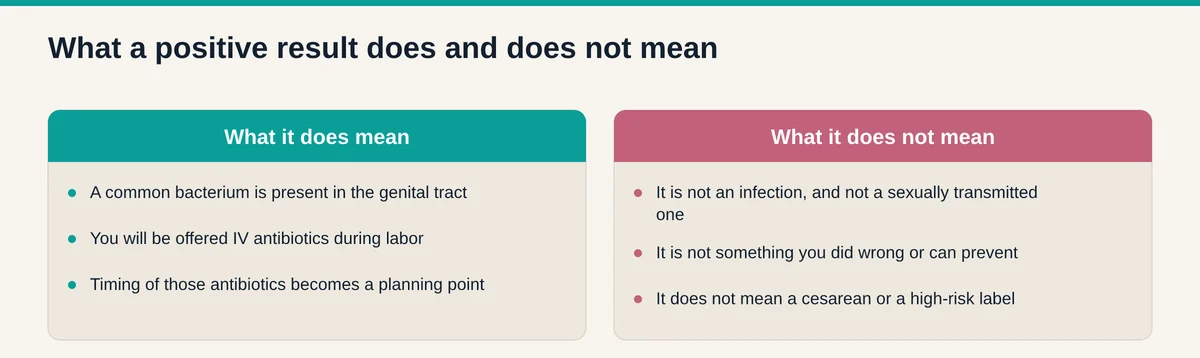
- It is not a sexually transmitted infection. GBS is part of the normal bacterial population in many people's bodies.
- It is not an infection in you. Colonization means the bacteria are present. In the overwhelming majority of cases you have no symptoms at all and need no treatment while pregnant.
- It is not caused by anything you did. Hygiene, diet, and behavior are not what determine GBS status. Colonization can also come and go over time, which is exactly why the test is done when it is done.
The reason anyone screens for it is narrow and specific: a newborn passing through a colonized birth canal can acquire the bacteria, and in a small number of cases that leads to early-onset GBS disease, which can be serious in a baby whose immune system is brand new.
When and How the Test Is Done
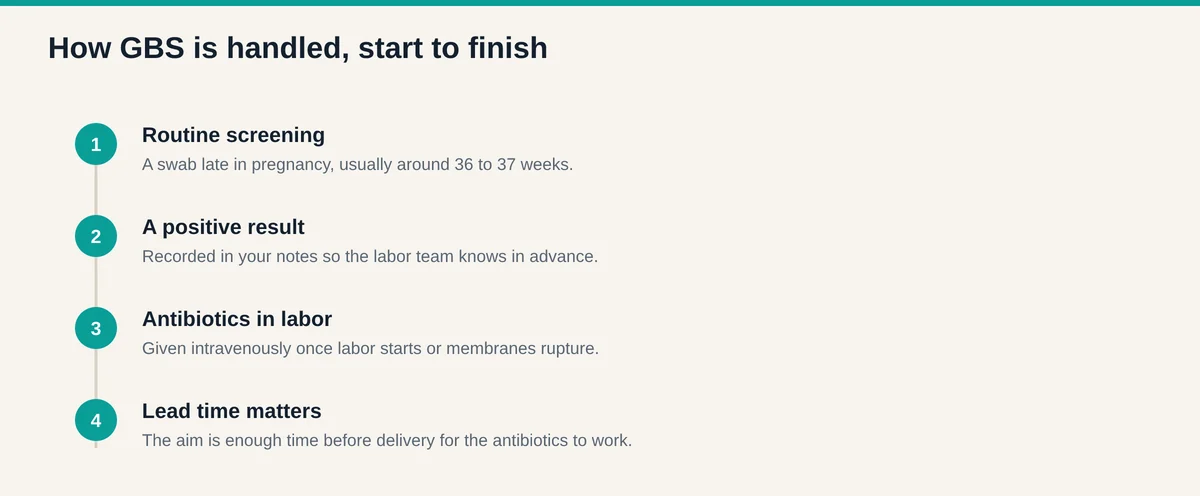
Screening is a swab of the lower vagina and rectum, usually done in the office and often something you can do yourself if you prefer. It takes seconds and is not painful. The sample goes to a lab for culture, and results typically come back within a couple of days.
Current ACOG guidance places routine screening in the window from 36 0/7 to 37 6/7 weeks of gestation. Earlier guidance used 35 to 37 weeks, so you may still see that range in older material.
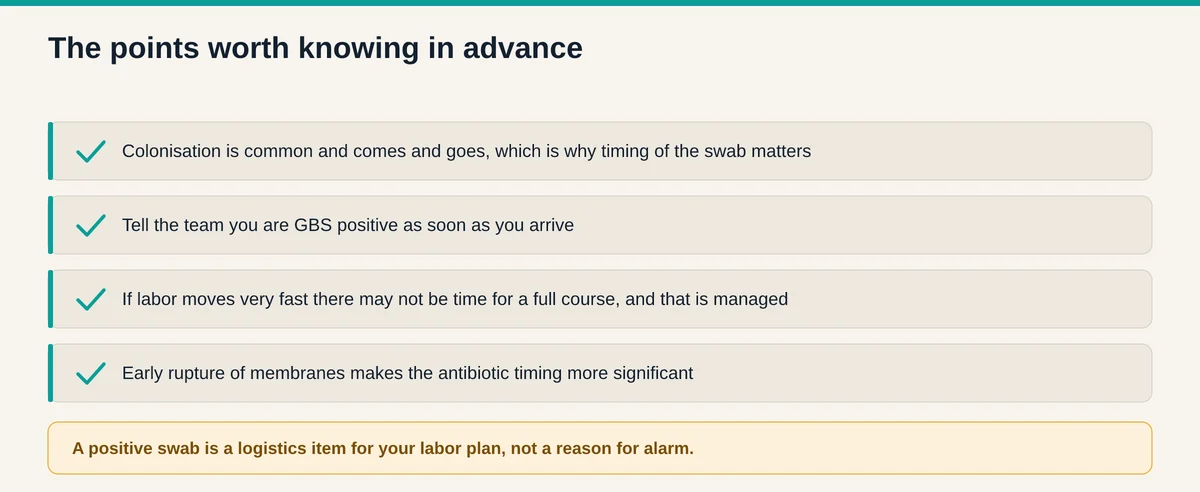
The timing is deliberate. Because colonization fluctuates, a swab taken too early does not reliably predict status at delivery. A culture is generally considered valid for about five weeks, which is designed to cover most people through the weeks when labor is most likely to begin.
Some people skip the swab because the answer is already known. If GBS has been found in your urine at any point during the pregnancy, or if you have previously had a baby with GBS disease, most guidelines say to treat during labor regardless of what a later swab shows.
What a Positive Result Actually Changes
One thing: you are offered intravenous antibiotics once labor begins or once your membranes rupture.
That is the entire intervention. Not oral antibiotics in advance, not a different birth plan, not a different delivery method. Treating colonization earlier in pregnancy does not reliably clear it, and it tends to come back, which is why the antibiotics are given during labor rather than before it.
Penicillin is the usual first choice, with ampicillin as a standard alternative. If you have a penicillin allergy, tell your provider the specific reaction you had, because the alternative chosen depends on how severe that history is. Cefazolin is often used for lower-risk allergy histories, and clindamycin or vancomycin may be used for higher-risk ones, sometimes guided by susceptibility testing done on your original culture.
Why the Timing of Antibiotics Is the Whole Point
This is the part that gets lost. The clinical focus is not on eliminating GBS from your body. It is on having enough antibiotic circulating through the placenta and into the amniotic fluid at the moment of delivery.
Prophylaxis is generally considered adequate when the first dose of penicillin, ampicillin, or cefazolin has been given at least four hours before birth. That threshold is why the hospital wants to start your IV early rather than waiting to see how labor unfolds.
Practically, this means:
- Call your provider when labor starts or when your water breaks, and say you are GBS positive. It changes the urgency of the conversation.
- The antibiotics are given every four hours or so until delivery, not as a single dose.
- You can usually still move around. Ask about a saline lock, which lets the IV line be disconnected between doses.
If you are trying to gauge whether what you are feeling is the real thing before you call, signs labor is close and when does labor start cover the difference between early and established labor.
When Labor Moves Too Fast for a Full Course
Sometimes labor is quicker than four hours. This happens often enough that it is a normal part of the conversation, not a crisis.
Partial prophylaxis is not the same as none. Some antibiotic exposure is generally better than zero, and providers plan around it. What usually changes is the newborn observation period: babies born after inadequate prophylaxis to a GBS positive parent are typically watched more closely in the first day or two for any sign of illness, rather than treated automatically.
If you have had a fast labor before, mention it early. Second and subsequent labors are often shorter, as covered in first-time vs second pregnancy labor, and that shortens the window for antibiotics too.
GBS and Ruptured Membranes
The interaction between GBS and early rupture of membranes is where the management genuinely shifts.
Once membranes rupture, the protective barrier between the vaginal environment and the baby is gone, and time matters more. Prolonged rupture, generally counted at 18 hours or more, is a recognized risk factor for early-onset GBS disease on its own, even in people whose status is unknown.
For that reason, if your water breaks and you are GBS positive, providers usually want antibiotics started promptly rather than after labor is well established. Many will also want to talk sooner about whether to encourage labor along rather than waiting a long stretch for it to start on its own. That is a discussion with real trade-offs, and induced vs spontaneous labor covers the general shape of it.
Unknown GBS status changes things too. If you arrive in labor without a valid result, most protocols treat based on risk factors: preterm labor before 37 weeks, membranes ruptured 18 hours or more, or a fever during labor. Some hospitals have rapid intrapartum testing available, but not all do.
The Numbers, Roughly
Precise rates vary by country, era, and surveillance method, so treat these as orientation rather than as your personal odds:
- Colonization: commonly reported in the range of 10% to 30% of pregnant people.
- Risk to the newborn without antibiotics: classically cited at roughly 1% to 2% of babies born to colonized parents who receive no intrapartum prophylaxis. The large majority of babies born to GBS positive parents are entirely fine either way.
- Effect of prophylaxis: early-onset GBS disease rates in the United States fell substantially after routine screening and intrapartum antibiotics were adopted in the 1990s, and current rates are well under 1 case per 1,000 live births.
- Late-onset disease: GBS illness appearing after the first week of life is not prevented by labor antibiotics. It is uncommon, and it is a separate problem from the one screening addresses.
What those numbers describe is a small absolute risk made smaller. That is a good thing to have done, and it is also not a reason to spend the third trimester worried.
What a Positive Result Does Not Mean
It does not mean a cesarean. GBS status is not an indication for surgical delivery, and a planned cesarean before labor begins with membranes intact generally does not call for GBS prophylaxis at all.
It does not put you in a high-risk category. Your prenatal care, monitoring schedule, and delivery options usually stay the same.
It does not rule out most of what people plan for. Mobility, position changes, delayed cord clamping, and immediate skin to skin are typically unaffected. Some settings have specific policies around water immersion with an IV in place, so ask rather than assume.
And it does not change when labor will start. GBS colonization is not a factor in labor timing. If you want a sense of how the probability of labor shifts week by week, the labor probability calculator works from gestational age and parity, which are the strongest population-level predictors, and due date accuracy explains why the date on your chart is a midpoint rather than a deadline.
The Bottom Line
A positive Group B Strep swab is a common, normal finding that triggers one specific, well-studied intervention: IV antibiotics during labor, ideally started at least four hours before delivery. The bacteria are not an infection, not something you caused, and not a reason to expect a different kind of birth. Tell your birth team your status as soon as labor starts or your water breaks, and ask what their protocol is if labor moves quickly. This is general information, not medical advice, and your provider should be the one interpreting your result.