How Accurate Is Your Due Date? What Research Shows
Only 4-5% of babies arrive on their due date. Here's what the research says about how accurate EDD calculations really are, and what that means for you.
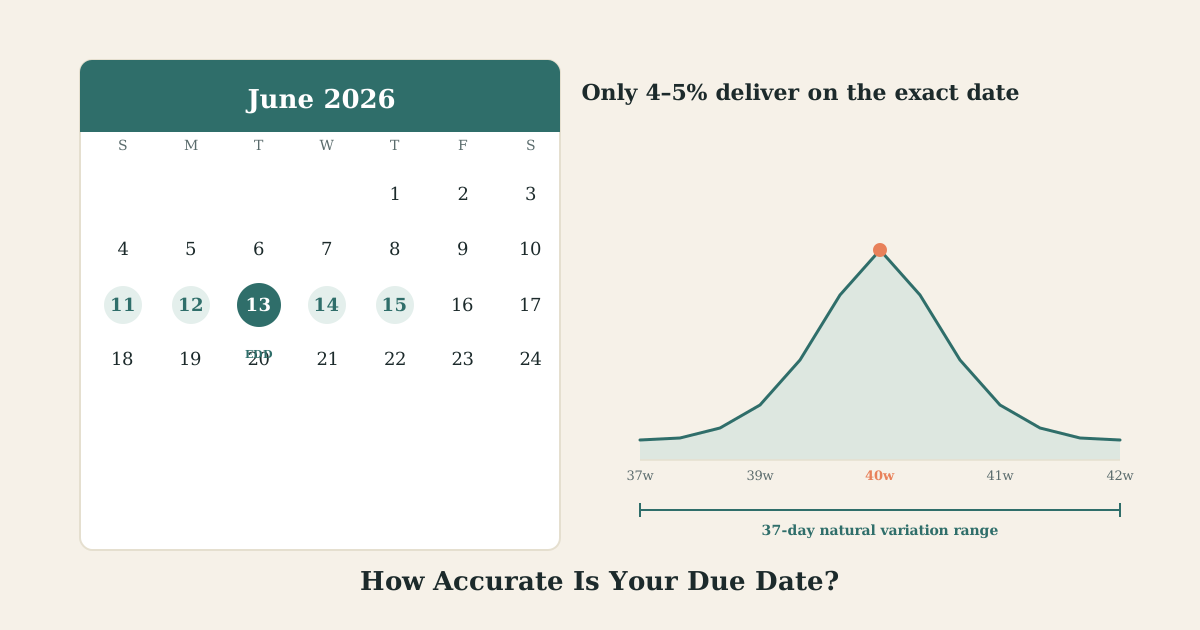
Your due date is one of the first numbers your provider gives you, and it immediately becomes the anchor for everything: when to take leave, when the nursery needs to be ready, when family flies in. The problem is that most people treat it like a flight arrival time when it's really more like a weather forecast.
Here's what the science actually says.
How Your Due Date Is Calculated: Naegele's Rule
The standard method for calculating a due date is Naegele's rule, named after German obstetrician Franz Karl Naegele, who described it in 1812. The formula is simple:
First day of last menstrual period (LMP) + 280 days = Estimated Due Date (EDD)
That 280 days (40 weeks) assumes a 28-day menstrual cycle with ovulation on day 14. In practice, cycle lengths range from 21 to 35 days, and ovulation timing varies. A woman with a 35-day cycle probably ovulates around day 21, meaning her actual gestational age at any given point is 7 days less than Naegele's formula would suggest.
This matters. A 7-day miscalculation can affect decisions about induction, how "overdue" a pregnancy is considered, and even whether a baby is classified as preterm.
LMP vs. Ultrasound Dating: Which Is More Accurate?
This is where clinical practice has genuinely evolved. Before first-trimester ultrasound became standard, LMP was the only option. Now there's debate about which method is better.
First-trimester ultrasound (between 8 and 13+6 weeks) measures crown-rump length (CRL). At this stage, fetal size varies very little between individuals, because growth hasn't yet diverged based on genetics, nutrition, or placental function. The margin of error is about ±5-7 days.
LMP dating relies on the mother accurately remembering her last period, having a regular cycle, and ovulating on schedule. In practice, 20-40% of women don't recall their LMP accurately enough for precise dating, and cycle irregularity is common.
ACOG's guidance (Committee Opinion 700, reaffirmed 2017) is clear: if first-trimester ultrasound disagrees with LMP by more than 7 days, the ultrasound date should be used. If a second-trimester ultrasound (14-20 weeks) disagrees with LMP by more than 10-14 days, ultrasound wins.
After 20 weeks, ultrasound dating becomes less reliable because fetal size starts to reflect individual growth patterns. A big baby at 32 weeks isn't necessarily more advanced in gestational age. They might just be big.
The Jukic Study: A 37-Day Spread in Normal Pregnancies
The most cited recent research on spontaneous labor timing comes from Jukic et al. (2013), published in Human Reproduction. This study was unusual because it used hormone testing (urinary hCG and progesterone metabolites) to precisely identify ovulation date, which eliminated the LMP guesswork entirely.
Key findings from Jukic et al.:
- The average pregnancy lasted 268 days from ovulation (38 weeks + 2 days)
- The range for spontaneous labor in normal pregnancies was 247 to 284 days from ovulation (a spread of 37 days)
- Women who had experienced a prior spontaneous birth tended to deliver at similar gestational ages (suggesting individual biological timing)
- Older mothers and heavier embryos (higher progesterone in early pregnancy) tended to have longer pregnancies
The 37-day spread is the key takeaway. Even when you know the exact day of conception, normal labor can start across a 5-week window. This is why your due date (even a perfectly calculated one) can only tell you so much.
Why Only 4-5% of Babies Are Born on Their Due Date
This statistic surprises a lot of people. Mittendorf et al. (1990) found that in a cohort of white, well-nourished, privately insured women with certain LMP dates, the average time from LMP to birth was 281 days for nulliparous women (first-time mothers) and 279 days for multiparous women. Both numbers are longer than the 280-day Naegele standard.
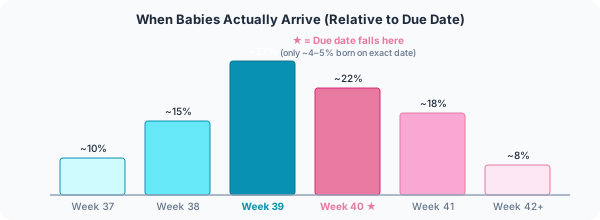
More recent data from national birth statistics consistently shows that only about 4-5% of deliveries occur on the exact EDD. About 70% occur within 10 days on either side, and about 90% occur within 2 weeks of the EDD.
Visualizing this as a bell curve: your due date is the peak of the curve, but the curve is wide and relatively flat. The probability of delivering on any given day near your due date hovers around 4-8%.
Use our labor probability calculator to see how these probabilities shift week by week as you approach and pass your due date.
EDD vs. EDC: A Terminology Note
You'll see both terms used in medical records:
- EDD = Estimated Due Date (more common in US clinical practice)
- EDC = Estimated Date of Confinement (older British term, still used in some records)
They mean the same thing. Some providers use EGA (estimated gestational age) to refer to how far along a pregnancy is at any given point. None of these are precise. They're all estimates built on the same 280-day framework.
How Providers Adjust Due Dates
Due dates can be revised, and the rules for when to revise are specific.
Rule for first-trimester ultrasound: If CRL-based dating disagrees with LMP by more than 7 days, use the ultrasound date.
Rule for second-trimester ultrasound: If dating disagrees by more than 10 days (before 20 weeks) or 14 days (20-28 weeks), use ultrasound.
Rule for third-trimester ultrasound: Late ultrasounds are unreliable for dating and shouldn't be used to change a due date established earlier.
Once a due date is set at your first ultrasound, it typically doesn't change even if later ultrasounds show a different size. This protects against the common scenario where a small baby in the third trimester gets reclassified as "less pregnant" when they might just be growth-restricted.
What IVF Changes
In IVF pregnancies, the date of embryo transfer is known exactly. For a day-5 blastocyst transfer, gestational age is calculated as transfer date + 266 days (or equivalently, transfer date − 5 days as conception, then + 280 days from LMP equivalent). IVF pregnancies have the most accurate dating of any conception method.
Interestingly, IVF pregnancies still show wide variation in spontaneous labor timing, which supports the idea that the variation is largely fetal and uterine rather than a measurement problem.
Due Date Accuracy by the Numbers
| Method | Margin of Error |
|---|---|
| LMP (regular cycles) | ±7-14 days |
| LMP (irregular cycles) | ±14-28 days |
| First-trimester ultrasound | ±5-7 days |
| Second-trimester ultrasound | ±10-14 days |
| Third-trimester ultrasound | ±14-21 days |
| Known ovulation date (e.g., IVF) | ±7-10 days (biological variation remains) |
Even with perfect dating, the Jukic data tells us that spontaneous labor has a 37-day window. The measurement method can be improved; the biological variation can't be eliminated.
Practical Implications
Knowing all this, here's how to think about your due date:
Don't treat it as a deadline. A baby born at 39 weeks and 2 days isn't "early". They're within the normal term window (39-40 weeks is actually statistically peak time for spontaneous labor onset).
Do prepare before it. Given the range, it's reasonable to be ready by 37-38 weeks. Most women going into spontaneous labor at 37 weeks weren't expecting it.
Understand the "overdue" threshold. Going past 40 weeks isn't unusual. Statistically, about 50% of first-time mothers don't deliver until after their due date. "Late-term" is defined as 41 0/7 to 41 6/7 weeks; "postterm" is 42 weeks and beyond. We discuss this in detail in our guide to going past your due date.
Know your provider's approach. Most US providers offer induction at 39 weeks for low-risk pregnancies and recommend it by 42 weeks at the latest. If your due date is uncertain (set by LMP only), this matters: induction timing based on an inaccurate date has real consequences.
For a deeper look at how labor timing varies by week and parity, see our article on when labor actually starts.
The Bottom Line
Your due date is the best estimate available with current methods. It's genuinely useful as a planning horizon. But it's an estimate built on a formula from 1812, averaged across populations, with real biological variation that no ultrasound can eliminate.
The research is clear: normal labor can start across a 5-week window. About 90% of births happen within 2 weeks of the EDD. Only 4-5% happen exactly on it.
To understand your week-by-week probability of going into labor, estimate when labor might start using our calculator, which accounts for gestational age and parity.
Learn more about how our tool works and the research behind it on our about page.