When Does Labor Actually Start? Signs, Stages, and Timing
Labor starts when uterine contractions become regular and cause cervical change. Here's how to tell the difference between false alarms and the real thing.
When does labor start? It's one of the most searched questions in pregnancy, and one of the most genuinely complicated to answer. The shift from "not in labor" to "definitely in labor" isn't a light switch. It's a slow dimmer.
Understanding what's actually happening in your body helps you stay calm, make better decisions, and know when to call your provider.
The Two Types of "Pre-Labor" Contractions
Not every contraction means labor has started. Your uterus has been contracting since around week 6 of pregnancy, even though you couldn't feel most of it.
Braxton Hicks contractions are irregular "practice" contractions that don't cause cervical change. They're usually painless or mildly uncomfortable, last 30-60 seconds, and stop when you change position, walk, or drink water. They tend to ramp up in the third trimester, especially after sex or physical activity.
Prodromal labor is different, and more confusing. These contractions are regular enough to feel real, sometimes 10-15 minutes apart, and can be genuinely painful. But they stall. They don't progress to active labor. Prodromal labor is more common in first-time mothers and can go on for days, which is exhausting and demoralizing.
The key distinction: true labor contractions get longer, stronger, and closer together over time. They don't stop when you move around.
The Latent Phase: What Most People Call "Early Labor"
The latent phase runs from your first regular contractions until your cervix reaches 6 cm dilation. This is the longest part of labor for most people, and it's where the biggest timing surprises happen.
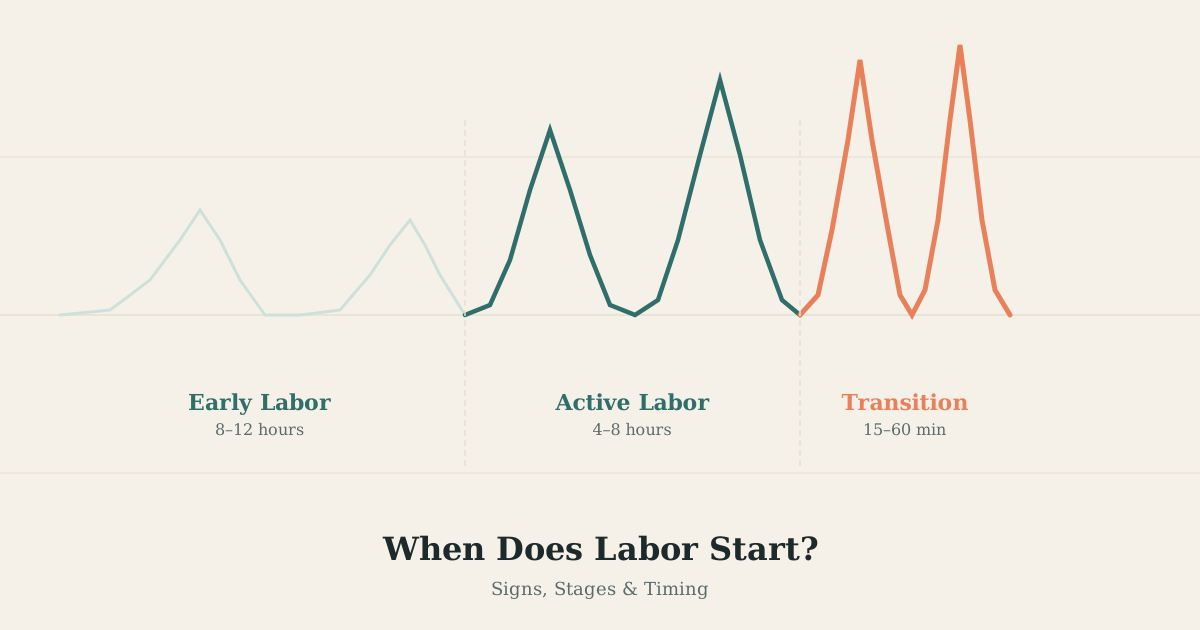
For first-time mothers, the latent phase averages 8-12 hours. For women who've given birth before, it's typically 4-6 hours. But these are averages. The normal range is wide. ACOG's 2014 consensus statement confirmed that slow progress in the latent phase (before 6 cm) is common and not by itself a reason for intervention.
During the latent phase:
- Contractions are 5-20 minutes apart
- Each contraction lasts 30-60 seconds
- Intensity builds gradually
- You can usually talk through contractions at the start
Most providers recommend staying home during this phase. Eat something light, drink fluids, rest if it's nighttime, and try to distract yourself. Going to the hospital too early in latent labor is associated with higher rates of intervention.
The Active Phase: When Things Move Faster
Active labor begins at 6 cm dilation. The 2014 ACOG guidelines moved this threshold from 4 cm to 6 cm based on better evidence about normal labor progress.
In active labor, contractions typically come every 3-5 minutes and last 45-60 seconds. Most first-time mothers dilate at about 1 cm per hour in active labor, though rates from 0.5 to 1.5 cm/hour are considered normal. Multiparous women (those who've given birth before) often dilate faster: 1.5-2 cm per hour is common.
Transition is the final stretch of active labor, roughly 8-10 cm. It's the shortest phase, often 15-60 minutes, but typically the most intense.
The 5-1-1 Rule: When to Head to the Hospital
Most providers use the 5-1-1 rule as the standard guideline for when to leave for the hospital:
- Contractions 5 minutes apart
- Each lasting at least 1 minute
- For at least 1 hour
This pattern suggests you're likely in active labor. At this point, you probably want to be assessed at the hospital or birth center.
That said, the 5-1-1 rule is a starting point, not a rigid protocol. Call your provider sooner if:
- Your water breaks (amniotic fluid is clear, pink, or bloody, but not green or brown)
- You're having a second or third baby and labor tends to go fast
- Contractions are suddenly very intense right from the start
- You have Group B Strep and your water has broken
- You notice decreased fetal movement
- You're bleeding more than spotting
True Labor Signs vs. False Alarms: A Practical Comparison
| True Labor | False Alarm | |
|---|---|---|
| Contraction timing | Regular, getting closer | Irregular, staying the same |
| Contraction intensity | Increasing with each one | Stays mild, doesn't progress |
| Effect of movement | Contractions continue or intensify | Often stop with position change |
| Lower back pain | Radiates from back to front | Usually isolated |
| Cervical change | Dilation and/or effacement | No change on exam |
You can't always tell from home. If you're unsure, call your provider or go in to be checked. A vaginal exam takes 2 minutes and ends the guessing.
How Long Does Labor Last? The Real Numbers
Labor duration varies enormously, but research gives us useful benchmarks.
For first-time mothers:
- Latent phase (0-6 cm): 8-12 hours average
- Active phase (6-10 cm): 4-8 hours average
- Pushing (second stage): 1-3 hours average
- Total: 12-24 hours is typical, though 6-36 hours is within normal range
For women who've given birth before:
- Active labor is often 3-5 hours
- Pushing is typically 20 minutes to 1 hour
- Total labor can be as short as 2-4 hours
These numbers come from studies by Zhang et al. (2010) using labor curve data from over 62,000 deliveries: a significant update to the Friedman curves that OBs used for decades.
What Triggers Labor to Start?
The exact mechanism is still being studied, but the current understanding involves a shift in hormonal signaling. Around 37-40 weeks, the fetus produces surfactant protein A, which signals the uterus that the lungs are mature. Inflammatory signals from fetal membranes also play a role.
Prostaglandins cause cervical ripening (softening, shortening, and rotating the cervix forward). Oxytocin receptors in the uterus multiply, making contractions more effective. The result is a cascade that, once it reaches a tipping point, becomes self-sustaining.
Use our labor probability calculator to see your statistical likelihood of going into labor this week based on your gestational age and pregnancy history.
When Labor Doesn't Start on Its Own
About 25% of pregnancies in the US are induced rather than spontaneous. ACOG recommends offering elective induction at 39 weeks for low-risk pregnancies, based on the ARRIVE trial showing no increase in cesarean rates and possible reduction in adverse outcomes.
If you reach 41-42 weeks, most providers will recommend induction. We cover this in detail in our guide to going past your due date.
A Note on Prodromal Labor
Prodromal labor deserves extra attention because it's poorly understood and often dismissively called "false labor" (which isn't accurate or helpful).
Prodromal contractions are real. They're doing real work: ripening the cervix, rotating the baby into optimal position, and sometimes causing early dilation. The difference is they stall before active labor begins.
If you're experiencing prodromal labor, your baby is most likely moving into a better position. It can go on for 1-5 days before transitioning into active labor. Rest when you can, stay hydrated, and try to stay off your feet when contractions are happening. Going to the hospital during prodromal labor often results in being sent home, which adds stress.
Read more about what early signs to watch for in our article on signs labor is close.
Timing Your Contractions Effectively
A simple contraction timer app or a piece of paper works. Record:
- The time each contraction starts
- How long it lasts (from start to when it fades)
- The interval (time from the start of one to the start of the next)
Track at least 6-8 contractions in a row before calling your provider. Random contractions in a 2-hour window don't give a clear picture; a consistent pattern does.
For context on how labor timing varies by week of pregnancy, see our breakdown of labor statistics week by week.
The Bottom Line
Labor starts when contractions become regular, increase in intensity, and cause cervical change. The latent phase is long and unpredictable. The active phase moves faster. The 5-1-1 rule is your go-to guideline for when to head in.
When in doubt, call your provider. That's what they're there for. And if you want to understand your personal probability of going into labor this week, check your delivery window using gestational age and parity data.