Induced vs Spontaneous Labor: Timing and Risks
ACOG recommends offering induction at 39-41 weeks. Here's how induction works, what the ARRIVE trial found, and how induced labor differs from spontaneous.
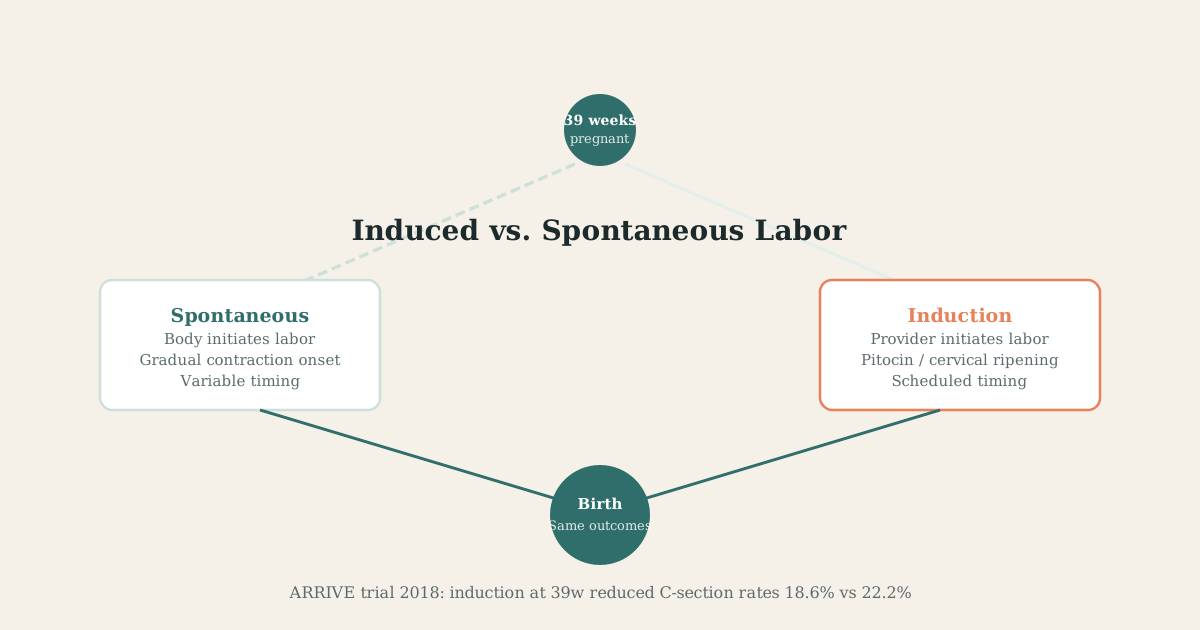
Induction used to be viewed as an intervention of last resort. That view has shifted substantially in the past decade, driven largely by one landmark trial. Here's what actually happens when labor is induced, how it compares to waiting, and what affects your individual experience.
Why Inductions Happen
Inductions fall into two categories: medically indicated and elective.
Medically indicated inductions happen when continuing the pregnancy carries more risk than delivering. Common indications include:
- Post-term pregnancy (41 0/7 weeks or beyond per ACOG guidelines)
- Gestational hypertension or preeclampsia
- Gestational diabetes with poor control
- Fetal growth restriction
- Oligohydramnios (low amniotic fluid)
- Prelabor rupture of membranes (PROM)
Elective induction at 39 weeks is now offered at most hospitals for low-risk pregnancies. This shift followed the 2018 ARRIVE trial (A Randomized Trial of Induction Versus Expectant Management).
The ARRIVE Trial Changed the Conversation
Before 2018, the standard thinking was that elective induction increased C-section rates. The ARRIVE trial (a randomized controlled trial of 6,106 low-risk, nulliparous women at 39 weeks) showed the opposite.
Women randomized to elective induction at 39 weeks had a C-section rate of 18.6%, compared to 22.2% in the expectant management group. That's a statistically significant reduction. Perinatal outcomes (neonatal death, NICU admission, low Apgar scores) were similar between groups.
The result was counterintuitive enough that it changed ACOG policy. Their 2018 update now says it's reasonable to offer elective induction at 39 0/7 weeks to low-risk nulliparous women.
Why did induction reduce C-sections? The leading theory: expectant management means some women inevitably progress to 41 or 42 weeks, where the cervix becomes less favorable and fetal complications increase. Both of those factors drive up C-section rates. Inducing at 39 weeks, when conditions are still favorable, may avoid that compounding risk.
Methods of Induction
Not all inductions work the same way. Your provider will choose a method based on your Bishop score: a 0-13 scale that evaluates cervical ripeness by scoring dilation, effacement, station, consistency, and position.
Bishop score interpretation:
- ≥ 8: Favorable cervix, induction likely to succeed with Pitocin alone
- 6–7: Intermediate, may need priming first
- ≤ 5: Unfavorable, cervical ripening recommended before Pitocin
Cervical ripening methods (used when Bishop score is low):
Cervidil (dinoprostone): A prostaglandin E2 vaginal insert that softens and ripens the cervix over 12 hours. Removable if contractions become too frequent.
Cytotec (misoprostol): An off-label but widely used prostaglandin E1. Given as a small oral or vaginal dose every 4–6 hours. More potent than Cervidil; cannot be removed once administered.
Foley balloon catheter: A mechanical option: a catheter with a small balloon inflated to 30-60 mL inside the cervix. Creates physical pressure to promote dilation. No drug exposure, which makes it useful for women with prior uterine surgery.
Oxytocin (Pitocin): Used once the cervix is favorable or to augment contractions already started. Administered via IV drip at a low starting dose, increased gradually per protocol. Pitocin has a short half-life (5–10 minutes), which is why dosing adjustments have rapid effect.
Membrane sweeping (or membrane stripping) is a low-tech option that can be done in office: your provider sweeps a finger around the cervix to separate the amniotic membranes from the lower uterine segment. It releases prostaglandins locally and can trigger spontaneous labor within 24–72 hours in women who are already somewhat dilated. A Cochrane review found it reduces the likelihood of reaching 41 weeks by about 30%.
How Induced Labor Feels Different
Spontaneous labor typically begins with irregular contractions that build over hours (or longer). The latent phase (from early contractions to 6 cm dilation) can last 8–20+ hours in first-time mothers but often doesn't feel as intense in the early hours because contractions start mild and ramp up gradually.
Induced labor with Pitocin often compresses this ramp-up. Contractions can become regular and moderately strong within 1–2 hours of starting Pitocin, which some women find more difficult to cope with than the gradual build of spontaneous labor. The overall length of active labor (6–10 cm) is similar between induced and spontaneous labor once the cervix is fully ripe, but the latent phase of induction can be longer, sometimes 12–24 hours if the cervix is initially unfavorable.
Epidural use rates are higher with induction, partly because of the more rapid onset and partly because of the longer overall time commitment.
Spontaneous Labor: The Waiting Game
If you don't get induced, your body initiates labor through a cascade of hormonal changes that's still not completely understood. Fetal cortisol, prostaglandins from the amniotic membranes, and a surge in oxytocin receptors all play roles.
The probability of spontaneous labor by week varies based on parity. For first-time mothers:
- By 39 weeks: ~52%
- By 40 weeks: ~74%
- By 41 weeks: ~92%
For second-time mothers, those numbers shift to ~60%, ~81%, and ~95% respectively.
That means if you're a first-time mother at exactly 40+0 weeks with no induction, there's roughly a 26% chance you'll still be pregnant next week. That's not rare. It's about 1 in 4.
To see week-by-week probabilities for your specific situation, use the labor probability calculator based on your gestational age and parity.
At 41 Weeks: What Changes
ACOG recommends delivery by 42 0/7 weeks for all pregnancies, and most providers offer or recommend induction at 41 0/7 weeks or shortly after.
Why the urgency after 41 weeks? Three things:
- Placental function declines. After 41 weeks, placental aging increases the risk of fetal distress during labor. Non-stress tests and biophysical profiles become important monitoring tools.
- Meconium risk increases. The incidence of meconium-stained amniotic fluid rises from about 5% at 37–38 weeks to roughly 25–30% at 42+ weeks. Meconium aspiration syndrome, while uncommon, is a serious neonatal complication.
- Macrosomia. The longer the pregnancy continues, the larger the fetus tends to get, increasing shoulder dystocia risk and operative delivery rates.
For a full breakdown of what to expect in overdue pregnancies, see our overdue pregnancy guide.
Making the Decision
If you're approaching 39 weeks and your provider raises the option of elective induction, here are the evidence-based points to consider:
- ARRIVE trial data applies specifically to low-risk, nulliparous women at 39 0/7 weeks. If you're multiparous or have risk factors, your conversation may be different.
- A favorable Bishop score (≥ 8) makes induction more likely to proceed efficiently.
- Hospital staffing, your provider's experience with induction, and your own preferences about labor experience all legitimately factor in.
- Waiting past 41 weeks is still a reasonable choice with appropriate monitoring, but ACOG's guidance supports offering induction at 41 weeks without waiting longer.
The question isn't "natural vs. medical". It's which path has the best risk profile for your specific pregnancy. Both can result in vaginal delivery. Both can result in C-section. The evidence says induction at term doesn't tip the scales against you.
For more on what to look for before labor regardless of how it starts, see signs labor is close and what happens to your cervix before labor. You can also learn more about how we built this tool on our about page.