Labor Probability by Week: When Babies Actually Arrive
Week 39 is the single busiest delivery week, but 26% of first-time mothers are still pregnant at 40+0. Here's the actual data table, and what it means.
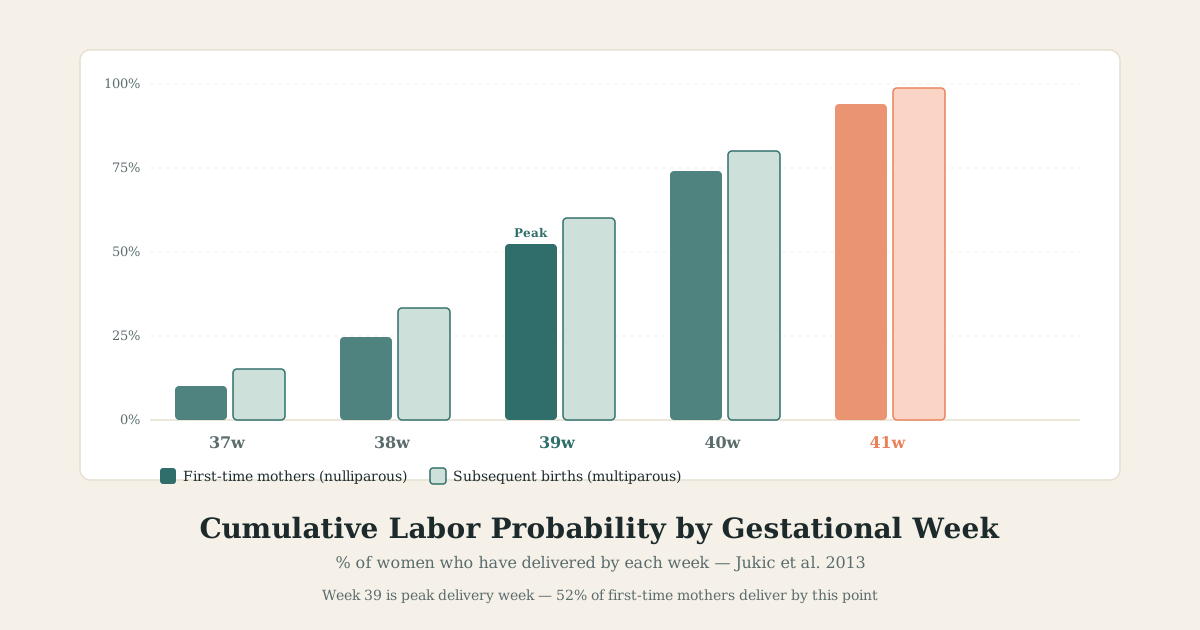
Labor probability statistics get misquoted constantly. You'll hear "most babies arrive at 40 weeks", which isn't quite right. You'll hear "you're overdue at 41 weeks", which doesn't match ACOG's definition. Here's what the actual data shows, where it comes from, and how to read it correctly.
The Source: Jukic et al. 2013
The most rigorous data on spontaneous labor timing comes from a 2013 study by Jukic and colleagues, published in Human Reproduction. The study tracked 125 women with precisely confirmed conception dates (established via daily urinary hormone measurements), which eliminated the imprecision that plagues due date calculations based on last menstrual period alone.
That precision matters enormously. When you know exactly when conception occurred, gestational age estimates are far more accurate. The resulting probability distributions are tighter and more meaningful. Most population-level data relies on ultrasound dating or LMP, which introduces errors of ±5-7 days.
The Jukic study is smaller than registry-based studies (125 women vs. millions), but its methodological rigor makes it the gold standard for timing data. It forms the backbone of the estimates used in our labor probability calculator.
The Cumulative Probability Tables
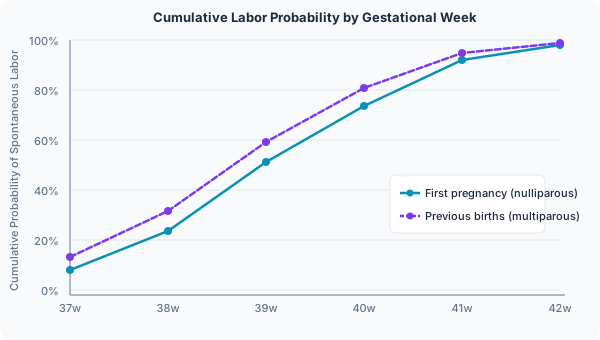
"Cumulative probability" means the percentage of women who have already delivered by a given week. It's always rising: once someone delivers, they stay in the "delivered" column.
Nulliparous (First-Time Mothers)
| Gestational Week | Cumulative % Delivered |
|---|---|
| 37 weeks | ~10% |
| 38 weeks | ~25% |
| 39 weeks | ~52% |
| 40 weeks | ~74% |
| 41 weeks | ~92% |
| 42 weeks | ~98% |
Multiparous (Second Birth or Later)
| Gestational Week | Cumulative % Delivered |
|---|---|
| 37 weeks | ~15% |
| 38 weeks | ~33% |
| 39 weeks | ~60% |
| 40 weeks | ~81% |
| 41 weeks | ~95% |
| 42 weeks | ~99% |
These numbers apply to spontaneous labor in low-risk pregnancies. They don't account for scheduled C-sections or medically indicated inductions, which would shift the "delivered" numbers upward at each week.
What "Per-Week" Probability Looks Like
Cumulative tables are useful for understanding where you stand. But per-week (conditional) probability tells you something different: given that you haven't delivered yet, what's the chance you'll deliver this week?
For first-time mothers, the per-week probabilities peak around week 39. Here's how it breaks down:
- Week 37: ~10% of those still pregnant deliver this week
- Week 38: ~17% of those still pregnant deliver this week
- Week 39: ~27% of those still pregnant deliver this week ← peak week
- Week 40: ~24% of those still pregnant deliver this week
- Week 41: ~69% of those still pregnant deliver this week (high because most remaining pregnancies end here with spontaneous labor or induction)
Week 39 isn't just statistically the most common. It's also the week ACOG identifies as the start of "full term," distinguishing it from "early term" (37–38 weeks) and "late term" (41 weeks).
Why the 40-Week Due Date Misleads People
The 40-week due date is the median for a first-time mother. Roughly half of first-time mothers haven't delivered yet at that point. It's not a target, and going past it doesn't mean anything has gone wrong.
If you're a first-time mother at exactly 40 weeks 0 days, there's about a 26% chance you'll still be pregnant a week from now. That's not unusual. It's just the right tail of a normal distribution.
The due date convention traces back to Naegele's Rule: a 19th-century formula based on 28-day menstrual cycles that assumed ovulation on day 14. Modern research suggests the actual median for women with confirmed ovulation dates is closer to 40 weeks and 5 days, slightly later than the commonly assigned due date.
For a deeper look at due date accuracy and how gestational age gets calculated, see how accurate is your due date.
Why Parity Changes Everything
The gap between first-time and second-time mothers is consistent across the entire distribution. It's not just a due-date effect. The gap shows up at every single week.
At 38 weeks, 25% of first-time mothers have delivered vs. 33% of multiparous mothers. That's a meaningful gap. The second-time uterus and cervix have been through labor before: the lower uterine segment has stretched, and the cervix tends to efface and dilate more readily. The difference compounds across the distribution.
For a detailed look at why first and subsequent pregnancies behave so differently, see first-time vs. second pregnancy labor differences.
What the Statistics Don't Tell You
These probabilities describe populations, not individuals. If you're at 40 weeks and haven't delivered yet, the cumulative table doesn't tell you that you'll go another week. It just says roughly 26% of people in your position did.
Individual variation is large. Factors like cervical length, fetal position, maternal BMI, and fetal sex all shift the distribution for any given person. See what affects when you go into labor for a breakdown of those six key modifiers.
The statistics also assume spontaneous labor. If your provider recommends induction (which ACOG supports at 41 weeks for all pregnancies and at 39 weeks for low-risk first-time mothers), your delivery won't follow the spontaneous distribution. About 26% of U.S. deliveries in 2022 were induced, and that proportion has risen steadily over the past decade.
Using the Calculator
The labor probability tool takes your current gestational week and parity and outputs your cumulative probability of having delivered by each upcoming week, along with the per-week conditional probability. It's built on the Jukic-derived data tables and distinguishes between nulliparous and multiparous distributions.
The calculation is straightforward: if cumulative probability at week N is P(N) and at week N-1 is P(N-1), then the per-week probability for someone still pregnant at week N-1 is:
Per-week probability = [P(N) − P(N−1)] / [1 − P(N−1)]
That denominator ("1 minus the chance you've already delivered") is what makes per-week probability different from the raw weekly increment.
A Note on Post-Term Definitions
"Post-term" has a specific clinical meaning: 42 weeks 0 days or beyond. "Late term" means 41 weeks 0 days through 41 weeks 6 days. ACOG uses these definitions consistently, and they matter because clinical management changes at each threshold.
At 41 weeks, most providers recommend delivery within the next week, either via induction or with intensified monitoring. By 42 weeks, delivery is recommended without waiting. These recommendations exist because placental function declines after 41 weeks and stillbirth risk, while still low in absolute terms, begins to rise meaningfully.
The team behind this tool maintains these probability estimates based on current ACOG guidance and peer-reviewed research.