First Baby vs Second Baby: How Labor Timing Differs
Second labors average 3 days earlier and hours shorter than first. Here's what the data shows about how labor timing and duration differ between first and subsequent births.
If you've had one baby and you're pregnant again, you've probably been told "the second one is faster." That's mostly true, but the details matter. A few things stay stubbornly the same regardless of how many times you've done this.
Use our labor probability calculator to see how parity (the number of prior births) shifts your week-by-week probability of going into labor.
The ~3 Day Difference in Gestational Age at Delivery
Mittendorf et al. (1990) found that nulliparous women (first-time mothers) had a mean time from LMP to delivery of 281 days, compared to 279 days for multiparous women (those with prior births). That's a 2-day average difference in that study.
More recent population-level data puts the difference closer to 2-4 days depending on the cohort. It's not dramatic, but it's consistent across studies. First-time mothers statistically carry slightly longer before going into spontaneous labor.
Why the difference? The cervix of a nulliparous woman has never dilated before. It takes more cumulative uterine pressure and prostaglandin exposure to ripen and open. Multiparous women's cervixes have been through the process once: the tissue is slightly more compliant, and cervical change can happen more readily.
This is also why multiparous women are more likely to have periods of prodromal labor that actually do something: light prelabor dilation and effacement can happen days before active contractions begin.
Cervical Ripening: What Changes After the First Birth
In a nulliparous pregnancy, the cervix starts firm, long, and closed (often described as "posterior", meaning it points toward your back). Before active labor begins, it needs to:
- Soften (ripen)
- Move forward (become anterior)
- Efface (shorten from ~4 cm to nearly 0)
- Begin to dilate
In many first-time mothers, this process takes place entirely during labor. The latent phase is spent doing the work the cervix needs before it can really open.
In a multiparous pregnancy, the cervix often begins this process earlier. It's not unusual for a woman at 38 weeks in her second pregnancy to already be 1-2 cm dilated and 50% effaced before any labor has started. Her body has a template. The cervical change happens more readily, and sometimes it starts earlier.
This doesn't mean multiparous women always have shorter labors. A persistent posterior baby, a long latent phase, or an epidural early in labor can stretch duration considerably. But the cervix's head start is real.
Labor Duration: The Numbers by Parity
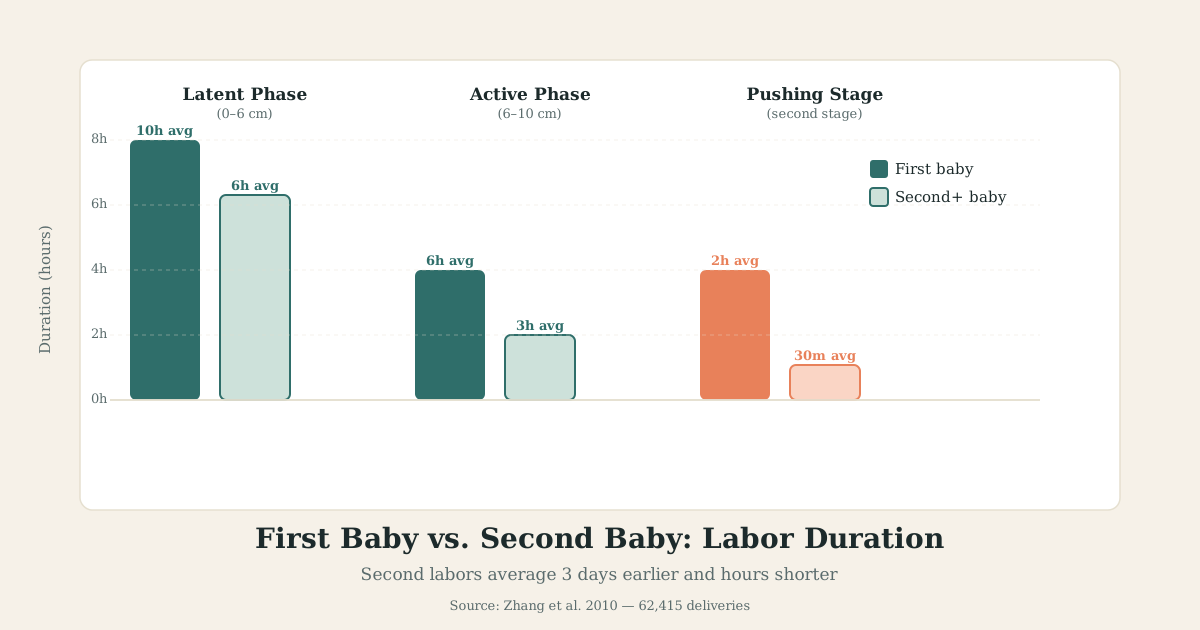
Based on the Zhang et al. (2010) labor progression study using data from 62,415 deliveries at 19 US hospitals, active labor durations by parity break down roughly as follows:
Nulliparous (first birth):
- Latent phase (0-6 cm): 8-12 hours average, up to 20 hours within normal range
- Active phase (6-10 cm): 4-8 hours average
- Second stage (pushing): 1-3 hours average
- Total first stage + second stage: 12-18 hours active is typical
Multiparous (subsequent births):
- Latent phase: 4-8 hours average, up to 14 hours within normal range
- Active phase: 2-4 hours average
- Second stage (pushing): 15-60 minutes average
- Total first stage + second stage: 6-8 hours active is typical
These are medians with substantial spread. Some second labors last 2 hours. Some first labors wrap up in 6 hours. And some multiparous women have labors that rival their first in length, especially if there's been a long gap between pregnancies (6+ years).
The Long Gap: When Your Body "Forgets"
A gap of 6 or more years between pregnancies is sometimes called a "grand multipara restart." The cervix isn't literally resetting, but clinically, labor often behaves more like a nulliparous labor than a typical multiparous one.
The cervical tissue has partially lost its prior plasticity. Providers often counsel these patients that their labor may be longer than expected given their history. The data supports this. Women with a 10-year gap between their first and second births show labor curves closer to first-time mothers.
Prodromal Labor: More Common the Second Time?
Prodromal labor (regular contractions that don't progress to active labor) is actually more common in multiparous pregnancies than most people expect.
In a first pregnancy, women often don't recognize prodromal labor because they don't have a reference point. In a second pregnancy, they do. They notice when "this feels like labor but it's stopping."
The reason prodromal labor increases with parity isn't fully understood. One theory is that multiparous uteruses have more stretch from prior pregnancies, and a baby in a suboptimal position (occiput posterior, asynclitic) causes the uterus to contract and attempt positioning work without achieving full dilation.
If you're in your second or third pregnancy experiencing regular contractions that keep stalling, it's usually not cause for alarm, but it is cause for calling your provider if you're unsure.
What Doesn't Change: GBS, Gestational Diabetes Risk, and Monitoring
Some things don't reset between pregnancies:
Group B Strep (GBS) status is retested every pregnancy. A negative GBS result from your first pregnancy doesn't carry over. You can be positive in a subsequent pregnancy even if you were negative before.
Gestational diabetes risk actually increases with each pregnancy, not decreases. If you had GDM in your first pregnancy, your risk in subsequent pregnancies is roughly 50-70%.
Fetal monitoring in labor follows the same protocols regardless of parity. Category I, II, and III fetal heart rate patterns are interpreted the same way.
Pushing mechanics are similar. The second stage can still be difficult, especially with epidurals, back labor, or a larger baby.
What Changes in the Pushing Stage
The second stage (pushing) is where multiparous mothers gain the most obvious advantage. The pelvic floor and vaginal tissues have been stretched before. The baby's path through the pelvis is more established.
Average pushing time drops from 1-3 hours (nulliparous) to 15-60 minutes (multiparous). Some multiparous women push 2-3 times and the baby is out.
The flip side is precipitous delivery: when labor and pushing happen so fast there's no time to get to the hospital. This is far more common in multiparous women. About 2-3% of multiparous deliveries are considered precipitous (under 3 hours total), compared to under 1% in nulliparous pregnancies.
If you had a short second stage in your first delivery, your provider should know. You may be advised to come in earlier in your next labor.
Recovery Differences: Afterpains
One thing that gets worse with subsequent pregnancies: afterpains (postpartum uterine cramping as the uterus contracts back to size). First-time mothers often barely notice them. By the third or fourth baby, they can be severe enough to require prescription pain management.
The uterus contracts more forcefully with each delivery as it works to involute. Breastfeeding amplifies afterpains because oxytocin released during nursing triggers uterine contractions.
Using Parity to Estimate Your Delivery Window
Your labor history is one of the strongest predictors of when labor will start and how long it will take. Parity is built into our delivery probability tool because it genuinely shifts the numbers.
For more on how week-by-week probabilities compare for first vs. subsequent pregnancies, see our breakdown of when labor actually starts, and for factors that influence spontaneous labor onset specifically, our article on spontaneous labor factors covers the research in detail.
The Bottom Line
Second labors are typically shorter and start slightly earlier, but "typical" has wide bands. A 3-day earlier average and a 6-hour shorter active phase are real statistical trends, not personal guarantees.
What you can count on: your cervix will likely do some of its preparatory work earlier, pushing will probably go faster, and if labor moves quickly this time, it may move very quickly. Check your own delivery window using your gestational age and number of prior births to see where you fall.
Learn more about the research behind our estimates on the about page.