Early Term, Full Term, Late Term, Post Term: What Each Means
In 2013, ACOG and SMFM split the old 37-to-42-week "term" window into four labeled categories. Here is what each one means and why the change was made.
For decades, anything from 37 weeks onward was simply "term," and 37 weeks was widely treated as the finish line. If a baby was term, the thinking went, the baby was done.
That framing turned out to be wrong in a way that mattered, and the vocabulary changed to reflect it.
The Four Categories
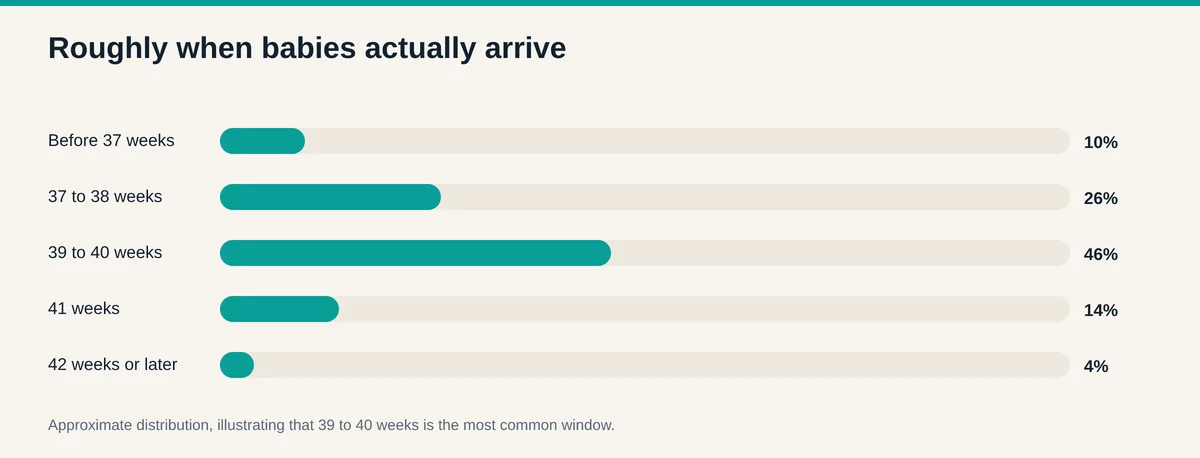
In 2013, ACOG and the Society for Maternal-Fetal Medicine, working with a workgroup convened by the Eunice Kennedy Shriver National Institute of Child Health and Human Development, published new definitions. They remain the standard in US practice.
- Early term: 37w0d through 38w6d
- Full term: 39w0d through 40w6d
- Late term: 41w0d through 41w6d
- Post term: 42w0d and beyond
Preterm remains anything before 37w0d, with its own subdivisions (late preterm at 34w0d to 36w6d, and earlier categories below that).
Note that the boundaries are precise to the day, not the week. The weeks-plus-days notation exists partly to support exactly this kind of cutoff. A baby at 38w6d is early term; the next day, at 39w0d, the same pregnancy is full term.
Why the Old Word Stopped Being Useful
The problem with "term" as a single 5-week bucket is that it implied uniformity across a range where outcomes are not uniform.
Accumulating evidence through the 2000s showed a consistent gradient. Compared with births at 39 to 40 weeks, births at 37 to 38 weeks were associated with higher rates of:
- Respiratory problems, including transient tachypnea and respiratory distress
- NICU admission
- Difficulty maintaining body temperature
- Feeding difficulties and hypoglycemia
- Jaundice requiring treatment
The absolute risks at 37 to 38 weeks are still low. Most early term babies do fine. But the differences were consistent across large datasets and large enough to matter at a population level, especially as scheduled deliveries had become common.
The last few weeks of pregnancy are not idle. Lung surfactant production continues, brain volume increases substantially, fat stores build, and the coordination between sucking, swallowing, and breathing matures. Delivering at 37 weeks skips a real developmental window, even though the baby is viable and usually healthy.
What Prompted the Change: Scheduled Early Deliveries
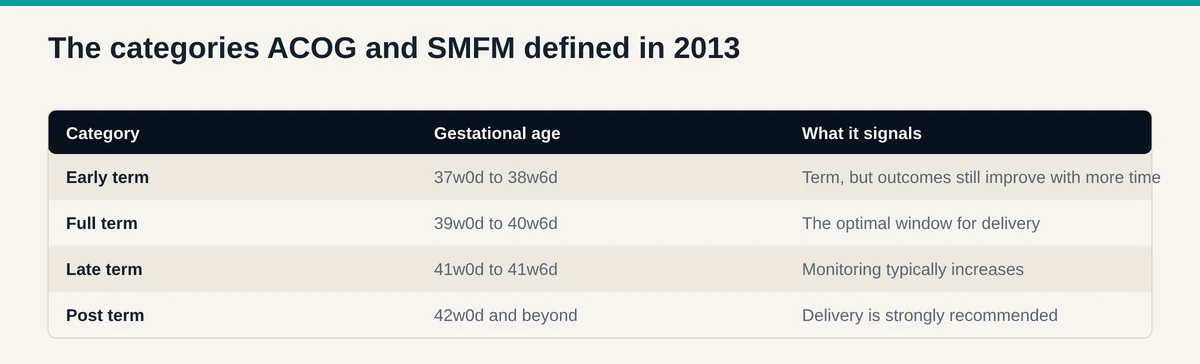
The push behind the relabeling was not academic. Through the 1990s and 2000s, scheduled deliveries at 37 and 38 weeks became increasingly routine, sometimes for convenience, provider scheduling, or patient preference rather than medical necessity.
Because "37 weeks equals term equals safe" was the operating assumption, there seemed to be no downside. The outcome data said otherwise.
Quality initiatives followed, most visibly the "39-week rule" campaigns that discouraged non-medically-indicated deliveries before 39w0d. Hospitals adopted hard-stop policies requiring documented medical indication for elective delivery before 39 weeks. Early elective delivery rates fell substantially across US hospitals in the years that followed.
The new terminology was the vocabulary that made the policy legible. Calling 37 weeks "early term" rather than "term" tells you something the old word actively hid.
What This Means for Scheduling
Practically, the categories change how planned deliveries get discussed.
If there is no medical indication, the current standard is not to schedule delivery, whether induction or cesarean, before 39w0d. That applies to elective inductions and to repeat cesareans.
If there is a medical indication, delivery before 39 weeks may absolutely be the right call. Preeclampsia, poorly controlled diabetes, growth restriction, cholestasis, and many other conditions have their own recommended timing, sometimes well before 39 weeks. "Early term is worse than full term" is a statement about otherwise uncomplicated pregnancies, not a rule that overrides an indication.
At 39 weeks, elective induction is now an option for low-risk first-time pregnancies. The ARRIVE trial (Grobman et al., published in the New England Journal of Medicine in 2018) randomized low-risk nulliparous women to elective induction at 39 weeks versus expectant management, and found a lower cesarean rate in the induction group along with less hypertensive disease of pregnancy. Interpretation and applicability outside trial conditions are still debated, but ACOG's position since then has been that it is reasonable to offer induction at 39 weeks in this population. We look at the tradeoffs in our comparison of induced and spontaneous labor.
Past 41 weeks, the conversation flips. Rates of stillbirth, meconium aspiration, macrosomia, and oligohydramnios rise gradually after 41 weeks, and more sharply beyond 42. Most guidelines recommend increased surveillance in the late term window and delivery by 42w0d at the latest, with many providers recommending it earlier. Our guide to going past your due date covers what that monitoring usually involves.
The Numbers Behind the Categories
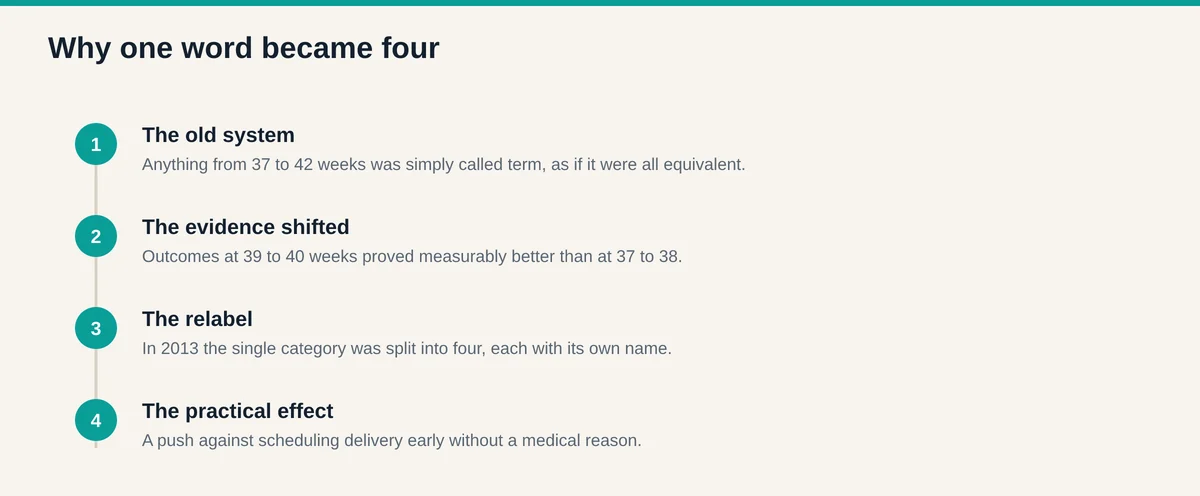
Where births actually happen in a modern US population, approximately:
- Before 37 weeks (preterm): roughly 10%
- Early term (37 to 38 weeks): roughly 25%
- Full term (39 to 40 weeks): roughly 55%
- Late term (41 weeks): under 10%
- Post term (42 weeks and beyond): well under 1%
The post term figure is small largely because of intervention, not biology. Left entirely alone, a meaningfully larger share of pregnancies would reach 42 weeks. Our week-by-week labor statistics break the distribution down further, including how it differs for first-time versus experienced mothers.
What the Labels Do Not Mean
A few things worth clearing up, because the categories get over-read.
Early term is not preterm. An early term baby is not premature and usually does not need any special care. The elevated risks are real but modest, and they describe averages across large populations, not a prediction about any individual birth. If you go into spontaneous labor at 37 weeks, that is normal labor, not a problem.
The categories describe timing, not readiness. There is no test that says a particular baby is done. Gestational age is the best available proxy, which is exactly why the boundaries are drawn where the outcome data supports them rather than where it would be convenient.
Spontaneous labor is treated differently from scheduled delivery. The 39-week standard is about elective scheduling. Nobody stops labor that starts on its own at 37 or 38 weeks simply to reach a category boundary. Guidance on avoiding early term delivery applies to decisions you and your provider control, not to when your body starts.
Full term is not a deadline either. 40w6d is still full term. Passing your due date does not move you into a worse category until 41w0d, and even then late term is a monitoring category, not an emergency. Our overview of what actually signals labor is close is more useful in that window than the calendar.
Why Your Category Depends on Your Dating
Every one of these boundaries is only as good as your due date, which is itself an estimate.
If your dating came from LMP alone with an irregular cycle, your true gestational age could be off by a week or more in either direction. That is the difference between early term and full term, or between late term and post term, without anything about the pregnancy changing.
This is why first-trimester ultrasound dating matters so much and why providers generally do not revise a due date established early. Our post on due date accuracy walks through the error margins for each dating method.
It is also worth holding lightly: even with perfect dating, Jukic et al. (2013) found a 37-day spread in the length of normal spontaneous pregnancies. Categories describe where you are on the calendar, not what your body is about to do.
Quick Reference
| Category | Gestational age |
|---|---|
| Preterm | Before 37w0d |
| Early term | 37w0d to 38w6d |
| Full term | 39w0d to 40w6d |
| Late term | 41w0d to 41w6d |
| Post term | 42w0d and beyond |
To see the week-by-week probability of labor starting across these windows, our labor probability calculator works in gestational weeks and days and accounts for whether this is a first birth.
The Bottom Line
The 2013 redefinition replaced a single 5-week "term" label with four categories, because outcomes at 39 to 40 weeks are consistently better than at 37 to 38, and the old word obscured that. The practical result is that elective delivery is generally not scheduled before 39w0d, while surveillance increases after 41.
This is educational information, not medical advice. Where your pregnancy falls in these categories and what timing makes sense for you are questions for your provider, who knows your dating, your history, and your specific risk factors.