Gestational Age vs Fetal Age: How Weeks Are Counted
Pregnancy weeks count from your last period, not conception, so you are "2 weeks pregnant" before conception happens. Here is how the system works.
Almost nobody gets this explained to them. You find out you are pregnant, someone tells you that you are 6 weeks along, and you quietly do the math and realize the timing does not work with anything that happened in your life six weeks ago.
The math is fine. The counting system is just counting something other than what you assumed.
Two Different Clocks
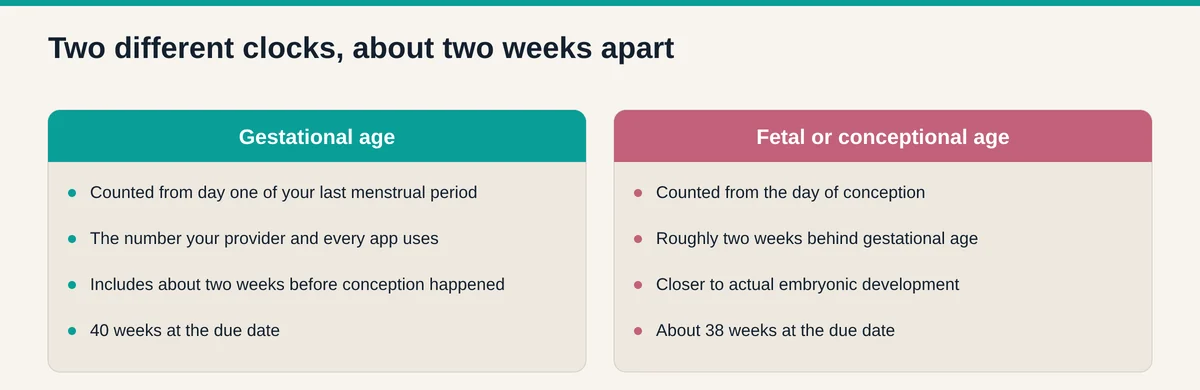
Gestational age (GA) counts from the first day of your last menstrual period (LMP). This is the number your provider uses, the number on your chart, and the number every pregnancy app displays.
Fetal age, also called conceptional or embryonic age, counts from fertilization. It is the number that describes how long the embryo has actually existed.
In a textbook 28-day cycle, ovulation and fertilization happen around day 14. So gestational age is about 14 days ahead of fetal age, all the way through.
Applied to real dates:
- The day your last period started: 0 weeks GA, no embryo exists
- Ovulation and fertilization: about 2 weeks GA, fetal age 0
- Implantation: about 3 weeks GA, fetal age 1 week
- First positive home test: usually 4 weeks GA, fetal age 2 weeks
- Full term at 40 weeks GA: fetal age about 38 weeks
That first bullet is the part that trips people up. During weeks 1 and 2 of a pregnancy as officially counted, you are not pregnant. Those weeks cover your period and the run-up to ovulation.
Why Medicine Counts From a Period Instead of Conception
It looks like an odd choice until you consider what is actually knowable.
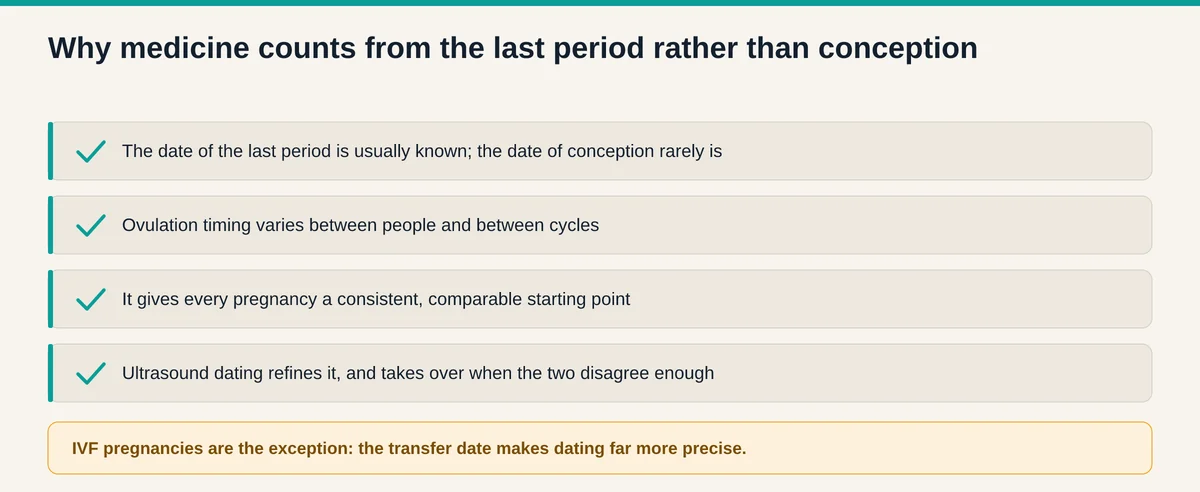
The first day of a period is a visible, datable event. Most people can name it, or at least narrow it to a few days. Conception is invisible. Sperm can survive in the reproductive tract for up to about five days, so even someone tracking intercourse precisely cannot pin fertilization to a single day. Ovulation timing itself varies considerably between people and between cycles for the same person.
So obstetrics standardized on the observable marker and built the 280-day framework around it. Naegele's rule (LMP plus 280 days) has been the standard since the early 1800s for exactly this reason. We cover its assumptions and its error bars in our article on how accurate due dates really are.
The tradeoff is that LMP dating inherits every irregularity in your cycle. If you ovulate on day 21 rather than day 14, your LMP-based gestational age overstates how far along you actually are by about a week.
The 40 Weeks That Are Really 38
This is the practical consequence people find most disorienting: pregnancy is described as 40 weeks, but embryonic and fetal development spans about 38.
That gap matters when you read developmental descriptions. Embryology textbooks often describe development in post-fertilization weeks, while pregnancy books and apps use gestational weeks. A description of "week 8 development" can mean two genuinely different points depending on which clock the author used, and most sources do not say which one they are using.
If a milestone description seems two weeks off from what your ultrasound showed, this mismatch is usually the reason.
Weeks Plus Days: Reading 39w2d
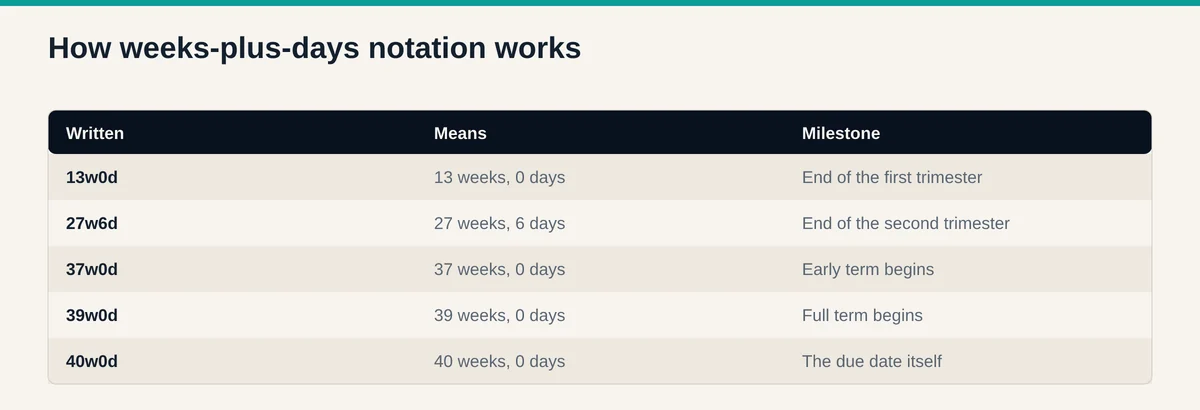
Clinical records almost never use decimals. Gestational age is written as completed weeks plus additional days, in a format like 39w2d, 39+2, or 39 2/7.
The "/7" version makes the logic explicit: 2 out of 7 days into the fortieth week. The days field only ever runs 0 through 6, so 39w6d is followed by 40w0d.
A subtle point that causes confusion: 39w0d means you have completed 39 weeks, not that you are in your thirty-ninth week. The whole seven days of 39w0d through 39w6d are "39 weeks." When someone says they are 39 weeks pregnant, they could be anywhere in that week.
This precision is not decorative. Term categories, induction timing, and steroid decisions in preterm labor are all keyed to specific week-and-day boundaries. Our post on what early term and full term mean walks through where those cutoffs sit and why.
Trimester Boundaries
Trimesters are conventional divisions rather than sharp biological transitions, and sources define them slightly differently. The most common version:
- First trimester: 0w0d through 13w6d
- Second trimester: 14w0d through 27w6d
- Third trimester: 28w0d through birth
Note the asymmetry: the third trimester is the longest, running roughly 12 weeks in a term pregnancy and longer if you go past 40 weeks. Some sources place the first-second boundary at 12 weeks instead of 14, which is why a due date app and a clinic handout can disagree about when your second trimester started.
Why IVF Dating Is More Precise
IVF removes the guesswork, because fertilization happens on a known date in a lab.
For a day-5 blastocyst transfer, gestational age is calculated as the transfer date plus 5 days as the fertilization equivalent, then dated as if conception occurred 2 weeks after LMP. In practice: transfer date plus 261 days gives the estimated due date for a day-5 transfer, and plus 263 days for a day-3 transfer.
Because the timing is exact, ACOG guidance says IVF dating should be used and should not be overridden by ultrasound measurements, even if the crown-rump length suggests a different date. In spontaneous conceptions, a first-trimester ultrasound disagreeing with LMP by more than 7 days generally wins; with IVF, the known date wins.
What IVF does not do is narrow the range of when labor starts. Jukic et al. (2013), which used hormone testing to identify ovulation precisely, still found a 37-day spread in the length of normal spontaneous pregnancies. Better dating removes measurement error, not biological variation.
How This Systematically Confuses People
A few predictable places where the two clocks collide:
The "I was already pregnant" reaction. Learning you are 5 weeks along when the positive test was yesterday feels like losing time you did not have. You have not. Fetal age is 3 weeks.
Miscalculating a conception window. People sometimes try to reverse-engineer a conception date by subtracting the gestational age from today. That lands two weeks too early unless you also add the two weeks back.
The last-period problem. About a fifth to two fifths of people cannot recall their LMP with the precision needed for reliable dating, and light early-pregnancy bleeding is sometimes mistaken for a period, which shifts the estimate by a full cycle.
Feeling "overdue" early. If you ovulated late, your true gestational age may run several days behind your chart, and 41 weeks by the chart might be closer to 40 biologically. Our guide to going past your due date covers what that means for induction conversations.
The Numbers in One Place
- Gestational age minus 2 weeks is roughly fetal age
- 280 days from LMP is the standard due date; 266 days from conception
- 38 weeks is approximately the true developmental span of a term pregnancy
- 7 days is the disagreement threshold at which first-trimester ultrasound replaces LMP dating
- 261 days after a day-5 embryo transfer is the IVF due date
To see how the probability of labor shifts across those final weeks, our labor probability calculator works directly in gestational weeks and days.
The Bottom Line
Gestational age counts from your last period and fetal age counts from conception, with about two weeks between them. Medicine uses the LMP-based clock because a period is a datable event and conception is not, which is also why first-trimester ultrasound and IVF dating are treated as more precise corrections to it.
This is educational information rather than medical advice. If your dating is uncertain or your cycles are irregular, that is worth raising directly with your provider, since gestational age drives real decisions about timing.