Going Past Your Due Date: 40, 41, and 42 Weeks
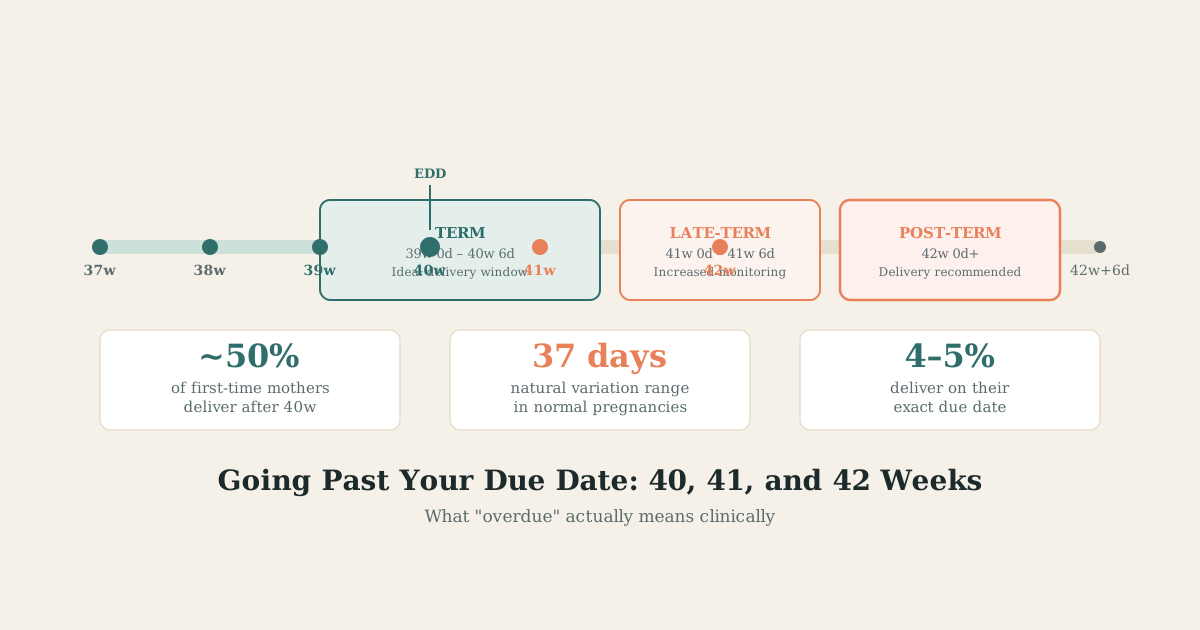
About 50% of first-time mothers deliver after their due date. Here's what "overdue" actually means clinically, what monitoring involves, and when induction is recommended.
The due date comes and goes, and you're still pregnant. That's one of the most common experiences in obstetrics, and one of the most emotionally difficult. Your bag is packed. Your leave has started. Everyone is texting. And yet.
Here's what's actually happening clinically, week by week, and what you can expect from your provider.
What "Overdue" Actually Means in Clinical Terms
The word "overdue" is colloquial. Clinicians use specific terminology based on gestational age:
- Term: 39 0/7 to 40 6/7 weeks (this is the ideal window)
- Late-term: 41 0/7 to 41 6/7 weeks
- Postterm: 42 0/7 weeks and beyond
Most people use "overdue" to mean "past 40 weeks," but clinically, the concern thresholds don't start there. At 40 weeks and 3 days, you're still term. You're not late-term until 41 weeks.
This distinction matters because it shapes what kind of monitoring you'll be offered and when induction discussions begin in earnest.
Why Pregnancies Go Longer Than 40 Weeks
The 40-week due date is built on Naegele's rule, which assumes a 28-day cycle and ovulation on day 14. Jukic et al. (2013) demonstrated that in 125 pregnancies with precisely identified ovulation dates, the range for spontaneous labor onset spanned 37 days, even when the underlying gestational age was known exactly.
Some women simply carry longer. It's genetic, it's individual, and it's not a sign that something is wrong. First-time mothers (nulliparous) statistically carry slightly longer than those who've given birth before. The Mittendorf et al. (1990) data puts the nulliparous mean at 281 days from LMP, not 280.
If your due date was set by LMP alone without a confirming ultrasound, it may be off by 7-14 days. An uncertain due date is one reason providers are cautious about recommending induction too aggressively.
For a full explanation of how due dates are calculated and why only 4-5% of babies arrive on the exact date, see our article on due date accuracy.
At 40 Weeks: You're Still Term, Monitoring Begins
At 40 weeks, most providers don't change management for a healthy pregnancy with normal fetal movement. You'll have your regular prenatal appointment, and the conversation about induction timing usually starts.
ACOG's guidance (Practice Bulletin 764, updated 2021) supports offering elective induction at 39 weeks for low-risk pregnancies based on the ARRIVE trial data. This means at 40 weeks, you're already in the window where induction has been studied and found safe. It's now a matter of patient preference and clinical judgment.
What happens at 40 weeks typically:
- Cervical exam to assess ripeness (Bishop score)
- Discussion of induction timing preference
- Fetal movement monitoring (you've likely been doing daily kick counts)
- Possible membrane sweep if the cervix is favorable
A membrane sweep (also called a membrane stripping) involves the provider inserting a finger into the cervix and sweeping around the amniotic membranes to separate them from the lower uterine segment. It triggers prostaglandin release and has modest evidence for promoting labor within 48-72 hours. About 1 in 8 membrane sweeps results in labor within 48 hours, and the procedure reduces the postterm rate by about 40%.
Use our labor probability calculator to see how your probability of spontaneous labor shifts each day after 40 weeks.
At 41 Weeks: Late-Term, Monitoring Increases
At 41 weeks, you're officially late-term, and your care intensifies. Most providers will schedule twice-weekly antenatal testing from this point forward.
Antenatal testing at 41 weeks typically includes:
Non-stress test (NST): A 20-30 minute external fetal monitor tracing. The provider is looking for at least 2 accelerations (heart rate increases of 15 bpm for at least 15 seconds) in a 20-minute window. A reactive NST is reassuring.
Biophysical profile (BPP): Ultrasound assessment of 5 components: fetal breathing movements, gross body movement, muscle tone, amniotic fluid volume, and the NST. Each component scores 0 or 2, for a maximum of 10. A score of 8-10 is normal; 6 is equivocal; 4 or below is concerning.
Amniotic fluid index (AFI) or maximum vertical pocket (MVP): The amniotic fluid around the baby is assessed. Oligohydramnios (low fluid) at 41+ weeks can be a reason to recommend delivery.
The risk of stillbirth at 41 weeks is approximately 1-2 per 1,000 ongoing pregnancies per week, elevated compared to earlier term weeks. This is why monitoring increases: not because stillbirth is common, but because it's preventable.
At 41 Weeks: The Induction Conversation
At 41 weeks, most US providers actively recommend induction. The evidence base:
The SWEPIS trial (Sweden, 2019) randomized 2,760 low-risk women at 41 weeks to induction vs. expectant management. The trial was stopped early because of a higher stillbirth rate in the expectant management group (6 vs. 0 perinatal deaths).
The INDEX trial (Netherlands, 2019) found induction at 41 weeks reduced perinatal mortality without increasing cesarean rates compared to expectant management to 42 weeks.
ACOG recommends that delivery should occur by 42 weeks and 6 days at the latest. Many providers recommend induction by 41 weeks and 3-5 days based on this evidence.
You have the right to decline induction. If you do, twice-weekly testing (NST + AFI or BPP) continues, with the understanding that the data supports delivery before 42 weeks.
At 42 Weeks: Postterm, Delivery Is Strongly Recommended
At 42 weeks, the pregnancy is postterm. ACOG's position is that delivery should occur. The risks of continuing beyond 42 weeks include:
Meconium aspiration: Postterm babies are more likely to pass meconium in utero. Meconium in the amniotic fluid raises the risk of meconium aspiration syndrome, which can be serious.
Macrosomia: Babies continue to grow. A postterm baby may be significantly larger, increasing the risk of shoulder dystocia and operative delivery.
Placental insufficiency: After 42 weeks, placental function may decline. The placenta can calcify and become less effective at gas and nutrient exchange.
Oligohydramnios: Amniotic fluid often decreases after 42 weeks, which can cause cord compression during labor.
Stillbirth risk: At 42 weeks, the stillbirth risk is approximately 3-4 per 1,000 ongoing pregnancies per week, roughly double the 41-week rate.
These aren't reasons to panic. They're reasons why induction at 42 weeks isn't optional in most clinical contexts.
Membrane Sweeping: What to Know
Membrane sweeping is often offered at 40-41 weeks for women who want to try to encourage labor before a scheduled induction. Evidence summary:
- Reduces the likelihood of going beyond 41 weeks by about 40%
- Does not increase the risk of infection when performed in a term pregnancy with intact membranes
- Causes cramping and spotting in most women, which resolves within 24 hours
- Can be performed at 39-40 weeks for women with a favorable cervix who want to reduce their postterm risk
It's not a guarantee. About 12-15% of membrane sweeps result in labor within 48 hours. The others result in cramping and waiting.
What Doesn't Help: Popular Induction Methods
Several home methods circulate online for "naturally inducing" labor at 40+ weeks. Evidence summary:
Evening primrose oil: No evidence of efficacy for cervical ripening or labor induction in well-designed trials.
Castor oil: May cause uterine contractions but also causes significant gastrointestinal distress. Not recommended by ACOG.
Spicy food: No evidence. Zero.
Sex: Semen contains prostaglandins, and orgasm releases oxytocin. The theory is reasonable, but evidence is mixed and weak. Not harmful, not reliable.
Walking: Doesn't induce labor, but staying upright and active can help with fetal positioning.
For a detailed look at what the evidence actually shows triggers spontaneous labor, see our article on signs labor is close and the evidence behind them.
The Bishop Score: How "Ripe" Is Your Cervix?
Before induction, your provider will assess your Bishop score: a composite score rating cervical dilation, effacement, station, consistency, and position (anterior vs. posterior). Scores range from 0-13.
- Score 8 or above: Cervix is favorable; labor is likely to start quickly with induction
- Score 6-7: Intermediate; may benefit from cervical ripening agents first
- Score 5 or below: Cervix is unfavorable; cervical ripening (misoprostol, Cervidil) before Pitocin is standard
A low Bishop score at 41 weeks doesn't mean induction won't work. It means it will take longer. Most unfavorable cervixes ripen within 12-24 hours of prostaglandin treatment.
The Bottom Line
Going past 40 weeks is normal. Going past 41 weeks puts you in a category where your provider will increase monitoring and begin recommending a delivery timeline. Going past 42 weeks is the point where the risk-benefit calculation shifts clearly toward delivery.
If your due date was established by first-trimester ultrasound, it's about as accurate as dating gets (±5-7 days). If it was set by LMP alone, there may be more uncertainty in your exact gestational age.
Check where you are in the probability curve with our labor probability calculator, and learn more about the team and research behind it on our about page.