The Bishop Score: How Providers Predict Induction Success
Five cervical findings, scored and added up. The Bishop score is the number behind "your cervix isn't favorable yet" and it shapes how an induction is likely to go.

"Your cervix isn't favorable yet" is one of those phrases that sounds like a diagnosis and is really a measurement. Behind it sits a scoring system published by Edward Bishop in 1964, still in use, still the shorthand providers reach for when deciding how an induction should be run.
If you are weighing an induction, this is the number that most directly shapes what the next two days will look like. Here is what goes into it, what the total means, and why a low score is a starting point rather than a prognosis.
The Five Components
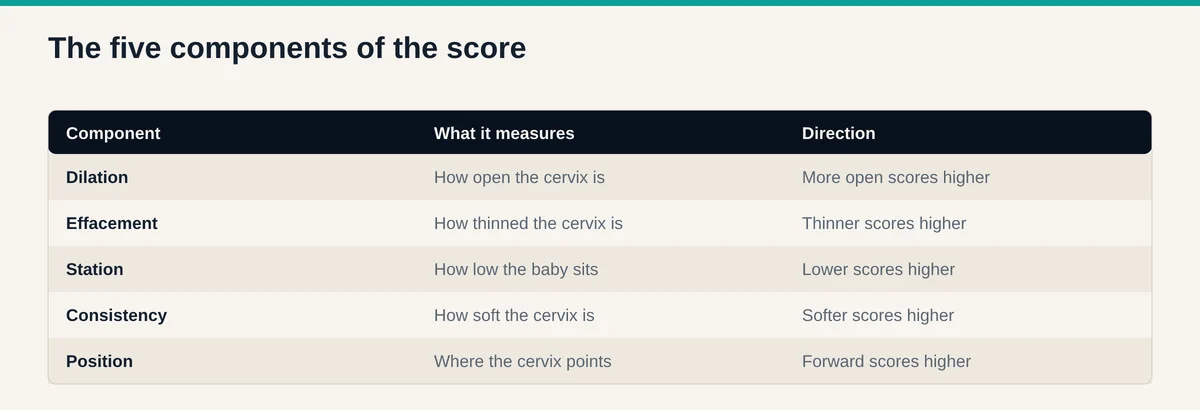
A Bishop score comes from a single cervical exam. Your provider is assessing five things at once, three of them positional or physical measurements and two of them qualitative judgments about the tissue.
Dilation. How open the cervical os is, in centimeters, from closed through the low single digits.
Effacement. How thinned out the cervix is, expressed as a percentage. A long, thick cervix is 0% effaced. One that has drawn up into the lower uterine segment is 80% or more.
Station. How far the baby's presenting part has descended relative to the ischial spines, from high and floating at -3 to well down in the pelvis at +1 or +2.
Consistency. How the cervical tissue feels: firm, medium, or soft. A firm cervix is often compared to the tip of your nose and a soft one to your lips. It is a judgment call, but an experienced hand makes it reliably.
Position. Where the cervix sits relative to the vaginal axis: posterior (pointing back toward the spine), mid, or anterior. A cervix that has rotated forward has generally done some of the work of getting ready.
Dilation, effacement, and station are the same three findings discussed in cervical dilation and labor progress. The Bishop score's addition is that it also asks how the tissue feels and where it points, which is where a lot of the readiness information actually lives.
How the Points Are Assigned
The classic scoring grid awards 0 to 3 points for the first three components and 0 to 2 for the last two, for a maximum of 13.
- Dilation: closed = 0, 1–2 cm = 1, 3–4 cm = 2, 5–6 cm = 3
- Effacement: 0–30% = 0, 40–50% = 1, 60–70% = 2, 80% or more = 3
- Station: -3 = 0, -2 = 1, -1 or 0 = 2, +1 or +2 = 3
- Consistency: firm = 0, medium = 1, soft = 2
- Position: posterior = 0, mid = 1, anterior = 2
Add the five and you have the score. You will also encounter modified Bishop scores, which simplify the grid, sometimes dropping consistency and position or scoring effacement by cervical length in centimeters instead of percentage. Different hospitals use different versions, so a number quoted at one place is not always directly comparable to a number quoted at another.
One honest caveat: every component except dilation involves subjective assessment, and studies of cervical examination have generally found meaningful disagreement between examiners. Two providers can score the same cervix a point or two apart. Treat the total as an estimate with a margin, not as a precise reading.
Favorable, Unfavorable, and the Grey Zone
The conventional interpretation runs roughly like this:
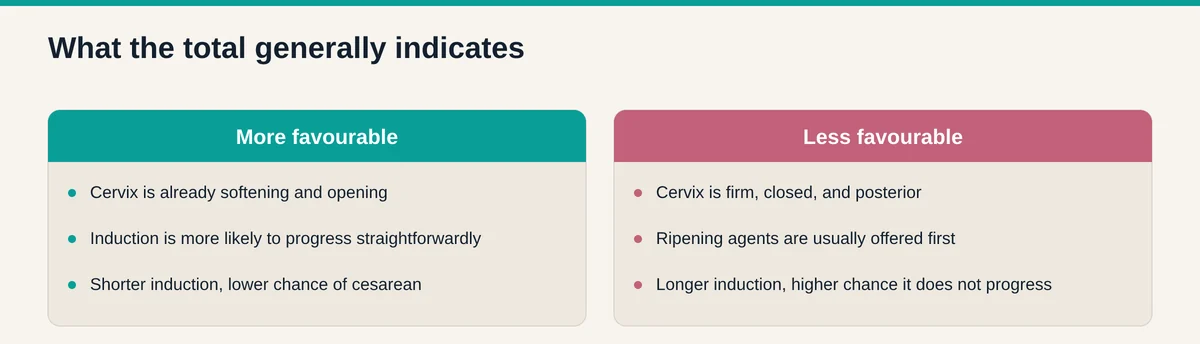
- 8 or higher: favorable. The likelihood of a vaginal delivery after induction is generally considered similar to what it would be if labor had started on its own.
- 6 or lower: unfavorable. Cervical ripening is usually recommended before or as part of the induction.
- 7: the grey zone, where the decision leans on the rest of the clinical picture.
Some protocols use different cutoffs, and the thresholds shift with the modified versions of the score. What holds across all of them is the direction: higher score, more ready cervix, shorter and more predictable induction.
Parity matters too. A cervix that has been through labor before tends to behave more cooperatively at the same score, which is one strand of the broader difference described in first-time vs second pregnancy labor.
What an Unfavorable Score Means in Practice
This is the part worth knowing before you agree to a date, because it is mostly about time.
With an unfavorable cervix, induction typically does not start with Pitocin. It starts with cervical ripening, and only once the cervix has responded does the induction proper begin. Common approaches include:
- Prostaglandins, such as dinoprostone as a gel or vaginal insert, or misoprostol given in small doses. These soften and efface the cervix directly.
- Mechanical methods, most often a Foley or double-balloon catheter placed through the cervix and inflated, applying steady pressure that encourages dilation. Membrane sweeping is a lighter-touch relative of this idea.
- Combined approaches, using a balloon and a prostaglandin or oxytocin together, which several trials suggest can shorten the total time to delivery compared with either alone.
The practical consequences of a low score:
- The induction takes longer. Ripening an unfavorable cervix can add many hours, and an induction beginning with a very low score can reasonably run past 24 hours before active labor is established. This is normal, not failure.
- The cesarean rate is higher. Induction with an unfavorable cervix carries a higher likelihood of cesarean delivery than induction with a favorable one. This is one of the most consistent findings around the score.
- You may be admitted the night before. Many units start ripening in the evening so that oxytocin can begin in the morning.
None of this makes an induction the wrong choice. It makes it a longer one, and knowing that in advance is most of what turns a slow induction from alarming into expected.
Why This Matters for the Induction Decision
If you are choosing whether and when to be induced, the Bishop score is the single most useful piece of information you can ask for, because it changes what you are actually deciding between.
An induction at a Bishop score of 9 and an induction at a Bishop score of 3 are different propositions with different time commitments and different odds, even though they get the same word. Two reasonable questions for that appointment: what is my score today, and would waiting a week be likely to improve it?
It is also worth knowing what the evidence base does and does not say. The ARRIVE trial (Grobman and colleagues, published in the New England Journal of Medicine in 2018) randomized low-risk first-time mothers to elective induction at 39 weeks or expectant management, and found a lower cesarean rate in the induction group, 18.6% compared with 22.2%. That result surprised a lot of people who expected the opposite. It is also a trial in a specific population, run in centers with particular induction protocols, and it does not translate automatically to every situation. Induced vs spontaneous labor goes through that comparison in more depth.
If the discussion is happening because you are past your due date, the overdue pregnancy guide covers how the risk calculus shifts through 41 and 42 weeks, and due date accuracy is a useful reminder that the date itself carries real uncertainty.
The Bishop Score Versus Waiting for Labor
There is a reason a favorable cervix predicts a smoother induction: it is largely measuring how much of the work spontaneous labor would have done for you.
In a labor that starts on its own, cervical ripening happens over days or weeks, quietly, before the first contraction that anyone counts. By the time labor is established, the cervix is soft, anterior, partly effaced, and the baby is usually well applied to it. An induction with a low Bishop score is asking the body to compress that preparation into hours, using medication or a balloon in place of the gradual process.
That framing also explains why the score is a poor predictor of one thing people want it to predict: when spontaneous labor will start. A high Bishop score at 39 weeks means your cervix is ready. It does not mean labor is imminent, and people sit at favorable scores for a week or more. The strongest population-level predictors of labor timing remain gestational age and parity, which is what the labor probability calculator is built on. For what actually does signal that labor is near, see signs labor is close.
A Low Score Is Not a Verdict
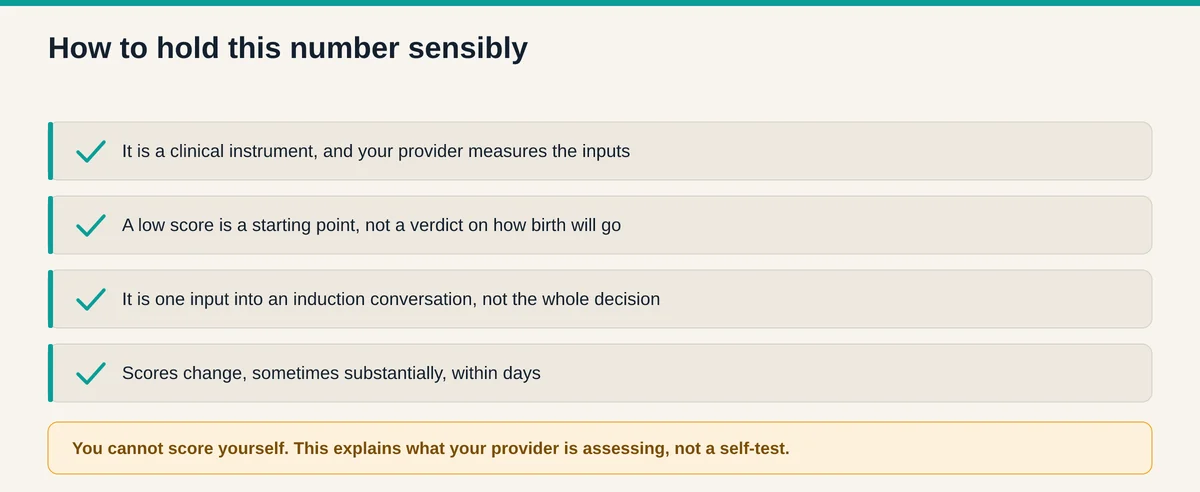
Worth stating plainly, because a number between 0 and 13 invites people to read it as a grade.
A low Bishop score describes your cervix today. It changes weekly, sometimes faster, and a score taken at 38 weeks is not the score you will have at 40. It is also an examiner's estimate with known variability. Plenty of inductions that begin with unfavorable cervices end in uncomplicated vaginal deliveries, and a low score is a reason to plan for a longer process, not to expect a cesarean.
What it gives you is a realistic frame: how long to plan for, what to pack, when to expect things to speed up, and what questions to ask if progress stalls.
The Bottom Line
The Bishop score turns five cervical findings into one number that summarizes how ready your cervix is for labor, with 8 or above generally counted as favorable and 6 or below as unfavorable. An unfavorable score usually means ripening first, a longer induction, and a somewhat higher chance of cesarean, all of which are much easier to handle when you know them in advance. Ask for your score before agreeing to an induction date. This is educational information rather than medical advice, and the decision belongs to you and your provider together.