Cervical Dilation and Labor Progress: A Plain-Language Guide
Dilation from 0 to 6 cm can take days. From 6 to 10 cm typically takes 1-3 hours in active labor. Here's what each number actually means.
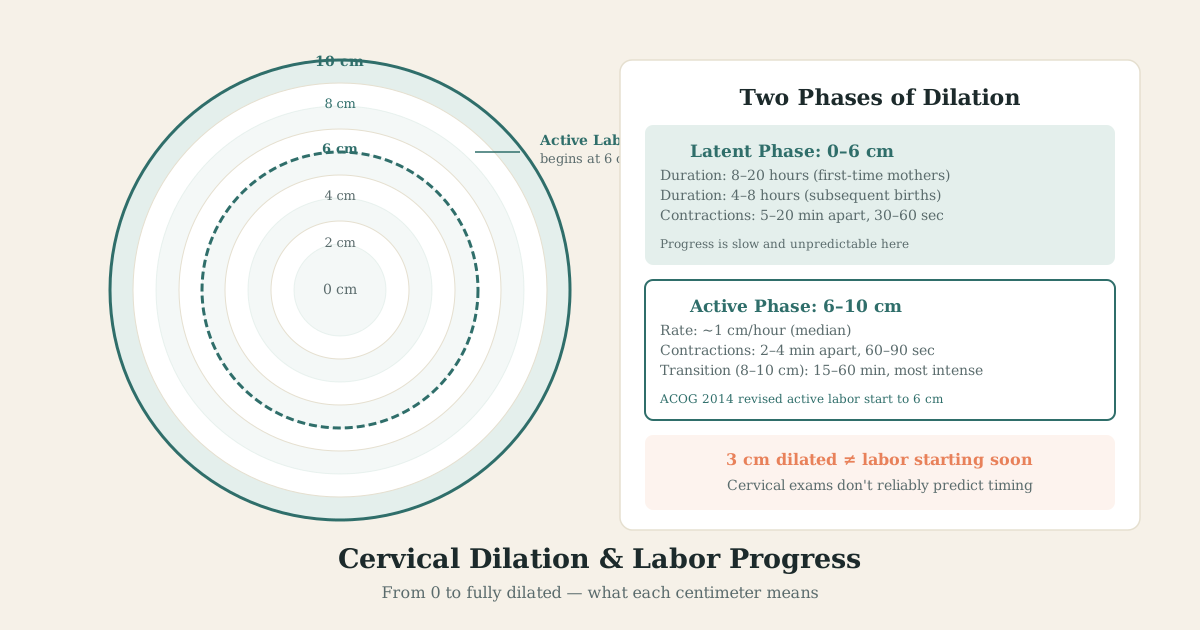
Cervical dilation is probably the most-watched number in late pregnancy, checked at appointments, compared between friends, treated as a countdown timer. But what it actually means is more complicated, and more interesting, than a simple number suggests.
What Dilation Actually Measures
The cervix is a cylinder of fibrous tissue at the bottom of the uterus, typically 3–5 cm long when you're not pregnant. During labor, it has to do two things: shorten (efface) and open (dilate).
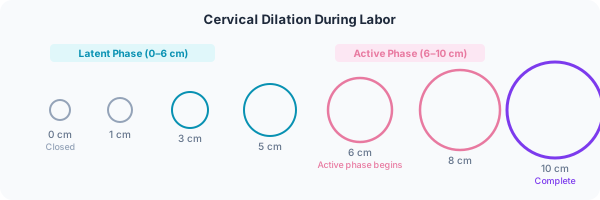
Dilation is measured in centimeters by a provider inserting two fingers into the vagina and feeling the opening of the cervix. It's an estimate, not a precise measurement, and different providers examining the same cervix can disagree by 1–2 cm. The scale runs from 0 (fully closed) to 10 cm (fully dilated, ready to push).
A 10 cm cervix isn't coincidentally the average diameter of a fetal head. It's exactly what it needs to be.
Effacement: The Other Half of the Picture
Effacement is how much the cervix has thinned and shortened, expressed as a percentage. A long, thick, uneffaced cervix is 0% effaced. When the cervix has completely thinned into the lower uterine segment, it's 100% effaced.
In first-time mothers, effacement usually precedes significant dilation. The cervix thins from the top down (a process called "taking up") before the opening widens. In multiparous women, dilation and effacement often happen more simultaneously.
A cervix that's 50% effaced but 1 cm dilated isn't "more ready" than a cervix that's 1 cm dilated and 80% effaced. Both measurements matter, and neither alone tells you when labor will start.
Station: Where the Baby Is
Station describes how far the baby's presenting part (usually the head) has descended into the pelvis. It's measured on a scale from -3 to +3:
- -3: Head is high, floating above the pelvic inlet
- 0: Head is at the level of the ischial spines (the midpoint of the pelvis)
- +3: Head is at the perineum, crowning imminent
Most first-time mothers see the baby descend (engage) into the pelvis at -1 or -2 station in the final weeks before labor. Multiparous women often don't engage until active labor begins, the pelvis has been through this before and doesn't need as much advance preparation.
A baby at -2 station with a ripe cervix doesn't mean labor is hours away. It means things are heading in the right direction.
The Latent Phase: 0 to 6 cm
The latent phase of labor covers cervical dilation from 0 to 6 cm. It's the longest and most variable part of labor, and the least predictable.
For first-time mothers, the latent phase can last 8–20 hours or longer. Contractions during this phase are real and doing work, but they may be irregular (anywhere from 5 to 20 minutes apart) and uncomfortable rather than intensely painful. This is often the phase where people wonder if they're "really" in labor.
The 2014 American College of Obstetricians and Gynecologists (ACOG) guidelines revised the definition of active labor upward to 6 cm, based on Zhang et al.'s analysis of 62,000 deliveries. Before this revision, active labor was considered to start at 4 cm, a definition that led to a lot of unnecessary interventions when women "failed to progress" from 4 to 5 cm as quickly as expected.
The new threshold matters: you're not expected to be progressing at 1 cm/hour during the latent phase. Normal latent phase progression is much slower and more variable.
The Active Phase: 6 to 10 cm
Once you reach 6 cm with regular contractions, active labor has begun. Progression accelerates.
In the active phase, the cervix typically dilates at 1 cm or more per hour, though even this is a median with normal variation around it. According to Zhang et al.'s cohort data, the 5th percentile for active phase progress in nulliparous women is about 0.5 cm/hour. Progress below 0.5 cm/hour over two hours in active labor is a clinical signal, but not automatically a reason for C-section.
Contractions during active labor are typically:
- 2–4 minutes apart
- 60–90 seconds long
- Intense enough to require focused coping (breathing, movement, medication)
The transition from 8–10 cm is often called "transition" and is frequently the most intense period of labor. Contractions may come 2 minutes apart with little break between peaks. For most women, transition lasts 15–60 minutes.
Why You Can Be 3 cm Dilated for Weeks
This confuses almost everyone who hears it at a 38-week appointment.
Prodromal dilation (gradual cervical softening and opening in the weeks before labor) is normal, especially in multiparous women. Being 3 cm dilated at 38 weeks doesn't mean you're in early labor, and it doesn't predict that labor will start in the next 24 hours.
The cervix dilates gradually as it softens and prepares, but without the regular uterine contractions that cause progressive change, you're not in labor. That holds true even at 3, 4, or occasionally 5 cm. What triggers the transition from "ripe cervix" to "active labor" is a sustained pattern of contractions that cause continued dilation.
A 2003 study of 6,289 women found that cervical dilation at 37 weeks had almost no predictive value for when labor would begin. Women at 3 cm delivered, on average, within 10 days; but the range was 0 to 42 days. It's useful for your provider to track the trend, but the number alone isn't a due date.
What Cervical Checks Can and Can't Tell You
A cervical exam tells your provider:
- Where you are now in the dilation and effacement process
- How favorable the cervix is for induction (the Bishop score incorporates dilation, effacement, station, consistency, and position)
- Whether active labor has begun (combined with contraction pattern and clinical picture)
It doesn't reliably tell you:
- When labor will start
- How long labor will last
- Whether you'll deliver vaginally
For context on the Bishop score and how it's used in induction decisions, see induced vs. spontaneous labor.
The Second Stage: Pushing
The second stage of labor begins when you're fully dilated (10 cm) and ends with delivery. Average duration varies significantly:
- First-time mothers without epidural: 30–60 minutes
- First-time mothers with epidural: 60–120 minutes (epidural can slow pushing sensation and motor coordination)
- Multiparous women: 5–30 minutes is typical
ACOG defines prolonged second stage as greater than 3 hours with an epidural (or 2 hours without) for first-time mothers, and greater than 2 hours with an epidural (or 1 hour without) for multiparous women. Reaching these thresholds doesn't automatically mean C-section, it means careful reassessment.
Connecting Dilation to Your Bigger Picture
Cervical dilation is one piece of the labor puzzle. The labor probability calculator focuses on gestational age and parity because those are the strongest population-level predictors of when labor begins, not cervical dilation, which tells you where you are in labor after it's started, not when it will start.
Once labor is underway, dilation becomes the key progress metric. But in the weeks before labor, the absolute number matters less than the trend and the full clinical picture.
For what to watch for in the days and hours before labor starts, see signs labor is close. And for a look at what's going on before any of this becomes relevant, when does labor actually start covers the physiology of labor onset.
The about page has more on how we build and maintain these tools using current obstetric research.