Membrane Sweeping: How It Works and Whether It Helps
What a membrane sweep actually does, what it feels like, when it is offered, what the research says about avoiding formal induction, and when to call after one.
Of everything offered in the last weeks of pregnancy, the membrane sweep sits in an odd middle ground. It is not an induction, it is not a treatment, and it is not something you have to accept. It is a small procedure with a modest, measurable effect that is easy to oversell and easy to dismiss.
This is the detailed version: the mechanics, the sensation, the numbers, and the parts that are genuinely uncertain.
What Actually Happens During a Sweep
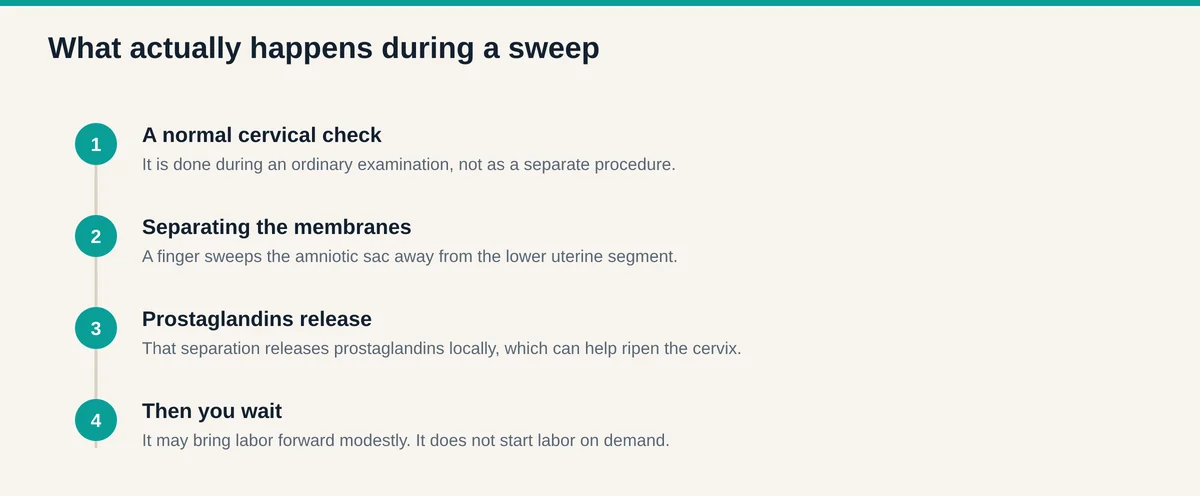
A membrane sweep, also called membrane stripping or a stretch and sweep, is done during a routine cervical examination. There is no separate appointment, no equipment, and no preparation.
The provider inserts one or two gloved fingers through the cervical opening and sweeps them in a circular motion, usually a full 360 degrees, between the inner surface of the cervix and lower uterine wall and the amniotic sac pressed against it. That motion separates the membranes from the underlying tissue over a small area.
The whole thing takes under a minute. You lie back the same way you would for any cervical check, and afterwards you get dressed and go home. There is no monitoring requirement in an uncomplicated term pregnancy, and no reason you cannot drive yourself.
Why Separating the Membranes Would Do Anything
The mechanism is local and biochemical rather than mechanical.
The decidua, the specialized uterine lining at the point where the membranes attach, is a rich source of prostaglandins, particularly prostaglandin F2 alpha. Disrupting the attachment between the membranes and the decidua causes a local release of these prostaglandins along with phospholipase A2, which drives further prostaglandin production.
Prostaglandins do two things that matter here. They soften, thin, and open the cervix, which is the process called ripening. And they increase uterine contractility. In effect, a sweep produces a small, local version of the same chemical signal that pharmacological cervical ripening agents deliver in a hospital.
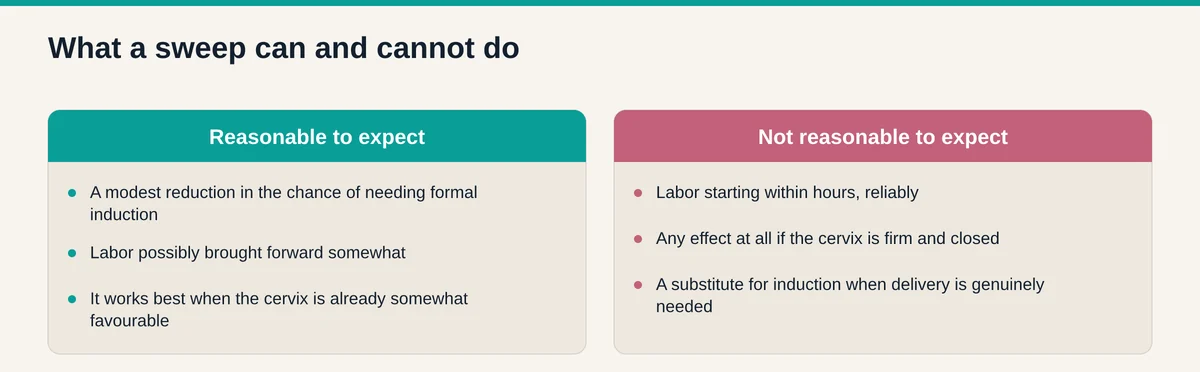
That is why the effect is described as bringing labor forward rather than starting it. You are adding a nudge to a process that has to be substantially underway on its own for the nudge to matter.
Why the Cervix Has to Cooperate
A sweep is physically possible only if the provider's finger can pass through the cervical os. If your cervix is still long, posterior, firm, and completely closed, there is nothing to sweep. In that situation a provider may offer a cervical massage or stretch instead, which has considerably less evidence behind it, or may simply recommend waiting.
Providers often describe cervical readiness using the Bishop score, which rates dilation, effacement, station, consistency, and position. A higher score means a more favorable cervix. Sweeps performed on a more favorable cervix have a better chance of tipping things over, which is one reason the same procedure produces very different reported experiences.
This also means the timing is worth a conversation. A sweep attempted at the first appointment where it is even physically possible is less likely to accomplish much than one done a week later when the cervix has changed. The cervical dilation guide covers what those measurements actually mean and why a number at one appointment predicts less than most people assume.
What It Feels Like
Honest answer: uncomfortable for most people, painful for some, and briefly.
The common descriptions are a strong period cramp, a deep pinching sensation, or intense pressure. It is more uncomfortable than a routine cervical check because the provider is reaching further and applying deliberate pressure against the cervix and membranes for 30 to 60 seconds.
A few things help:
- Ask your provider to talk you through it as they go, and to stop if you say stop. You can stop it at any point.
- Slow exhaling through the sweep helps more than tensing and holding your breath.
- Emptying your bladder first is generally more comfortable.
- Some people take paracetamol beforehand. Ask your provider whether that is appropriate for you.
Discomfort during the procedure does not indicate anything about whether it will work.
When It Is Typically Offered
Practice varies by country and by provider, but the common pattern in the US looks roughly like this:
- 39 to 40 weeks: sometimes offered to those with a favorable cervix who would prefer to avoid a later formal induction.
- 40 to 41 weeks: the most common window, usually framed as part of the conversation about post-dates management.
- 41 weeks and beyond: frequently offered alongside scheduling for a formal induction, since ACOG guidance supports offering induction at 41 0/7 weeks.
Sweeps are generally not offered if your water has already broken, if you have placenta previa or a low-lying placenta, if you have an active genital infection, if there is unexplained vaginal bleeding, or in some cases with a previous caesarean or a planned caesarean. Your provider will know which of these apply to you.
For where a sweep fits into the wider post-dates picture, see the overdue pregnancy guide.
What the Evidence Actually Shows
This is the part most worth being precise about, because sweeps are routinely described as either useless or as a reliable way to start labor, and neither is right.
Systematic review evidence, principally the Cochrane review of membrane sweeping for induction of labor at or beyond term, supports the following:
- Sweeping increases the likelihood of spontaneous labor compared with no sweep, and reduces the proportion of pregnancies continuing past 41 and 42 weeks.
- It reduces the use of formal induction. The commonly cited figure is a number needed to treat of around eight, meaning roughly eight women need a sweep to avoid one formal induction. That is a genuine effect and also a fairly ordinary one.
- It does not appear to increase infection rates in term pregnancies with intact membranes, which was the historical concern.
- It has not been shown to change caesarean rates or major maternal and neonatal outcomes. The benefit is about the route into labor, not the outcome of the birth.
- The effect is measured in days. Studies describe pregnancies ending modestly earlier, not labor starting on the day of the procedure.
Put plainly: it slightly increases the odds of your body doing this on its own, and slightly decreases the odds of a scheduled induction. It does not put you in labor tonight. Anyone who tells you it does is describing a person who was going into labor anyway.
The distinction between spontaneous onset and formal induction matters to a lot of people for reasons of mobility, monitoring, and pain management, which is discussed in induction versus spontaneous labor.
Normal After-Effects Versus When to Call
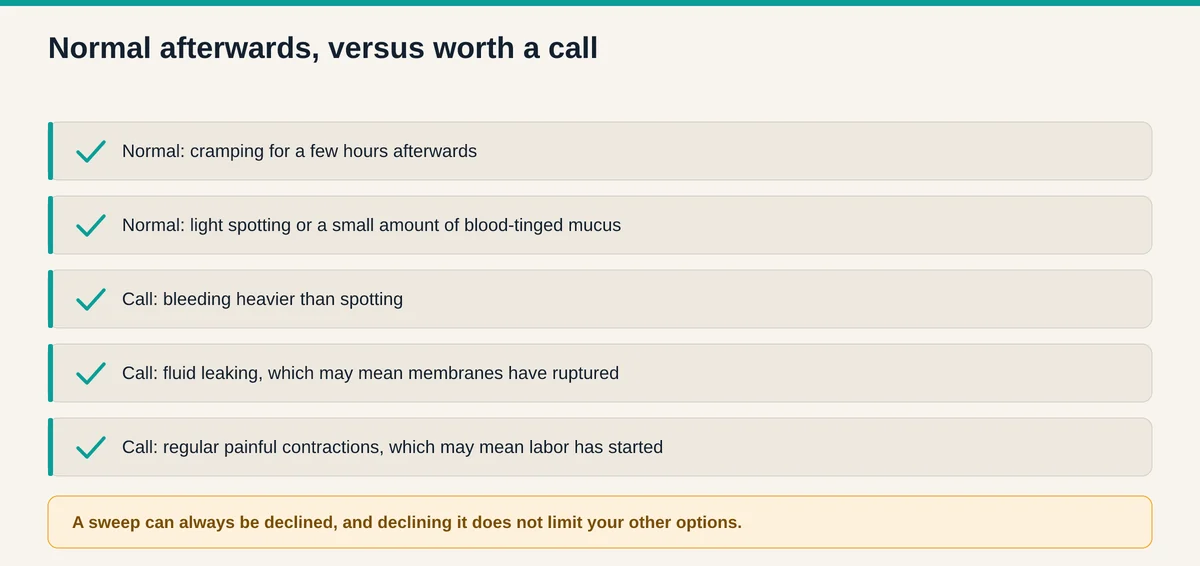
Expect the following in the 24 hours afterwards, all of which are ordinary:
- Cramping, often period-like, sometimes for several hours.
- Light spotting or brown or pink discharge. The cervix is vascular at term and bleeds easily when handled.
- Irregular contractions that may build for a while and then fade. This is common and is not a failed sweep, just a cervix that was not quite ready.
- Losing your mucus plug or bloody show. A sweep frequently dislodges it, and this by itself does not mean labor is imminent.
Call your provider or go in if you have any of the following:
- Bleeding heavier than spotting, especially anything approaching a period flow or with clots.
- A gush or steady trickle of fluid, which may mean your waters have broken.
- Regular, painful contractions that establish a pattern, following whatever guidance your provider gave you about when to come in.
- Reduced or changed fetal movement. This always warrants a call, sweep or not.
- Fever, chills, or foul-smelling discharge.
If the cramping is uncomfortable but nothing on the second list is happening, a warm bath, fluids, and rest are usually the reasonable response. If you are trying to work out whether what you are feeling is the real thing, the signs that labor is close is a useful reference.
You Can Decline, and You Can Have More Than One
Two things that often go unsaid.
A sweep is optional. It requires your consent like any procedure, and declining it is a completely reasonable choice with no bearing on the rest of your care. It is also worth knowing that a sweep can be performed during a routine cervical check without an explicit conversation if nobody has one, so if you do not want one, say so before the examination begins. Equally, if you want one, ask, because it is not always volunteered.
Repeat sweeps are common. If the first one does not produce labor, a second at the next appointment is often offered, and the evidence base includes repeated sweeps. Some data suggest repeated attempts may be somewhat more effective than a single one, and a later sweep has the advantage of a cervix that has had more time to change. There is no fixed maximum, but if two or three sweeps have produced nothing and you are approaching 41 weeks, the conversation typically shifts toward formal induction rather than continuing to try.
Putting It in Context
The realistic way to think about a sweep is as one input into a probability that is already moving on its own. At 40 weeks, most first-time mothers who are still pregnant will go into labor within the following one to two weeks with no intervention whatsoever. A sweep shifts that curve slightly earlier and slightly toward spontaneous onset.
If you want a sense of your own baseline before adding anything to it, the labor probability calculator shows how the odds change day by day, and the week-by-week labor statistics show the underlying distribution.
The Bottom Line
A membrane sweep is a short, unpleasant but low-risk procedure that releases prostaglandins and modestly improves the chance of labor starting on its own, with roughly one formal induction avoided for every eight women who have one. It works only when the cervix is already somewhat favorable, it brings labor forward by days rather than hours, and cramping and spotting afterwards are expected. It is entirely your choice, and this article is educational information rather than medical advice, so your provider is the person to decide the timing with.