Water Breaking: What Happens and When to Call
Only a minority of labors begin with the water breaking. Here is how to tell amniotic fluid from urine, which colors are emergencies, and why the clock starts at rupture.

Films have given rupture of membranes an outsized role. In the movie version, the water breaks in a supermarket aisle and the baby arrives shortly after. In reality most people are already contracting well before anything leaks, and a large share never experience a spontaneous rupture at all because the provider breaks the sac during labor instead.
Knowing what is normal here matters mostly because a few specific findings are urgent, and they are easy to recognize once you know what to look for.
Check your probability of going into labor this week for context on where you sit in the timeline.
How Often It Actually Happens First
Membranes rupturing before labor starts is called prelabor rupture of membranes (PROM). Most sources put it at somewhere between 8 and 15 percent of term pregnancies. The large majority of people have contractions first.
Of the pregnancies where membranes stay intact into labor, many rupture spontaneously during active labor, often around the transition to full dilation. Others never rupture on their own and the provider performs an amniotomy, breaking the sac with a small hook, usually to augment a labor that has slowed.
So the realistic distribution looks roughly like this:
- A minority, around 1 in 10: water breaks before any contractions
- The majority: contractions come first, rupture happens later in labor
- A meaningful share: membranes never rupture spontaneously and are broken by the provider
- Rarely: the baby is born inside an intact sac, the so-called "en caul" birth
If your water has not broken at 39 weeks, that is not a sign that anything is behind schedule. Our week-by-week labor statistics put the overall timing picture in perspective.
Gush Versus Trickle
Both are normal, and the trickle is more common than people expect.
A gush usually happens when the rupture is low, near the cervix, and the baby's head is not fully blocking the opening. It can be genuinely dramatic: a cup or more of warm fluid at once, often with a sensation of a small pop beforehand. Standing up after lying down is a classic trigger, because fluid pools while you are horizontal.
A trickle is more common when the tear is high on the sac, above the presenting part. Fluid seeps past slowly and intermittently. It can feel like nothing more than persistent dampness, and it is extremely easy to mistake for urine leakage, which is also common at 38 weeks.
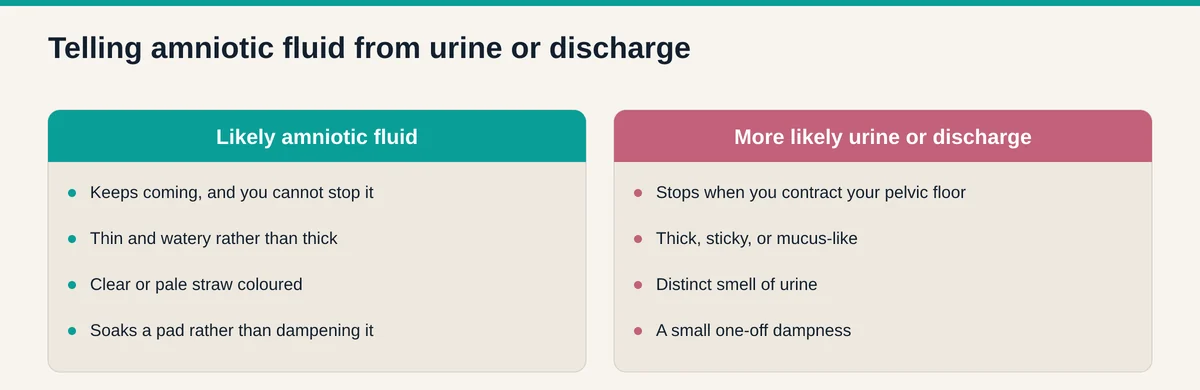
The distinguishing feature of a trickle is that it does not stop. Discharge and urine leaks are episodic. Amniotic fluid keeps coming because the body continues producing it, replacing roughly the full volume every few hours until delivery.
How to Tell Amniotic Fluid From Urine or Discharge
There is a reasonable home check, though nothing at home is definitive.
The pad test. Put on a clean pad, empty your bladder first, and lie down for 20 to 30 minutes. Then stand up. If fluid releases when you stand and the pad is wet in a way that continues, amniotic fluid is more likely. Look at the pad rather than guessing.
Characteristics to compare:
- Amniotic fluid: clear to pale straw yellow, watery and thin, odorless or faintly sweet, does not stop, soaks rather than sits
- Urine: distinctly yellow, unmistakable ammonia smell, stops when the bladder is empty, usually released with movement, coughing, or sneezing
- Normal discharge: white or cream, thick or mucus-like, does not soak through, no continuous flow
- Mucus plug: thick, jelly-like, often streaked with blood, a one-time event rather than a leak
What not to do: do not insert anything to check, do not have sex, do not take a bath once you suspect rupture. Each introduces infection risk. Showers are fine.
Your provider can confirm it definitively with a sterile speculum exam, a nitrazine pH strip, a ferning test under the microscope, or a commercial protein assay, plus ultrasound to measure remaining fluid.
Colors That Are Emergencies
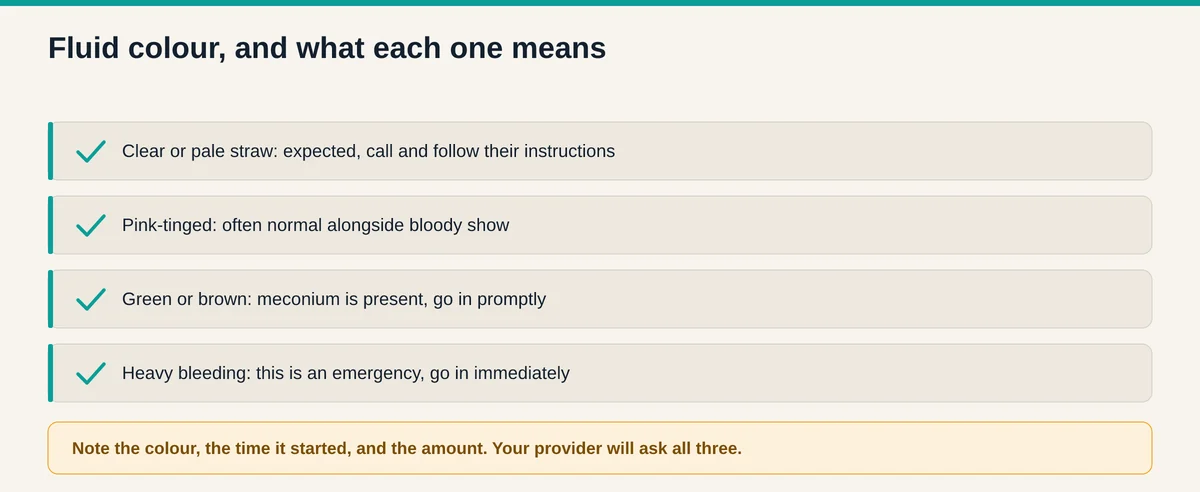
Normal amniotic fluid is clear or very pale yellow, sometimes with small white flecks of vernix. Anything else needs a call.
- Green or brown, thin or thick: meconium, meaning the baby has passed stool in utero. It happens in a meaningful share of term and postterm births and is more common the further past the due date you are. Most babies do fine, but there is a risk of meconium aspiration, so it changes monitoring and delivery-room staffing. Call immediately and mention the color
- Heavy or bright red blood: a small amount of blood-tinged fluid can be bloody show mixed in and is common. Frank bleeding, clots, or fluid that looks like blood rather than tinted by it needs emergency evaluation, since placental abruption and vasa previa both present this way
- Yellow-green and foul-smelling: a possible sign of intra-amniotic infection, particularly if you also have a fever, a fast heart rate, or uterine tenderness. Call immediately
- Very dark brown: may indicate older meconium. Call
Note the color and, if you can, keep the pad. Describing it accurately over the phone is genuinely useful.
PROM, PPROM, and Why the Distinction Matters
Two terms come up constantly and they mean different things.
PROM (prelabor rupture of membranes) is rupture at or after 37 weeks before contractions start. Most people with term PROM go into labor on their own within 24 hours, and the large majority within 48. Standard management is either prompt induction or a short period of expectant management, and the evidence, including large randomized trials and Cochrane reviews, generally favors planned early induction because it lowers infection rates without raising cesarean rates. Your provider will discuss which applies to you.
PPROM (preterm prelabor rupture of membranes) is rupture before 37 weeks. This is a different situation entirely, managed in hospital, and often involves antibiotics, corticosteroids to accelerate fetal lung maturity, and sometimes magnesium sulfate for neuroprotection depending on gestational age. The management goal shifts toward buying safe time rather than delivering promptly. Any suspected leak before 37 weeks needs immediate assessment.
The Infection Clock
This is the reason providers ask, precisely, what time your water broke.
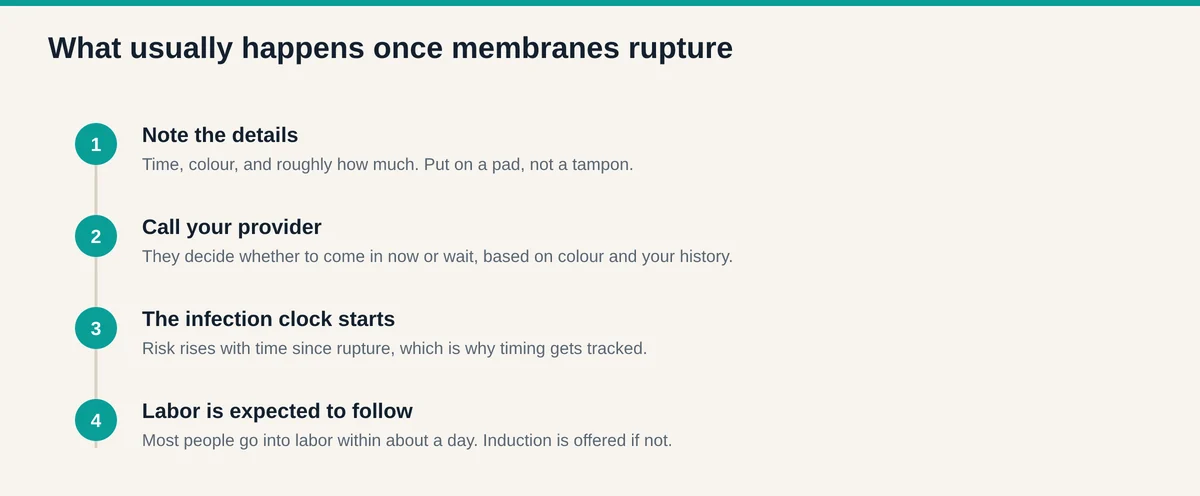
The amniotic sac is a sterile barrier. Once it opens, bacteria from the vagina can ascend into the uterus, and the risk of chorioamnionitis, an infection of the membranes and fluid, rises the longer rupture continues before delivery. The risk is low in the first several hours and climbs steadily after roughly 18 to 24 hours.
Practical consequences of the clock:
- Note the exact time. Write it down. You will be asked repeatedly
- Limit vaginal exams. Each one raises infection risk, which is why staff perform fewer once membranes are ruptured
- GBS status becomes urgent. If you are Group B Strep positive, intravenous antibiotics are typically started as soon as possible after rupture, and providers want adequate time before delivery
- Induction is often recommended at term if labor does not begin on its own, generally within a window your provider will specify. Our comparison of induction versus spontaneous labor covers what that involves
- Fever, uterine tenderness, foul-smelling fluid, or a rising heart rate are all reasons to call immediately, whatever the elapsed time
Cord Prolapse: Rare but a True Emergency
Umbilical cord prolapse happens when the cord slips down past the baby's head after the membranes rupture. It is uncommon, well under one percent of births, but it compresses the cord and cuts off oxygen, so it is a genuine obstetric emergency.
Risk is higher when the baby is not head-down, when the head is high and unengaged, with excess fluid, or with a rapid gush.
Call 911 rather than driving if you feel something in the vagina after your water breaks, see anything protruding, or the baby's movement changes sharply right after rupture. While waiting, get into a knee-to-chest position, kneeling with your chest down and hips up, which uses gravity to lift the baby's weight off the cord. Do not attempt to push anything back in.
This is also the main reason providers want to hear from you promptly after rupture even when everything feels fine.
What Usually Happens When You Arrive
For a straightforward term rupture, the visit tends to follow a predictable shape:
- Confirmation of rupture by speculum exam, pH strip, ferning, or a protein test
- Fetal monitoring for at least 20 to 30 minutes to check heart rate and any contractions
- Vital signs and temperature, watching for infection
- A cervical exam, though sometimes deferred to limit infection risk
- Ultrasound to check remaining fluid volume and confirm the baby's position
- GBS antibiotics started if you are positive or your status is unknown
- A conversation about induction timing versus waiting
If rupture is confirmed at term, you will usually be admitted rather than sent home, because delivery is now expected within roughly a day. Bring your bag. Our guide to preparing for labor in the third trimester covers what to have ready.
The Bottom Line
Most labors do not start with the water breaking, and when it does happen it is more often a trickle than a gush. Note the exact time, note the color, use a pad rather than guessing, and call your provider whether or not contractions have started. Green or brown fluid, heavy bleeding, fever, reduced fetal movement, or any leak before 37 weeks means call immediately. This is educational information, not medical advice, and your provider's instructions for your pregnancy come first.
Estimate your personal delivery window, or read the full list of signs labor is coming in the next 48 hours.