Third Trimester Prep: What to Do in the Final 4 Weeks
Weeks 36-40 each have specific tasks: GBS testing, car seat installation, hospital bag, birth plan. Here's the week-by-week checklist with specifics.
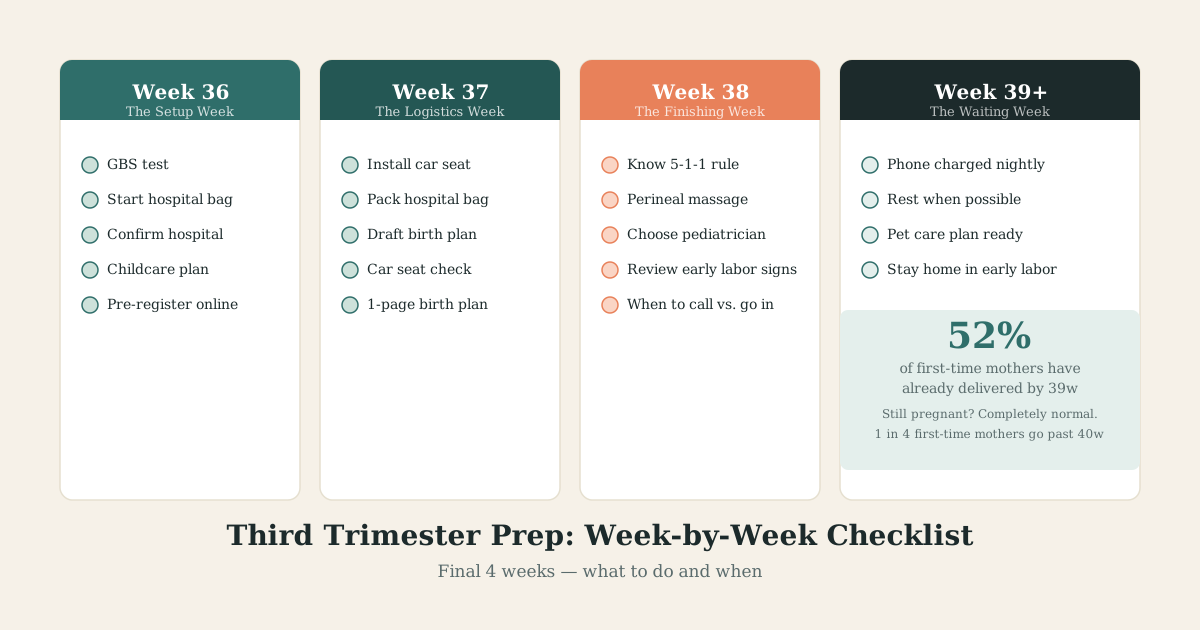
The third trimester moves fast once you hit 36 weeks. Labor can start at any time, and the difference between being prepared and scrambling is mostly about getting specific tasks done in the right order. Here's a week-by-week breakdown.
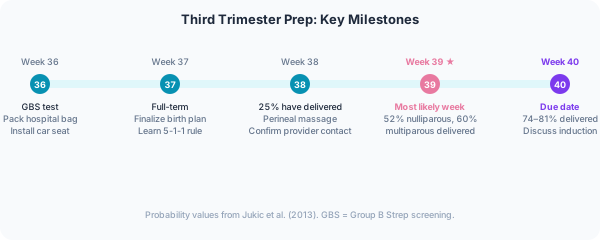
Week 36: The Setup Week
Group B Strep (GBS) testing. Between 36 and 37 weeks, your provider will swab your vagina and rectum to test for Group B Streptococcus. GBS is a common bacterium (about 25% of healthy adults carry it) that's harmless to you but can cause serious infection in newborns during delivery. If you test positive, you'll receive IV antibiotics (usually penicillin) during labor. This doesn't change your birth plan or require early induction; it just means the IV gets started when you arrive.
GBS status can change between pregnancies and even within the same pregnancy. A negative test from a previous pregnancy doesn't apply to this one.
Start your hospital bag. You don't need to pack everything this week, but you need a list. See the detailed checklist below.
Confirm your birth location. Know your hospital's entrance procedure for labor (after-hours entrances are often different from the main entrance), where to park, and whether you need to pre-register. Most hospitals allow pre-registration online. Do it now, not at 3 a.m. in labor.
Finalize childcare. If you have older children, the person covering for you during labor should know at 36 weeks, not 40 weeks. Practice the handoff.
Week 37: The Logistics Week
Car seat installation. This takes longer than almost everyone expects. The car seat manual is typically 40+ pages. Many seats are installed incorrectly on the first try. The National Highway Traffic Safety Administration estimates that roughly 59% of car seats are misused in some way.
Options:
- Many fire stations offer free car seat checks (call ahead; not all do)
- NHTSA maintains a certified technician locator at nhtsa.gov
- Certifying the seat at a check station takes about 45 minutes
Install rear-facing, at the correct angle (most seats have a built-in angle indicator), with less than 1 inch of movement at the belt path. The chest clip sits at armpit level, not stomach level.
Hospital bag: what to actually bring. The internet is full of 80-item hospital bag lists. Here's what you'll realistically use:
For labor and delivery:
- Your own pillow (with a colored or patterned case so it doesn't get mixed up with hospital linens)
- Phone charger (a long cord is better)
- Lip balm (breathing exercises dry out lips fast)
- Snacks for your support person
- Insurance card and ID
- Your birth plan (printed, 1 page)
- Earbuds or a small speaker for music
Postpartum (for you):
- 2–3 pairs of high-waisted underwear you don't mind ruining
- Loose, front-opening pajamas or a nursing nightgown
- Your own toiletries (hospital soap is harsh)
- Flip flops for the shower
- Nursing bra or supportive tank if breastfeeding
For the baby:
- 1–2 going-home outfits (newborn and 0–3 months; babies vary)
- A swaddle blanket
- Infant car seat installed and ready before you leave for the hospital
Don't bring: jewelry, valuables, your entire wardrobe, or a suitcase that won't fit in a postpartum room.
Draft your birth plan. One page. This is not negotiable. A 4-page birth plan signals rigidity to nursing staff, which is the opposite of what you want.
What belongs on a birth plan:
- Your top 2–3 preferences (e.g., "I prefer to try unmedicated labor and want to be offered pain medication rather than asked")
- Any medical allergies
- Who is your support person and what is their role
- Newborn preferences (delayed cord clamping, skin-to-skin, breastfeeding intention)
What doesn't belong on a birth plan: detailed contingency plans for every possible complication, or restrictions that contradict standard of care. Your providers will do their jobs. The plan is communication, not a contract.
Week 38: The Finishing Week
Know your signs of labor. This is the week to be clear on when to call your provider versus when to head to the hospital.
Call your provider if:
- Contractions are regular and getting stronger but not yet at the 5-1-1 pattern (contractions 5 minutes apart, lasting 1 minute, for 1 hour)
- You have questions about what you're feeling
- You notice decreased fetal movement (less than 10 kicks in 2 hours)
Go to the hospital (don't call first) if:
- Your water breaks (clear or pale yellow is normal; green or brown-tinged needs immediate evaluation for meconium)
- You have heavy vaginal bleeding
- Contractions are 5 minutes apart, 1 minute long, for 1 hour (the 5-1-1 rule for first-time mothers; multiparous women may be told to come sooner)
- You feel something is urgently wrong
Perineal massage. Starting at 34–36 weeks and continuing daily for 5–10 minutes, perineal massage reduces the risk of perineal tearing and episiotomy at delivery. A 2013 Cochrane review of 4 trials (2,497 women) found a 15% reduction in perineal trauma and a significant reduction in episiotomy rates for first-time mothers who performed perineal massage from 35 weeks. The technique: using clean thumbs or forefingers and a lubricant (coconut oil or vitamin E oil), apply steady downward pressure inside the vagina for 1–2 minutes, then sweep side to side. Ask your midwife or provider to demonstrate.
The benefit is documented specifically in nulliparous women. The data for multiparous women is less conclusive.
Confirm your pediatrician. The hospital will want the name of your baby's doctor within 24–48 hours of delivery. If you haven't chosen one, do it this week. The pediatrician doesn't need to be in your insurance network for the birth hospitalization (newborns are typically covered under the mother's policy for the first 30 days regardless), but you'll need them for the first well-visit at 3–5 days old.
Week 39: The Waiting Week
At 39 weeks, roughly 52% of first-time mothers have already delivered. If you're still pregnant, you're in the middle of the normal distribution rather than the late end. See the labor probability calculator for your specific week-by-week probabilities.
Finalize logistics for labor day:
- Is your phone charged every night?
- Does your support person know to come quickly if needed?
- If you have pets, is there a backup plan?
Rest when you can. The advice is obvious but underweighted. Sleep deprivation going into labor is real. If you're awake at 2 a.m. with false labor, lying down matters more than timing contractions.
Know what early labor looks like. Many people expect labor to start dramatically. It usually doesn't. Early contractions may feel like strong menstrual cramps that come every 10–20 minutes and last 30–45 seconds. This phase can last 8–12 hours in first-time mothers before you reach the 5-1-1 pattern. Staying home during early labor, if possible, is generally recommended. Walking, eating, and resting at home tends to be more comfortable than a hospital waiting room.
For a fuller picture of what's happening in the days before labor, see signs labor is close and when labor actually starts.
Week 40+: If You're Still Waiting
First-time mothers have about a 26% chance of still being pregnant at 40+0. That's not rare. It's expected for about 1 in 4 women. Your provider will likely schedule additional monitoring.
Non-stress tests (NSTs) after 40 weeks check fetal heart rate reactivity. A reactive NST (two accelerations of 15 bpm for 15 seconds in a 20-minute window) is reassuring. NSTs are typically done twice weekly from 41 weeks onward.
Biophysical profiles (BPPs) combine NST with ultrasound assessment of fetal breathing, movement, muscle tone, and amniotic fluid. A score of 8–10 out of 10 is normal.
If your due date comes and goes, the clinical conversation shifts toward induction timing. ACOG supports offering induction at 41 0/7 weeks. For a full explanation of what happens when pregnancy continues past 40 weeks, see the overdue pregnancy guide.
The team behind this calculator maintains all tools and content based on current ACOG guidelines and peer-reviewed obstetric research.