Twin Pregnancy: Why Multiples Arrive Earlier
Twins average around 35 to 36 weeks, and chorionicity drives monitoring intensity and recommended delivery timing. Here is why multiples arrive early.

Let's start with the thing that matters most on this page.
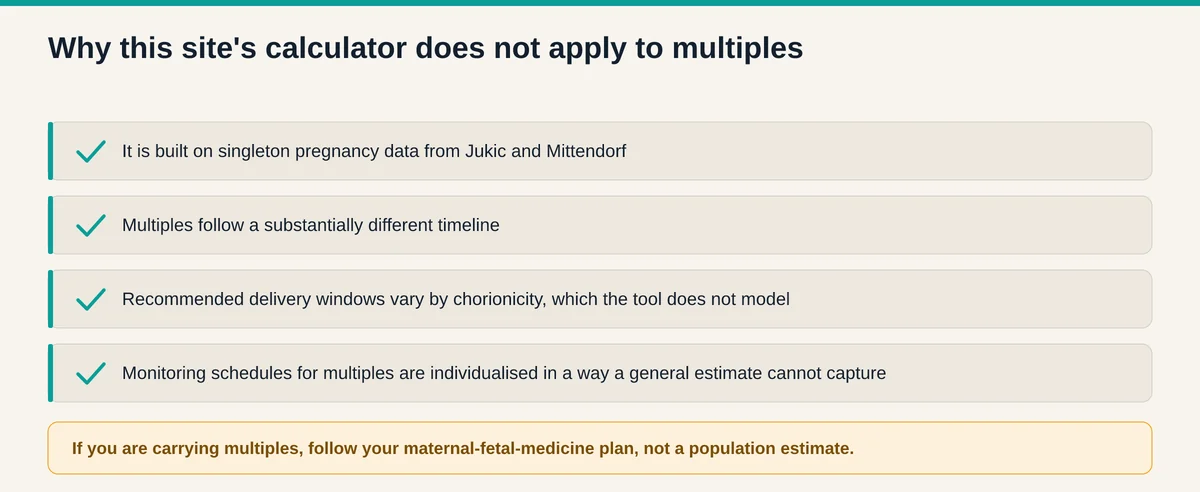
The labor probability calculator on this site is built for uncomplicated singleton pregnancies. It reflects the distribution of spontaneous labor onset in the general population, and that distribution simply does not describe twins. If you are carrying multiples, do not use it to plan. Use your maternal-fetal medicine (MFM) plan instead. Everything below is context to help you understand that plan, not a substitute for it.
Twins Run on a Different Clock
Twin pregnancies are shorter than singleton pregnancies, and by a wide margin.
- Singletons: commonly cited average around 39 weeks, with roughly 1 in 10 born preterm
- Twins: average delivery around 35 to 36 weeks, with more than half born before 37 weeks
- Triplets: average around 32 weeks, with the large majority born preterm
- Quadruplets and higher: earlier still, and almost always preterm
Twins account for something on the order of 3 percent of births in the United States but a disproportionate share of preterm deliveries.
Notice what this does to the meaning of a "due date." A twin due date is still calculated as 40 weeks from the last menstrual period, but almost no twin pregnancy reaches it. Our post on due date accuracy explains why the singleton due date is already a midpoint rather than a deadline. For twins, it is barely even that.
Chorionicity Is the Single Most Important Number
Early in a twin pregnancy, usually on a first-trimester ultrasound, your provider determines chorionicity (how many placentas) and amnionicity (how many amniotic sacs). This determination is most accurate before about 14 weeks, which is one reason early twin ultrasounds matter.
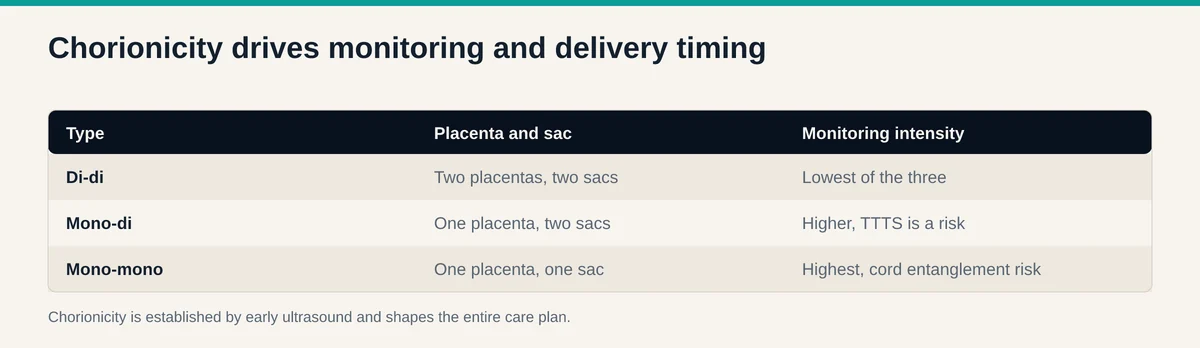
Dichorionic-diamniotic (di-di): two placentas, two sacs. The most common arrangement and the lowest-risk one. All fraternal (dizygotic) twins are di-di, and some identical twins are too.
Monochorionic-diamniotic (mono-di): one shared placenta, two sacs. Always identical twins. The shared placenta means shared circulation, which introduces a set of complications that di-di twins do not face.
Monochorionic-monoamniotic (mono-mono): one placenta, one sac, no dividing membrane. Rare, roughly 1 percent of twin pregnancies, and the highest-risk arrangement because the cords share a space and can become entangled.
This one distinction reshapes everything: how often you are scanned, what is being looked for, and when delivery is recommended.
Why a Shared Placenta Changes the Monitoring
With monochorionic twins, the placental vessels connect the two circulations. That connection is what creates the specific risks.
Twin-to-twin transfusion syndrome (TTTS) occurs when blood flow across those connections becomes unbalanced, leaving one twin with too much volume and the other with too little. It affects roughly 10 to 15 percent of monochorionic pregnancies and can progress quickly, which is why mono-di pregnancies are typically scanned every two weeks from the mid-second trimester rather than monthly.
Related conditions include selective fetal growth restriction, where one twin grows significantly behind the other, and twin anemia-polycythemia sequence. Treatments such as fetoscopic laser surgery exist for TTTS at specialized centers, which is part of why monochorionic pregnancies are usually co-managed with MFM.
Di-di twins do not have shared circulation, so they skip this entire category of risk. They are still monitored more intensively than singletons, for growth and for preterm labor, just not on the same schedule.
Why Multiples Trigger Labor Earlier
Two mechanisms do most of the work.
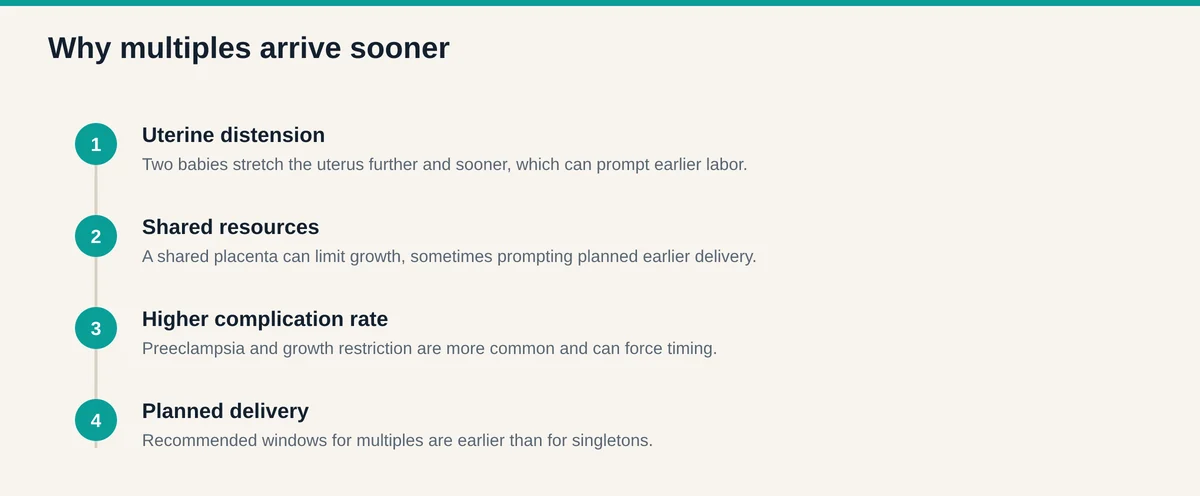
Uterine distension. The uterus is a stretch-sensitive organ. Mechanical stretch upregulates the contraction-associated machinery, including oxytocin receptors and prostaglandin production, and the uterus reaches that threshold much sooner with two babies in it. Cervical shortening also tends to begin earlier in twin pregnancies, which is why cervical length surveillance is often part of twin care.
Placental mass and hormonal signaling. More placental tissue means more of the hormones that appear to function as the biological clock of pregnancy, including corticotropin-releasing hormone. The signaling cascade that ends in labor appears to run ahead of schedule.
Add the higher rates of preeclampsia, gestational diabetes, and growth restriction in twin pregnancies, and a meaningful share of early twin deliveries are medically indicated rather than spontaneous. Twins arrive early both because labor starts early and because delivery is sometimes recommended early.
It is also worth noting what has not panned out. Interventions that help in some singleton pregnancies, including progesterone and routine cerclage, have generally not been shown to prevent preterm birth in unselected twin pregnancies. Prevention is not the lever it is with singletons, which puts more weight on monitoring and on timing the delivery well.
Recommended Delivery Windows by Chorionicity
For uncomplicated twin pregnancies, professional guidance generally points to earlier planned delivery than for singletons, with the window depending on chorionicity:
- Di-di, uncomplicated: commonly around 38 weeks, before the point where continuing appears to add risk
- Mono-di, uncomplicated: earlier, commonly in the mid-30s to around 37 weeks
- Mono-mono: substantially earlier, typically in the range of 32 to 34 weeks, often with inpatient monitoring in the weeks leading up to it
These are general ranges, not prescriptions. Any complication, including growth discordance, TTTS, preeclampsia, or an abnormal fetal test, moves the recommendation earlier. Your specific date should come from your MFM team.
Mode of delivery is a separate conversation and depends heavily on the presentation of the first twin, the presentation of the second, gestational age, and the experience of the delivering clinician. Vaginal birth is possible for many twin pairs, particularly when the presenting twin is head-down.
Higher-Order Multiples
Triplets and above compress the timeline further. Average gestation for triplets is commonly cited around 32 weeks, and planned delivery is typically recommended in the low 30s. Nearly all higher-order multiples are born preterm, and cesarean delivery is the usual route.
Care for higher-order multiples is almost always MFM-led from the start, with a delivery hospital chosen for its NICU level rather than for convenience. If that is your situation, the sequencing of care matters more than any timing statistic you will read online.
Watch for Preterm Labor Signs Sooner
Because the baseline risk is so much higher, the threshold for calling should be lower. Regular contractions, a low dull backache, new pelvic pressure, cramping, any fluid or bleeding, or a change in discharge before 37 weeks all warrant an immediate call. Our post on preterm labor warning signs covers what those symptoms mean and what happens when you get evaluated.
Do not talk yourself out of the call because you assume twins "just feel like this." Some of it genuinely is the ordinary discomfort of carrying two. Sorting out which is which is exactly what a 60-minute evaluation is for.
The Bottom Line
Twins average roughly 35 to 36 weeks, more than half are born preterm, and chorionicity determines both how closely the pregnancy is watched and when delivery is recommended. Uterine distension, greater placental mass, and higher complication rates all pull the timeline earlier, and prevention strategies that help some singleton pregnancies have not proven effective in twins. Follow your maternal-fetal medicine plan rather than any general-population estimate, including this site's calculator, which models singleton pregnancies only. This article is educational information and not medical advice.
If you are looking for singleton context, our posts on labor probability by week and when labor starts describe the distribution that twins depart from.