Preterm Labor: Warning Signs and Risk Factors
Preterm labor means regular contractions and cervical change before 37 weeks. Here are the warning signs, the real risk factors, and why to call right away.
Most of what happens in the third trimester is uncomfortable and completely normal. Braxton Hicks tighten and let go. Your pelvis aches. The baby's head presses on things it did not press on last month.
The hard part is that a few of those same sensations, in a different pattern, are how preterm labor announces itself. This post is about telling the difference, and about why the safest move is almost always to get checked rather than to reason your way through it at home.
What Preterm Labor Actually Means
Preterm birth is delivery before 37 completed weeks of gestation. In the United States it accounts for roughly 1 in 10 births.
Preterm labor is the process: regular uterine contractions accompanied by cervical change (dilation, effacement, or both) before 37 weeks. Contractions alone are not enough for the diagnosis, which is exactly why the evaluation happens at the hospital and not over the phone.
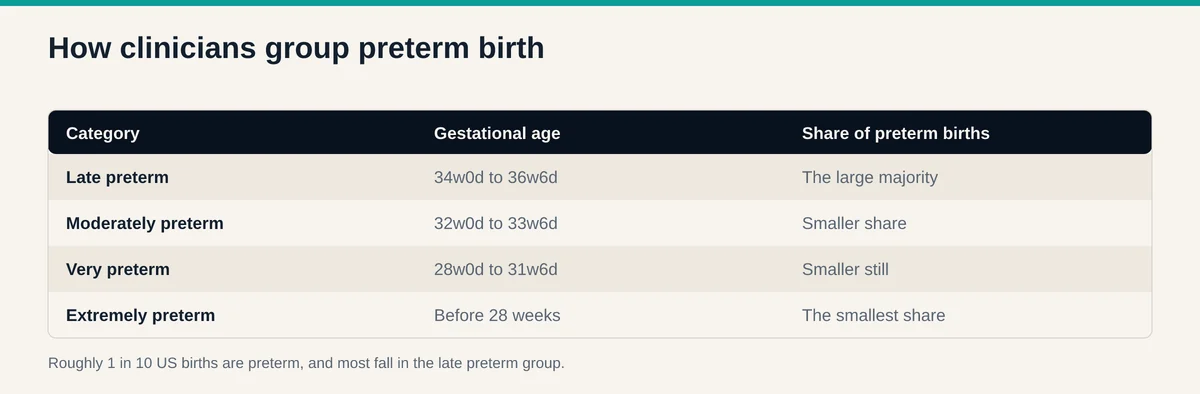
Clinicians usually group preterm birth by how early it is:
- Late preterm: 34 0/7 to 36 6/7 weeks
- Moderately preterm: 32 0/7 to 33 6/7 weeks
- Very preterm: 28 0/7 to 31 6/7 weeks
- Extremely preterm: before 28 weeks
The majority of preterm births fall in the late preterm group. That matters, because outcomes at 35 or 36 weeks are generally much better than the word "preterm" makes them sound. It does not mean those weeks are unimportant. Every additional week of lung and brain development counts.
The Signs That Are Different From Normal Discomfort
Normal third-trimester tightening is irregular, often one-sided or focal, and it usually eases with rest, hydration, or changing position. It does not build a rhythm.
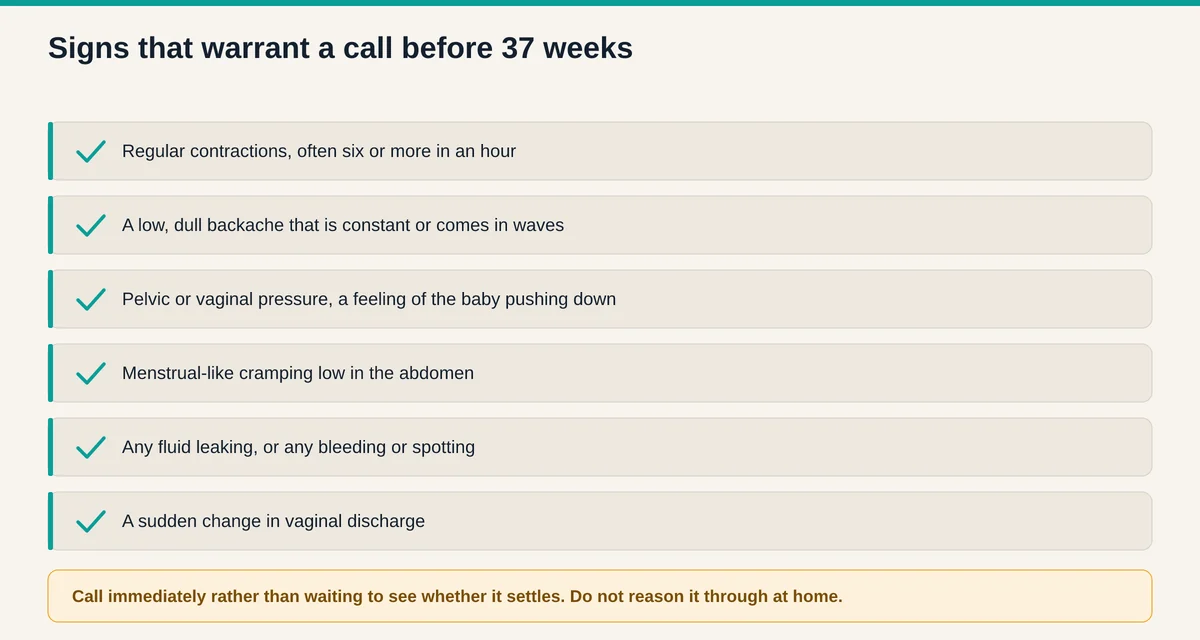
Signs that should prompt a call before 37 weeks:
- Regular contractions. Tightening that comes in a pattern, often described as six or more in an hour, or roughly every 10 minutes or more often, and that keeps going after you rest and drink water.
- A low, dull backache that is constant or comes in waves, and is different from your usual back pain. This one is easy to dismiss, and it is one of the most commonly reported early symptoms.
- Pelvic or vaginal pressure, a feeling that the baby is pushing down, especially if it is new or noticeably stronger.
- Menstrual-like cramping, low in the abdomen, with or without intestinal cramping or diarrhea.
- Any fluid leaking. A gush or a persistent trickle may mean your membranes have ruptured. Do not try to distinguish it from urine at home.
- Any vaginal bleeding or spotting.
- A distinct change in discharge, particularly a shift to watery, mucus-like, or blood-tinged.
None of these individually proves anything. A backache is usually just a backache. But before 37 weeks, the pattern matters more than any single symptom, and the pattern is what an exam can sort out in an hour.
If you want a sense of what late-pregnancy symptoms usually mean at term, our post on the signs labor is close covers the term picture, which is a different situation with different urgency.
The Risk Factors That Actually Carry Weight
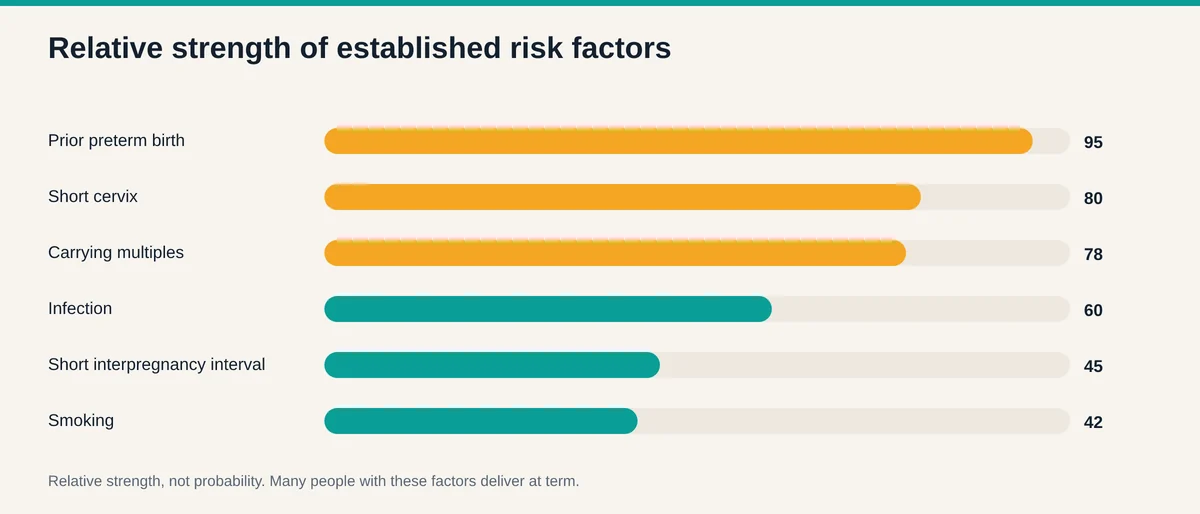
Some risk factors are strongly predictive. Many people with none of them still go into preterm labor, and most people with one or two of them deliver at term. Both things are true.
Prior spontaneous preterm birth is the strongest known risk factor. A previous preterm delivery substantially raises the odds of another, and the earlier the prior birth, the higher the risk. If this is you, your provider should be planning for it from early pregnancy rather than reacting later.
A short cervix on transvaginal ultrasound in the second trimester. A cervical length under 25 mm before 24 weeks is associated with meaningfully elevated preterm birth risk, and shorter measurements carry more risk than borderline ones.
Carrying multiples. Twins and higher-order multiples deliver early far more often than singletons, for reasons covered in our post on twin pregnancy delivery timing.
Infection. Intrauterine infection, urinary tract infections, and some genital tract infections are established contributors. This is part of why an unexplained fever or urinary symptoms in pregnancy is worth a same-day call.
A short interpregnancy interval. Conceiving within roughly 6 months of a prior birth is associated with higher preterm risk, and intervals under about 18 months are generally considered short.
Smoking and substance use. Smoking is one of the more modifiable risk factors on this list, and stopping at any point in pregnancy appears to help.
Other contributors include vaginal bleeding in pregnancy, certain uterine or cervical anomalies, prior cervical surgery, low pre-pregnancy BMI, and significant chronic stress. In the United States, Black patients experience preterm birth at substantially higher rates, a disparity that research attributes largely to structural and social factors rather than to biology alone.
What Happens When You Go In
Knowing the sequence takes some of the fear out of it.
Monitoring. You will be put on a tocodynamometer and fetal monitor to record contraction frequency and the baby's heart rate.
Cervical exam. A digital exam or a speculum exam to check dilation and effacement, and to look for fluid or bleeding.
Transvaginal cervical length ultrasound. A short cervix on this scan raises concern. A reassuringly long one lowers it considerably.
Fetal fibronectin (fFN) testing. A swab of cervicovaginal secretions, usually used between about 22 and 34 weeks. Its main value is its negative predictive value: a negative test makes delivery within the next 1 to 2 weeks unlikely, which is often enough to send you home with reassurance. A positive test is much less informative on its own.
If your provider concludes you are in genuine preterm labor, several interventions may follow:
- Antenatal corticosteroids (betamethasone or dexamethasone) to accelerate fetal lung maturity and reduce respiratory complications. This is the single highest-value intervention in preterm labor, and it is generally given when delivery within 7 days is considered likely in the relevant gestational age window.
- Magnesium sulfate for neuroprotection, typically when delivery before 32 weeks is anticipated. It is associated with reduced rates of cerebral palsy in babies born very preterm.
- Tocolytics such as nifedipine or indomethacin. These are used to buy time, generally around 48 hours, not to hold off labor indefinitely. That window is what allows steroids to take effect and, if needed, transfer to a hospital with a higher-level NICU.
- Antibiotics, if group B strep status is unknown or positive, or if infection is suspected.
For people with a prior preterm birth or a short cervix, prevention strategies discussed earlier in pregnancy may include vaginal progesterone or a cervical cerclage. Those decisions belong with your obstetric provider and depend on your specific history.
Why Getting Checked Is a Low-Cost Decision
Here is the part worth internalizing: a large share of people evaluated for preterm labor symptoms do not deliver preterm. Many go home the same day and carry to term.
That is not a reason to skip the trip. It is the reason to take it. The evaluation is quick, low-risk, and mostly non-invasive, and the information it gives you is genuinely hard to get any other way. Meanwhile, the value of steroids and magnesium depends entirely on being given before delivery, so arriving early is what makes them possible at all.
Weigh the two errors honestly. Going in and being sent home costs you an evening. Waiting it out at home when it was real costs a window that does not reopen.
Call Immediately. Do Not Wait It Out.
If you are less than 37 weeks and you have regular contractions, leaking fluid, bleeding, new pelvic pressure, or a persistent low backache, call your provider or your labor and delivery unit now. Not in the morning. Not after you see whether a bath helps.
Say clearly how many weeks you are and what you are feeling. Preterm symptoms are triaged differently from term symptoms, and the gestational age changes the answer you get.
If you cannot reach anyone, go in. Labor and delivery units triage walk-ins around the clock and no one there will think you overreacted.
The Bottom Line
Preterm labor is contractions plus cervical change before 37 weeks, and its early signs overlap enough with ordinary third-trimester discomfort that pattern and timing matter more than any single symptom. Prior preterm birth, a short cervix, multiples, infection, a short interpregnancy interval, and smoking are the risk factors with the most evidence behind them. Because steroids and magnesium only help if given before delivery, the right response to any suspicion is an immediate call, not a wait-and-see. This article is educational information and not medical advice; your obstetric provider knows your history and is the person to act on it.
For general term-pregnancy timing, you can run a week-by-week probability estimate or read our breakdown of labor probability by week. Those tools model uncomplicated singleton pregnancies at term and are not designed to assess preterm risk.