The Three Stages of Labor: A Complete Walkthrough
First, second, and third stage, plus the recovery hour often called the fourth. What happens in each, and how long each typically lasts.
Most people learn labor as a single event: contractions, then a baby. The clinical map is more useful than that, because each stage has different mechanics, different timelines, and different things your care team is watching for.
Knowing which stage you are in also tells you something practical: whether it is time to call, time to go in, or time to keep resting at home.
The First Stage: Closed Cervix to 10 Centimeters
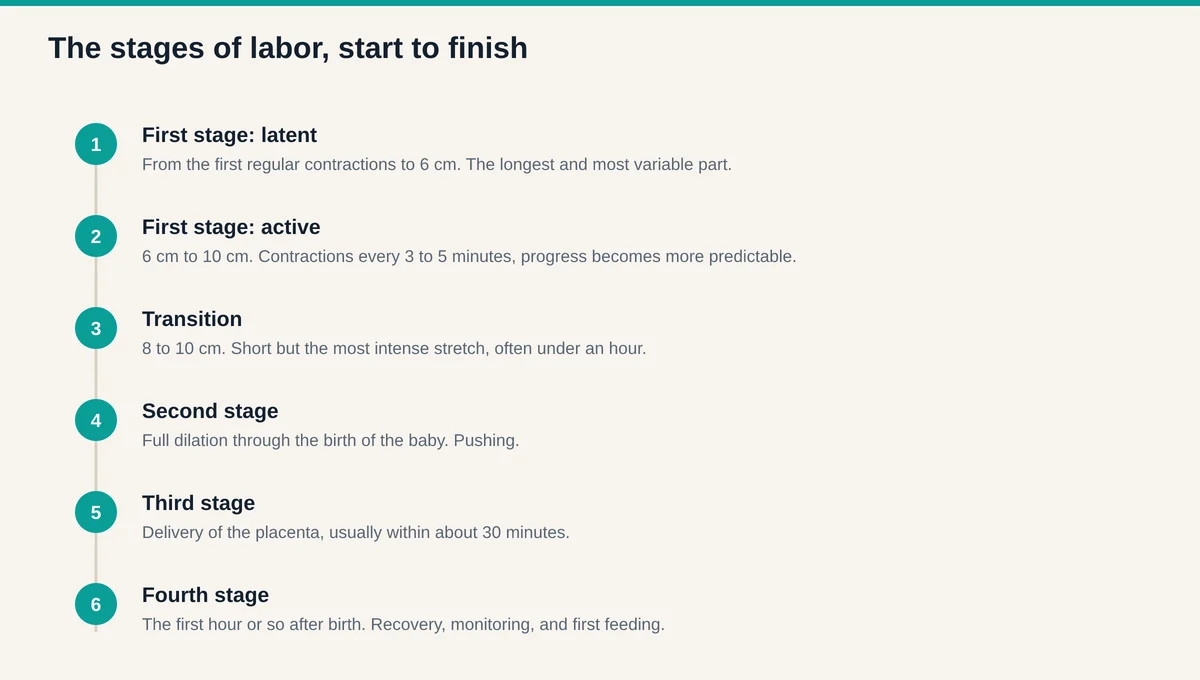
The first stage is by far the longest. It runs from the onset of regular contractions until the cervix is fully dilated at 10 cm. It has three commonly described phases.
Latent phase (roughly 0 to 6 cm). Contractions are usually irregular at first, then settle into a pattern, often 5 to 20 minutes apart and 30 to 45 seconds long. The cervix is doing two jobs simultaneously: effacement (thinning from a thick tube into paper-thin tissue) and early dilation. In a first pregnancy, effacement often largely precedes dilation. In a later pregnancy, they tend to happen together, which is one reason repeat labors move faster.
This phase is the most variable part of the entire process. It can take a few hours or stretch across more than a day, sometimes with long stalls. Most people spend it at home, and most guidance recommends staying there while it is comfortable to do so. Our article on what labor actually feels like when it starts covers how to tell this apart from prodromal contractions.
Active phase (roughly 6 to 10 cm). Contractions become regular, strong, and closer together, typically 2 to 4 minutes apart lasting 60 to 90 seconds. Dilation speeds up noticeably. Talking through contractions becomes difficult, and most people who want an epidural request one somewhere in this window.
Transition (roughly 8 to 10 cm). The shortest and most intense stretch of the first stage. Contractions may come every 2 minutes with little rest between. Shaking, nausea, vomiting, feeling hot then cold, and a sudden sense of "I cannot do this" are all common and all normal. Transition often lasts 15 minutes to an hour. The rectal pressure that shows up here is the baby descending, not a bowel problem.
Why ACOG Moved Active Labor from 4 cm to 6 cm
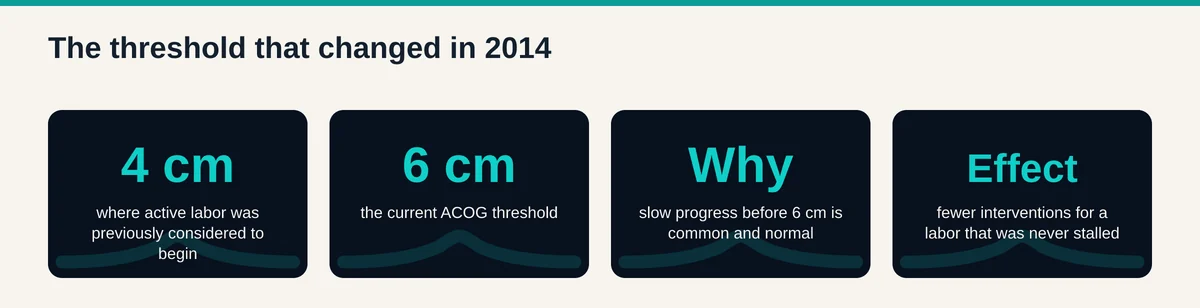
For decades, active labor was defined as starting around 4 cm, based on labor curves published by Emanuel Friedman in the 1950s. If a person at 4 cm was not dilating at roughly 1 cm per hour, they were often diagnosed with "failure to progress."
Larger and more modern datasets, particularly the Consortium on Safe Labor analyses led by Zhang and colleagues, showed that contemporary labor is slower than Friedman's curves suggested, and that dilation does not accelerate meaningfully until around 6 cm. Progress between 4 and 6 cm is often genuinely slow in normal labor.
In 2014, ACOG and the Society for Maternal-Fetal Medicine issued joint guidance on the safe prevention of primary cesarean delivery that moved the active-phase threshold to 6 cm. The practical effect was significant: labors that would previously have been called stalled at 4 or 5 cm were reclassified as still latent, which meant more time rather than an immediate surgical decision. It remains one of the clearest examples of a definition change altering real clinical outcomes.
If a nurse tells you that you are 5 cm and "still early," this is why. It is not a dismissal.
First Stage Duration: What Is Realistic
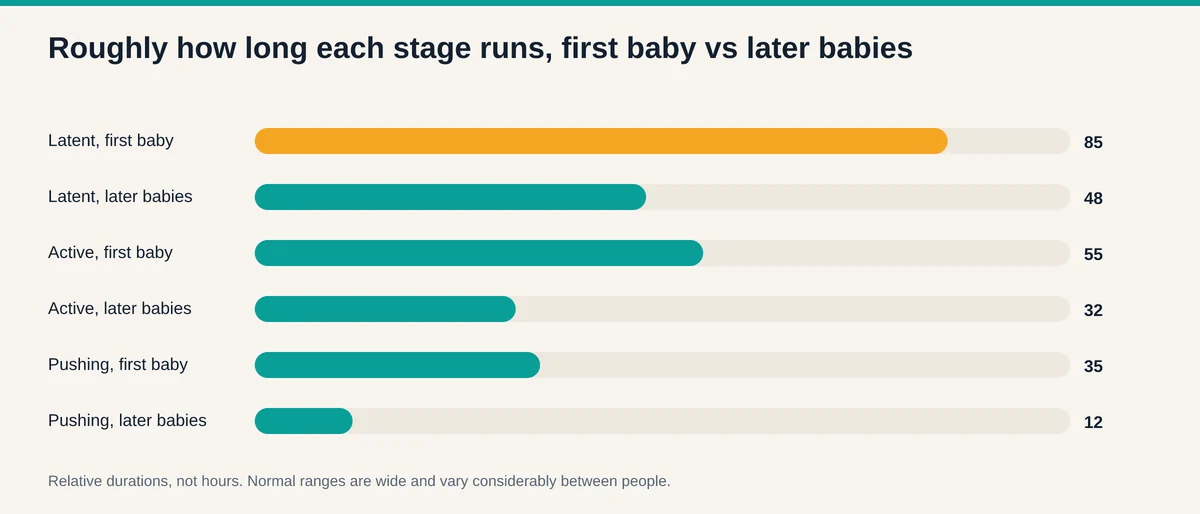
Durations vary enormously, and any single number hides that. Broad ranges commonly reported for the active phase specifically:
- First-time (nulliparous): often 4 to 8 hours, with the upper end of normal extending well past 12 hours
- Experienced (multiparous): often 2 to 5 hours, sometimes much shorter
- Latent phase, first-time: highly variable, commonly 6 to 12 hours but can exceed 20
- Latent phase, experienced: commonly shorter, though prodromal patterns can still stretch across days
An epidural tends to lengthen labor modestly, mostly in the second stage rather than the first. We break down the first-versus-later-birth differences further in our comparison of first and second labors, and dilation specifically in our guide to cervical dilation.
The Second Stage: Full Dilation to Birth
The second stage begins the moment the cervix reaches 10 cm and ends when the baby is born. Two things happen here: descent through the pelvis and rotation, as the baby turns to fit the changing shape of the birth canal.
The urge to push is a reflex triggered by the baby's head pressing on the pelvic floor, sometimes called the Ferguson reflex. With a dense epidural, that urge may be muted or absent, and many providers will suggest "laboring down," waiting for the baby to descend passively before active pushing begins.
Typical second-stage durations:
- First-time, no epidural: often 30 minutes to 2 hours
- First-time, with epidural: often 1 to 3 hours
- Experienced, no epidural: often 5 to 30 minutes
- Experienced, with epidural: often 20 minutes to 2 hours
ACOG's current guidance allows longer second stages than older standards did, provided both the parent and baby are doing well and there is evidence of progress. Time alone is not a reason to intervene.
What you experience: intense pressure rather than the wave-like pain of the first stage, often a strange relief in being able to do something active, a burning stretching sensation as the head crowns (frequently described as the "ring of fire"), and then a sudden release as the head and body deliver.
The Third Stage: Delivering the Placenta
The third stage runs from the birth of the baby to the delivery of the placenta. It usually takes 5 to 30 minutes. Most guidelines consider a placenta retained past 30 minutes as needing intervention, and past 60 minutes as requiring it.
Two approaches exist:
Active management is standard in most hospitals. It typically includes a dose of oxytocin after birth, controlled cord traction, and uterine massage. Cochrane reviews of active versus expectant management consistently find that active management reduces the risk of postpartum hemorrhage, which is why it is the default recommendation in most settings.
Expectant (physiological) management waits for the placenta to separate on its own with no routine medication. It may be offered in low-risk births, often alongside delayed cord clamping.
You will likely feel a few mild contractions, a sensation of fullness, and then a soft slippery release. Compared with what came before, most people barely register it. Your provider will examine the placenta to confirm it is complete, since retained fragments can cause bleeding later.
The Fourth Stage: The First Hour or Two After Birth
Not an official stage in every text, but widely used clinically. This covers roughly the first 1 to 2 hours postpartum, when the uterus is contracting down to control bleeding and your body is making a large hormonal shift.
What your care team is monitoring: uterine tone (a firm, well-contracted uterus is the main defense against hemorrhage), blood loss, blood pressure and pulse, and any perineal repair that is needed. This is also the window for skin-to-skin contact and first feeding, both of which trigger natural oxytocin release that helps the uterus contract.
Shaking is extremely common here and is not a sign that something is wrong. So is intense hunger and thirst.
Numbers Worth Remembering
- 10 cm is full dilation, the boundary between first and second stage
- 6 cm is the current active-labor threshold, changed from 4 cm in 2014
- 5 to 30 minutes is the usual third stage; 30 minutes is the common threshold for concern
- Under 3 hours total defines precipitous labor, which happens in a small percentage of births
- Roughly half of first-time labors involve some form of augmentation with oxytocin
None of these are hard rules for your labor. They are population patterns that help set expectations.
When Stage Boundaries Get Blurry
Real labor is messier than the outline. The cervix can be 4 cm for eight hours and then reach 10 cm in ninety minutes. Some people never feel a clear transition. Some go from "this is manageable" to pushing without an obvious active phase in between, which is more common in later pregnancies.
Contractions can also stall entirely, then restart. This is not failure, and it is not unusual. What your provider is watching is the overall trajectory plus how the baby is tolerating it, not whether you match a textbook curve.
If you want to think about the earlier question of when any of this begins, our overview of the signs labor is close and the week-by-week odds in our labor probability calculator are the better starting points.
The Bottom Line
Labor moves through a long first stage of dilation, a shorter second stage of pushing, and a brief third stage delivering the placenta, followed by a closely monitored recovery hour. Durations vary widely, especially between first and later births, and the 2014 shift of active labor to 6 cm gave many labors more room before intervention.
This is educational information, not medical advice. Your provider knows your pregnancy, your history, and how your labor is actually progressing, and their guidance should take precedence over any general timeline.