Natural Ways to Induce Labor: What the Evidence Shows
An honest review of nipple stimulation, sex, dates, raspberry leaf tea, castor oil, pineapple and more, and how strong the research behind each one actually is.

Search this topic and you will find hundreds of confident articles listing the same twelve methods, with no distinction between the ones studied in randomized trials and the ones that are folklore. That flattening is the actual problem, because it makes a well-designed Cochrane review and a message board anecdote look equally credible.
Here is the honest version, method by method, with the strength of the evidence stated plainly. None of this is medical advice, and everything below should be cleared with your provider first.
The One Thing That Determines Whether Any of It Works
Labor onset is not a switch you flip from the outside. It is the end of a cascade involving fetal maturity signals, rising oxytocin receptor density in the uterus, and prostaglandin-driven softening of the cervix. When that cascade is already underway, small nudges can plausibly tip you over. When it is not, nothing you do at home will force it.
This is why the same method appears to work brilliantly for one person and do nothing for another. The person it "worked" for was likely going into labor within a day or two regardless. This is also why the honest framing for every method below is "may bring labor forward slightly if you are already close," never "starts labor."
If your cervix is still long, firm, and closed, the realistic expectation is that you are not going into labor tonight regardless of what you eat or do. The cervical dilation guide explains what providers are assessing when they check.
Nipple Stimulation: The Strongest Evidence of the Group
Nipple stimulation triggers release of endogenous oxytocin, the same hormone used pharmacologically as Pitocin. The mechanism is real and well understood, which is more than can be said for most items on this list.
A Cochrane systematic review of breast stimulation for cervical ripening and labor induction found that, compared with no intervention, breast stimulation increased the proportion of women in labor within 72 hours and was associated with a reduction in postpartum hemorrhage. The trials involved were small and mostly enrolled women with a favorable cervix at term, so the finding applies most directly to that group.
The important caution: the reviewers did not recommend it for high-risk pregnancies, because oxytocin release cannot be dosed or switched off, and uterine hyperstimulation is a theoretical concern. If you have any risk factor at all, or a baby whose heart rate is already being watched, this is a conversation to have with your provider rather than a thing to try at home.
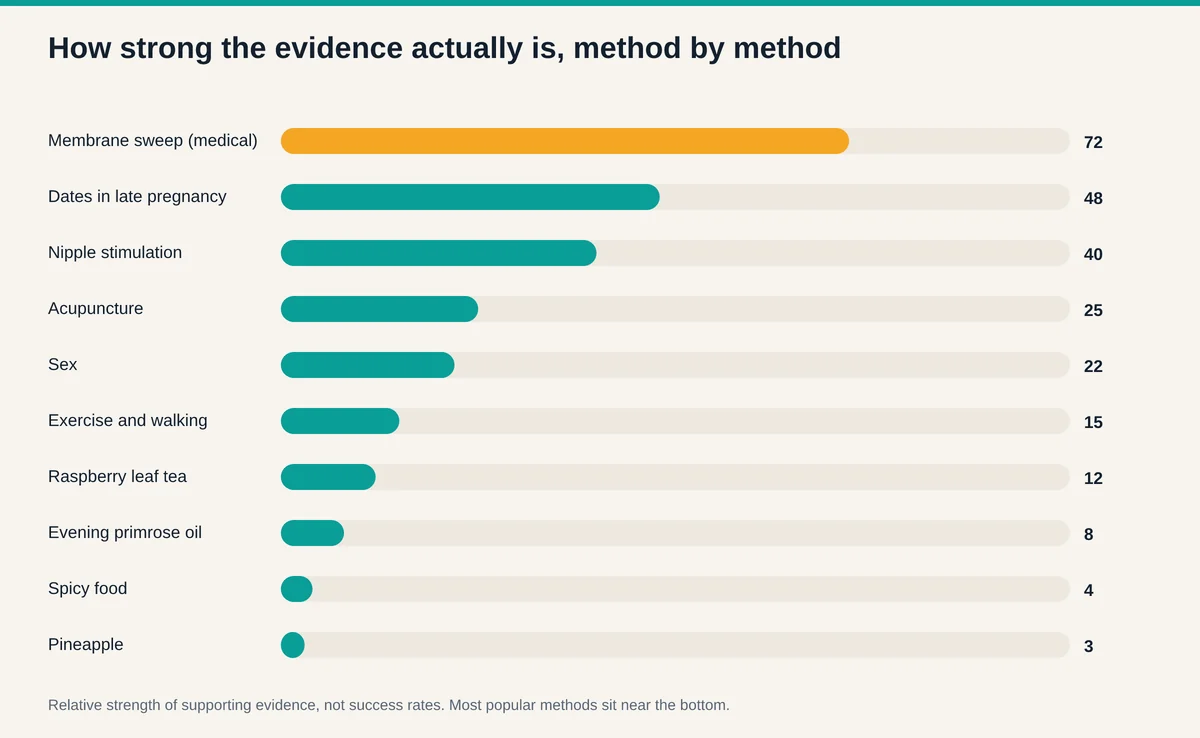
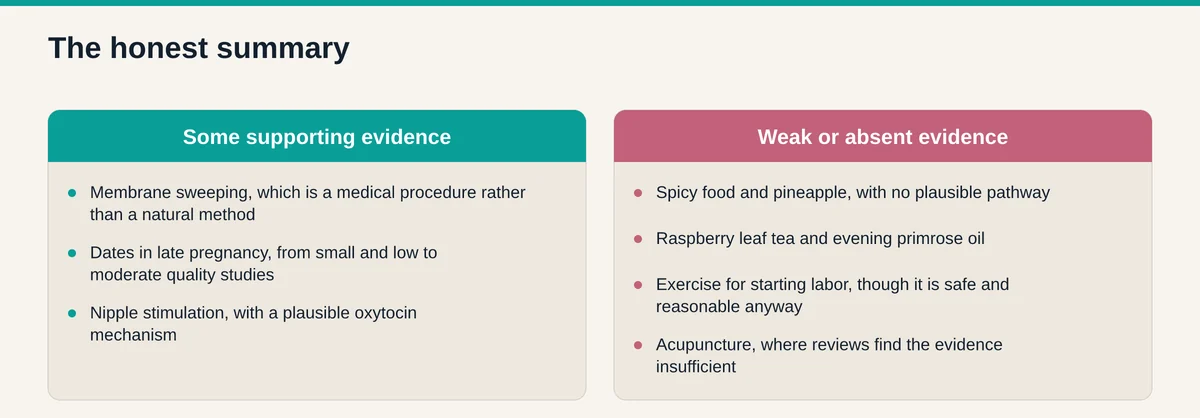
Evidence strength: moderate, the best of any home method.
Sex and Semen: Plausible Mechanism, Unimpressive Trials
The theory is triple: semen contains prostaglandins, orgasm releases oxytocin, and the mechanical action may nudge the cervix. All three are biologically real.
The trial evidence is nonetheless underwhelming. Studies of intercourse at term have generally not shown a clear reduction in time to labor onset or in the rate of formal induction, and a Cochrane review concluded the evidence was insufficient to say whether it helps.
Sex at term is safe in an uncomplicated pregnancy with intact membranes. It is not safe if your water has broken, if you have placenta previa, or if you have been advised against it. Fine to try, unlikely to be decisive.
Evidence strength: weak. Plausible mechanism, no reliable effect demonstrated.
Walking, Spicy Food, and Pineapple: The Folklore Tier
Walking, exercise, and bouncing on a ball. Common advice, almost no supporting evidence for labor onset. Upright positions and movement do appear to help labor progress once it is underway, which is likely where the belief comes from, but that is a different claim from starting it. Walking three miles at 39 weeks is fine if it feels good. If it exhausts you, going into labor already depleted is a genuine disadvantage.
Spicy food. May irritate the gut and cause cramping that gets mistaken for contractions. No trial evidence, no plausible pathway to uterine activity, and it tends to worsen heartburn at exactly the stage when heartburn is already at its worst.
Pineapple. Said to work because it contains bromelain, an enzyme with proteolytic activity. The quantity in fresh pineapple is small, orally consumed bromelain is largely broken down by digestion, and there is no clinical evidence of an effect on the cervix or uterus. Reaching anything like a pharmacological dose would mainly give you a sore mouth and diarrhea.
Evidence strength: none for spicy food or pineapple. No evidence that exercise starts labor, though it is safe and reasonable anyway.
Dates in Late Pregnancy: Small but Real Signal
Eating dates in the last few weeks of pregnancy is one of the few folk methods with a plausible research trail. Several small randomized and observational studies, mostly conducted in the Middle East and involving roughly six dates per day from around 36 weeks, have reported outcomes such as greater cervical dilation on admission, a higher rate of spontaneous labor onset, and lower rates of formal induction and augmentation.
Two caveats. The studies are small, heterogeneous, and of low to moderate quality, and blinding is basically impossible when the intervention is a food. Also, six dates per day is a meaningful sugar load if you have gestational diabetes.
Evidence strength: modest and encouraging, but not strong. Ask about the sugar if your glucose control is an issue.
Raspberry Leaf, Evening Primrose Oil, and Acupuncture
Three popular complementary approaches, none of which has held up well under study.
Red raspberry leaf tea. The traditional claim is that it tones the uterus rather than inducing labor. Trial evidence is thin: the small studies that exist have not shown a clear effect on labor onset, and any suggestion of a shortened second stage has not been convincingly replicated. It is widely consumed and generally considered low risk in the third trimester, but widely consumed is not the same as studied. Herbal preparations are unregulated for potency, and raspberry leaf does have uterine activity in laboratory settings, so it is not a nothing-substance to take casually.
Evening primrose oil. Taken orally or placed vaginally on the theory that its fatty acids convert to prostaglandins and ripen the cervix. Well-designed trials have not shown a benefit for ripening or for shortening labor, and some have raised the possibility of longer labor or more frequent intervention in users, the opposite of the intended effect.
Acupuncture and acupressure. Cochrane reviews have generally concluded the evidence is insufficient. Some individual trials report improved cervical ripeness scores, but no consistent reduction in caesarean rates or in the need for formal induction, and blinding is a persistent problem. Good safety record with a practitioner trained in pregnancy work. Treat it as low risk and unproven rather than effective.
Evidence strength: weak to absent for all three, with some signals of possible harm for evening primrose oil.
Castor Oil: Some Evidence, Real Downsides
Castor oil is the one method on this list with both some supporting data and genuine reasons for caution.
Ricinoleic acid, its active component, stimulates receptors in the gut and appears to have some uterine activity as well. A number of small and generally low-quality studies have found increased rates of labor onset within about 24 hours in women at or past term who took it, compared with no treatment.
The downsides are not trivial: nausea, vomiting, cramping, and diarrhea are common rather than occasional. That can cause dehydration and electrolyte disturbance right before a physically demanding labor, and it means starting labor in poor condition. There has also been longstanding discussion in the literature about meconium-stained amniotic fluid in association with castor oil use, though the data are not conclusive either way.
This is the method most worth not attempting on your own. If you are seriously considering it, raise it with your provider, who can tell you whether it is reasonable in your specific case.
Evidence strength: some low-quality evidence of effect, with meaningful side effects.
Membrane Sweeping Is Medical, Not Natural
Membrane sweeping gets grouped with home remedies constantly, and it does not belong there. It is a clinical procedure, performed by a provider, that separates the amniotic sac from the lower uterine segment and releases local prostaglandins.
It also happens to have better evidence than anything else on this page. Systematic review data suggest that sweeping reduces the likelihood of the pregnancy continuing past 41 weeks and reduces the need for formal induction, with roughly one formal induction avoided for every eight or so women who have a sweep. The effect is best described as bringing labor forward modestly rather than starting it on command.
If you are looking for the intervention with the most evidence behind it, this is the one, and it requires an appointment rather than a grocery list. See the full explanation in membrane sweeping, how it works and whether it helps.
Safety Rules That Are Not Negotiable
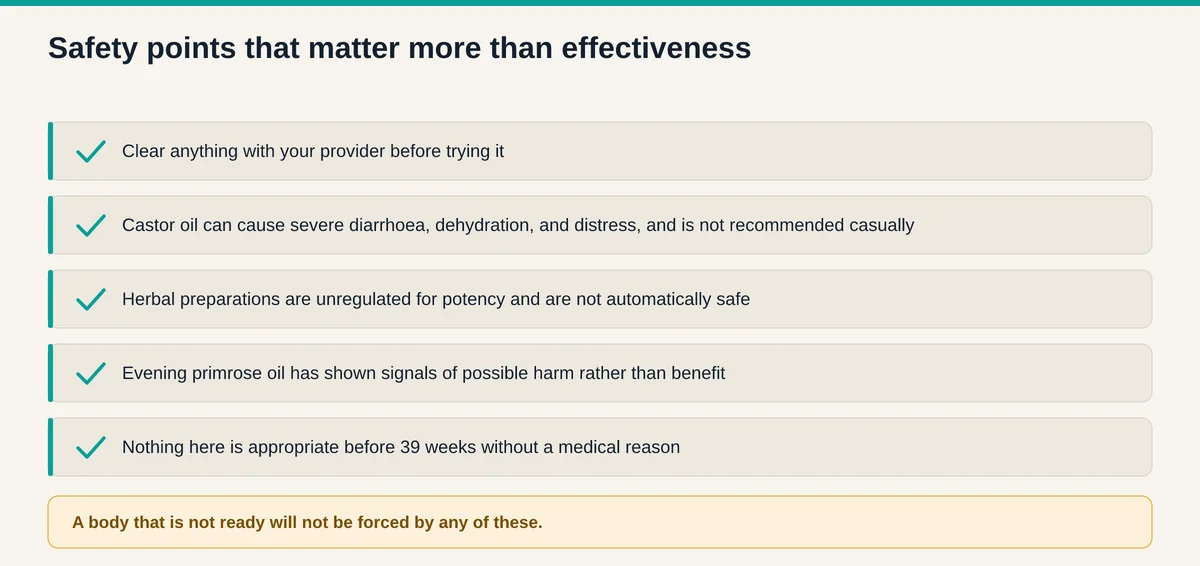
- Clear anything with your provider first, including foods and teas. What is reasonable at 39 weeks in a low-risk pregnancy may be a bad idea at 37 weeks, with a previous caesarean, with placenta previa, or with a growth-restricted baby.
- Never take herbal or oil preparations unsupervised. Supplements are not regulated for potency or purity, and "natural" carries no safety guarantee. Blue cohosh in particular has been linked to serious neonatal cardiac events and should not be used.
- Stop and call if anything unusual happens: bleeding, fluid loss, painful contractions that will not stop, or reduced fetal movement.
- Do not try to start labor before 39 weeks without a medical reason. Those last two weeks matter for lung and brain maturation.
The Bottom Line
Nipple stimulation has the best evidence among home methods, dates have modest support, castor oil has some support and real costs, and most of the rest are folklore with a mechanism attached after the fact. A body that is genuinely close to labor may be nudged; a body that is not will not be talked into it. If waiting is the hard part, it may help to see where you actually sit in the distribution using the labor probability calculator, or to read what actually influences spontaneous labor timing and what happens if you go past your due date. This is educational information only, not medical advice: talk to your provider before trying anything here.