What Affects When You Go Into Labor? 6 Key Factors Explained
Parity, cervical length, BMI, maternal age, fetal sex, and stress all influence labor timing. Here's what the research actually says about each.
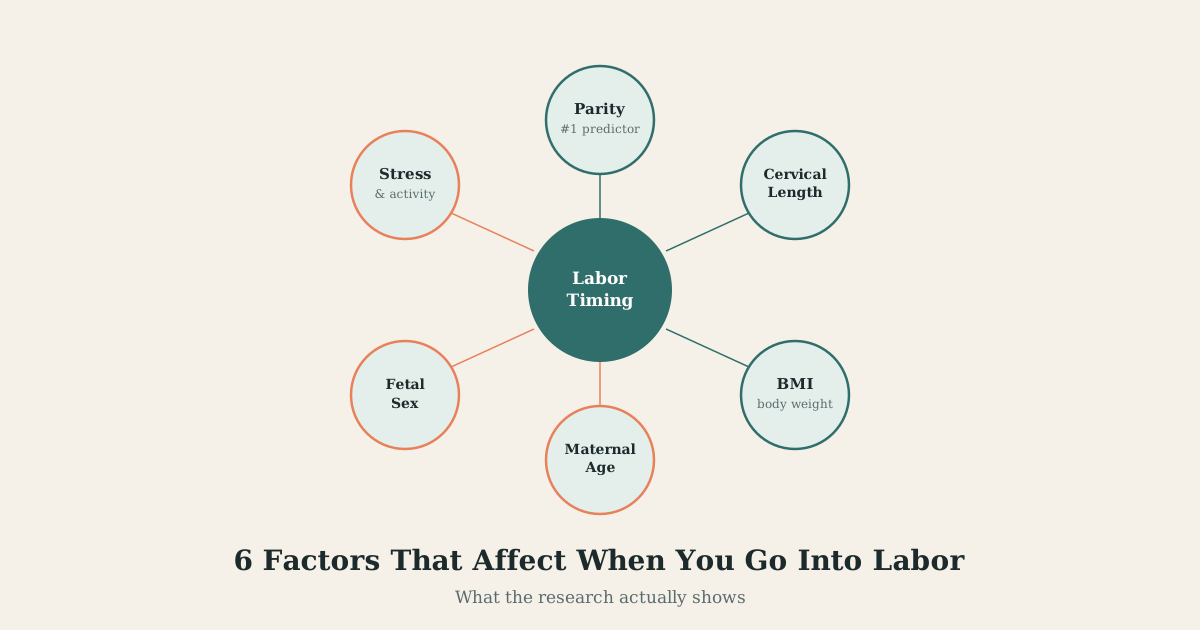
Spontaneous labor timing varies by roughly 5 weeks in normal pregnancies, from 37 to 42 weeks. That's a wide window. And it's not random. Researchers have identified at least 6 biological and physical factors that shift where in that window you're likely to land.
Here's what the data actually shows.
1. Parity: Your Strongest Predictor
Parity (whether you've given birth before) is the single most reliable predictor of labor timing in low-risk pregnancies.
First-time mothers (nulliparous) tend to deliver later than women who've had prior births. The cumulative probability of spontaneous labor by 40 weeks is about 74% for nulliparous women vs. 81% for multiparous women, based on the Jukic et al. 2013 study of 125 women with confirmed ovulation dates.
The difference is even clearer before 39 weeks. At 38 weeks, roughly 25% of first-time mothers have delivered spontaneously, compared to about 33% of women on their second or later pregnancies.
Why? The cervix and uterus in a first pregnancy are less "experienced." The lower uterine segment hasn't stretched before, and the cervix tends to start later in the ripening process. Women who've given birth before often begin their third trimester with a slightly more favorable cervical exam already.
If you want to see how parity changes your personal probability window, plug your details into the labor probability calculator to get a week-by-week breakdown.
2. Cervical Length (Ultrasound Measurement)
A cervical length measurement done via transvaginal ultrasound between 18 and 24 weeks is one of the more objective predictors of preterm birth risk, and it also correlates with overall labor timing at term.
A normal cervical length at 20 weeks is between 35 and 45 mm. A length under 25 mm before 24 weeks is associated with significantly elevated preterm birth risk. In the general population, fewer than 2% of women have a cervical length under 15 mm.
At term (37+ weeks), a shorter cervical length on ultrasound correlates with earlier spontaneous labor. Women entering the third trimester with a cervix already partially effaced and shortened tend to labor earlier than those with a long, closed cervix. This is part of why cervical exams in the final weeks, combined with Bishop scoring, have some (though imperfect) predictive value.
Cervical length measurement isn't typically repeated at 36 weeks in low-risk pregnancies, but your provider may note cervical changes on pelvic exam that suggest where you fall on this spectrum.
3. BMI and Delivery Timing
Higher pre-pregnancy BMI is consistently associated with later delivery and higher rates of post-term pregnancy.
A 2016 meta-analysis of over 1.6 million pregnancies found that women with obesity (BMI ≥ 30) had a 1.7x increased risk of going past 42 weeks compared to women with BMI 18.5–24.9. The association holds even after controlling for induction rates.
The mechanism isn't fully understood, but elevated estrogen levels in adipose tissue may interfere with the hormonal cascade that triggers labor. Leptin resistance, common in obesity, may also blunt the inflammatory signaling that contributes to cervical ripening.
On the other end, very low BMI (under 18.5) is associated with slightly earlier delivery on average. This isn't necessarily favorable; growth-restricted pregnancies and nutritional deficiencies are contributing factors in some of those early deliveries.
The practical takeaway: BMI is one factor, not destiny. But it's worth knowing that a higher BMI makes going past 40 weeks more statistically likely.
4. Maternal Age: Older Mothers Deliver Later
Women over 35 tend to have longer pregnancies than younger mothers. A 2014 Danish cohort study of 78,000 pregnancies found that women aged 35–39 had a 1.3x higher likelihood of going past 41 weeks compared to women aged 25–29.
This effect is partly explained by higher rates of first pregnancies at older ages (parity and age are intertwined), but maternal age appears to have an independent effect even among multiparous women.
The exact biology isn't settled, but age-related changes in uterine muscle contractility and cervical collagen remodeling are likely contributors. The uterus doesn't contract as efficiently in response to oxytocin in older myometrium, which also shows up in longer labor durations for women over 35.
If you're 35+ and planning your leave or logistics, it's worth knowing that your probability of still being pregnant at 40+4 or 40+5 is modestly higher than for a 28-year-old with the same parity.
5. Fetal Sex: Male Fetuses Mean Slightly Longer Pregnancies
This one surprises most people. Carrying a male fetus is associated with pregnancies that run about 1–2 days longer on average, and a modestly higher rate of post-term pregnancy.
A Norwegian registry study of over 2 million births (Basso et al. 2001) found that male fetuses were significantly more likely to be delivered at 42+ weeks than female fetuses. The adjusted odds ratio was 1.27: a 27% higher likelihood of post-dates.
The proposed mechanism involves the HY antigen (a male-specific fetal antigen) triggering different maternal immune responses, as well as differences in fetal cortisol production, which plays a role in signaling labor readiness. Male fetuses also tend to be slightly heavier at any given gestational age, which may contribute.
It's a small effect in absolute terms (1–2 days, not weeks). But it's a real and replicated finding, and it's included in research-based probability models for good reason.
6. Stress and Physical Activity
The relationship between psychological stress and labor timing is real but complicated.
Chronic prenatal stress elevates corticotropin-releasing hormone (CRH), a placental hormone that rises throughout pregnancy and appears to function as a "placental clock." Higher CRH levels earlier in pregnancy are associated with earlier delivery. A study by Hobel et al. (1999) found that elevated third-trimester stress scores correlated with shorter gestational duration.
However, the effect size is modest, and stress is hard to measure objectively. High-anxiety pregnancies don't reliably deliver early. The biology is probabilistic, not deterministic.
Physical activity shows a similarly nuanced picture. Regular moderate exercise (walking 30 minutes/day, prenatal yoga) is associated with on-time delivery and doesn't increase preterm labor risk in healthy pregnancies. Strenuous physical labor (the kind involved in physically demanding jobs) is weakly associated with preterm birth in some occupational studies, though confounders make this difficult to isolate.
Standing for more than 6 hours per day has a documented association with shorter cervical length. A meta-analysis of 29 studies found a relative risk of 1.26 for preterm birth in women with prolonged standing occupations.
None of this means you need to stop moving. It means that working a physically demanding job late into pregnancy is worth discussing with your provider, not because labor will definitely come early, but because the cumulative data suggests it's worth monitoring.
Putting It All Together
No single factor locks in your delivery date. But they compound.
A 38-year-old first-time mother with a BMI of 31 carrying a male fetus has a statistically different probability profile than a 29-year-old second-time mother with a BMI of 22 carrying a girl. The first scenario pushes toward the later end of the distribution. The second pushes toward earlier.
For more on how these factors interact with week-by-week statistics, see labor probability by week: the statistics behind when babies arrive and first-time vs. second pregnancy labor differences.
You can also run your own probability estimate based on your specific parity and gestational week. It won't account for every biological variable, but it gives you a data-grounded picture of where you stand.
The research is clear on one thing: the 40-week due date is the midpoint of a normal distribution, not a deadline. Most healthy pregnancies land somewhere in a 3-week window on either side of it, and your individual factors shape exactly where.
For more context on how due dates are calculated and how accurate they really are, see our breakdown on due date accuracy. And if you're curious about the team behind this tool, visit our about page.