How to Time Contractions Correctly
Time from the start of one contraction to the start of the next, not the gap between them. Here is the correct method, the 5-1-1 rule, and the mistakes that mislead.
Most people time contractions wrong on the first try, and the mistake is understandable. When you are the one having the contraction, the part you notice is the break in between, so that is what gets written down. Unfortunately it is the wrong number, and it is the number triage nurses will ask you for.
The good news is that the correct method takes about two minutes to learn and works with nothing more than a clock and a piece of paper.
Check how likely labor is this week based on your gestational age and parity before you start counting.
Frequency and Duration Are Two Different Measurements
There are exactly two numbers that matter, and they are measured differently.
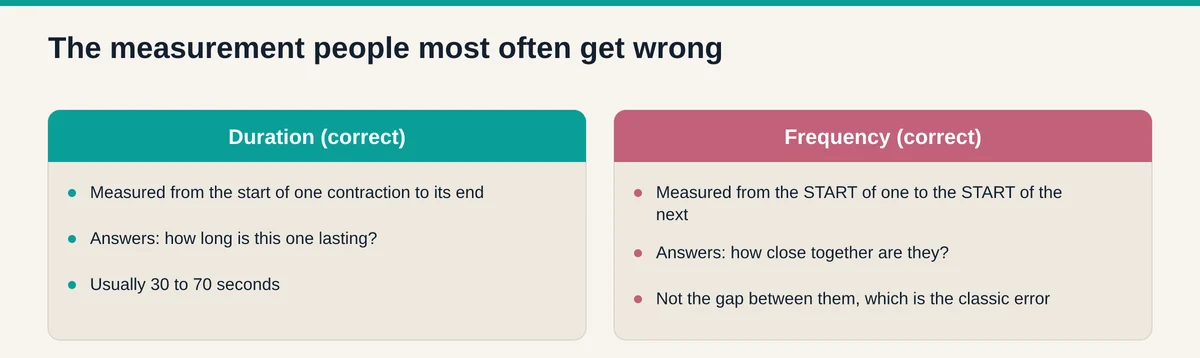
Frequency is start-to-start. When a contraction begins, note the time. When the next contraction begins, note that time too. The difference is your frequency. If one started at 2:00 and the next started at 2:07, your contractions are seven minutes apart.
Duration is beginning-to-end of a single contraction. From the moment you feel the tightening begin to the moment your belly is fully soft again. Early labor contractions often run about 30 to 45 seconds. As labor progresses they lengthen toward 60 to 90 seconds.
Critically, frequency includes the contraction itself. A contraction lasting 60 seconds with a four-minute rest afterward is a five-minute frequency, not four.
The Mistake Almost Everyone Makes
The classic error is timing the rest period: the gap from the end of one contraction to the start of the next.
Here is why it matters so much. Suppose your contractions last 90 seconds with three minutes of rest between them. Timed the wrong way, you report "three minutes apart." Timed correctly, they are four and a half minutes apart. That is a real difference, but it errs in the safe direction.
The dangerous version is the reverse. Early in labor, contractions are short. A 30-second contraction with a four-and-a-half-minute rest is a five-minute frequency, which meets the threshold most providers use. Reported as the gap, it sounds like four and a half minutes and roughly matches, so the error is small early on.
The error grows as contractions lengthen, which is exactly when the number matters most. Late in active labor, contractions can last 90 seconds or more, and the rest period shrinks dramatically. If you are only tracking the gaps, your log will look like the pattern has plateaued when it is actually intensifying.
Rule of thumb: if you find yourself hitting "stop" and then waiting to hit "start," you are timing the right thing. If you hit "start" only when the break begins, you are timing the wrong thing.
The 5-1-1 Rule
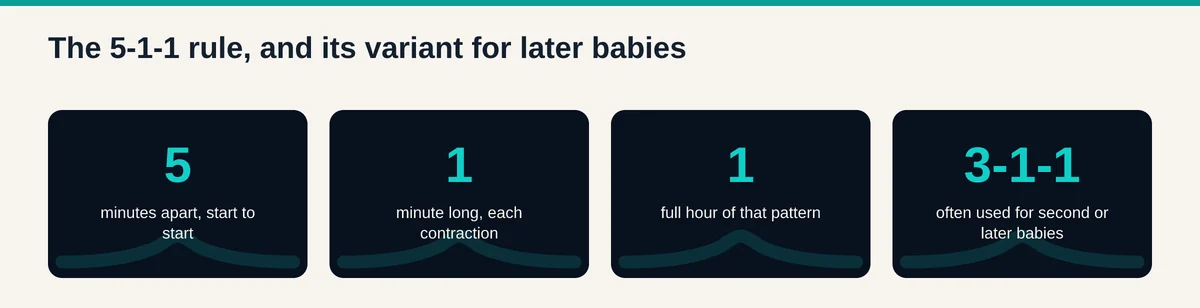
The most widely used threshold for when to head to the hospital is 5-1-1:
- Contractions every 5 minutes, measured start to start
- Each lasting at least 1 minute
- Sustained for at least 1 hour
All three conditions have to be true at once. Contractions every five minutes lasting 30 seconds is not 5-1-1. Neither is one strong hour after a pattern that has been all over the place, if the following hour falls apart.
The one-hour requirement exists specifically to filter out the false alarms. Plenty of contraction patterns look convincing for 20 minutes and then dissolve. If you are unsure whether you are watching real labor or practice contractions, our comparison of Braxton Hicks and real contractions covers the position, hydration, and movement tests that separate them.
The 3-1-1 Variant and Other Adjustments
Not everyone gets the same threshold, and you should ask your provider which one applies to you.
3-1-1 for second and subsequent babies. Multiparous labor is often significantly faster, particularly in the active phase, so many providers ask second-time parents to come in when contractions are three to four minutes apart rather than waiting for five. Some use a simpler instruction: come in as soon as the pattern is clearly regular and painful. Our comparison of first-time versus second pregnancy labor explains why the timelines differ.
Distance to hospital. If you are 60 minutes from your birth location, your provider may move the threshold earlier regardless of parity.
Prior fast labor. A previous delivery under four hours often means you are told to come in at the first regular pattern.
Risk factors. GBS-positive status requiring antibiotics, a prior cesarean, planned pain relief, or any pregnancy complication can all shift the instruction earlier.
Written thresholds are defaults. What your own provider told you at your last appointment overrides anything on the internet, including this page.
How Long to Track Before Drawing a Conclusion
A single contraction tells you nothing. A handful tells you very little. The pattern is the diagnosis.
Track at least six consecutive contractions before forming any opinion, and ideally a full hour. Six gives you five frequency intervals, which is enough to see whether the spacing is genuinely tightening or just noisy.
Then look at the trend across the hour, not the individual numbers. Real labor shows a direction: intervals shrinking, durations lengthening, intensity climbing. Random variation shows scatter without direction.
Why a single 40-minute window misleads. Early labor is naturally irregular. It is entirely normal to get three contractions five minutes apart followed by a 20-minute gap. If your window happens to catch the tight cluster, you conclude you are in active labor. If it catches the gap, you conclude nothing is happening. Both readings come from the same labor, 40 minutes apart. Widen the window and the noise averages out.
The same problem runs in reverse. Contractions often space out when you lie down to sleep and pick up again when you get up. A pattern measured entirely in bed at 3am can look far weaker than the same labor measured while walking around.
Apps Versus Paper
Both work. The choice matters less than using the method correctly.
Contraction timer apps have one real advantage: you press one button at the start and one at the end, and the app computes frequency and duration for you. That removes the arithmetic error entirely, which is the whole problem. Most also produce a summary you can show triage.
Their weakness is accidental input. Falling asleep with the timer running, or forgetting to press stop, produces a 40-minute contraction in the log and skews the averages. Delete obvious errors rather than leaving them in.
Paper works perfectly well and is what hospitals used for decades. Draw three columns: start time, end time, and notes. Compute duration and start-to-start frequency afterward. The act of writing also keeps you engaged with the trend, which is what you are actually trying to read.
Whichever you use, add a short intensity note for each one: mild, moderate, or "could not talk through it." Intensity progression is a genuine signal, and it is the thing apps cannot capture.
What a Real Timing Log Looks Like as It Progresses
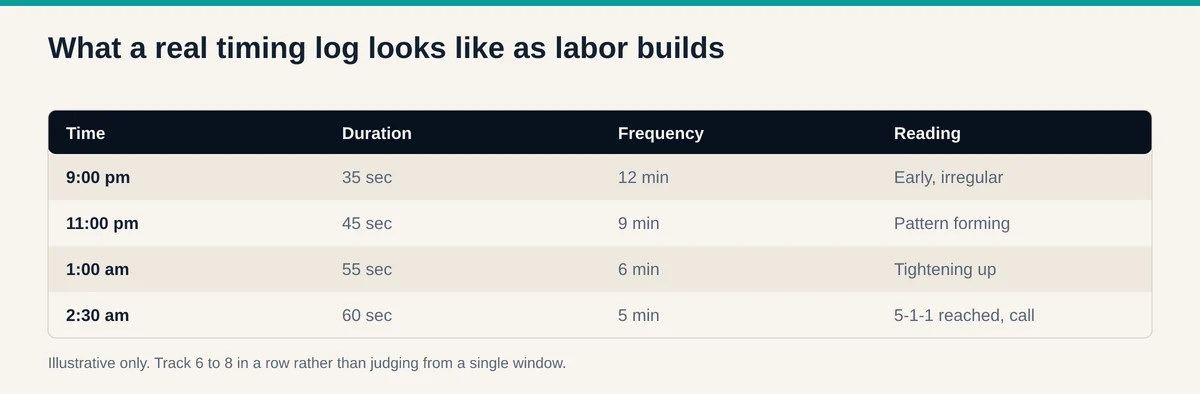
A log that is genuinely progressing tends to look something like this.
Early labor, hours 1–3:
- Frequency 10–20 minutes, irregular
- Duration 30–45 seconds
- Intensity mild; you can talk and walk through them
Early labor, hours 3–6:
- Frequency 7–10 minutes, becoming more consistent
- Duration 40–60 seconds
- Intensity moderate; you pause at the peak
Approaching active labor:
- Frequency 4–6 minutes, clearly regular
- Duration 60–75 seconds
- Intensity strong; talking through the peak is not possible
Active labor:
- Frequency 2–4 minutes
- Duration 60–90 seconds
- Intensity strong, requiring full attention and breathing
These ranges are typical rather than universal, and the hour counts vary enormously. What generalizes is the shape: all three columns move together. If frequency tightens but duration and intensity stay flat for hours, you may be looking at prodromal labor rather than progressing labor.
When to Stop Timing and Just Call
Timing is a tool, not an obligation. Put the timer down and call your provider if:
- Contractions meet whatever threshold your provider gave you
- Your water breaks, gush or trickle, contractions or not. See what to expect when your water breaks
- You have bright red bleeding, more than a small amount of blood-tinged mucus
- Fetal movement decreases
- You are under 37 weeks with six or more contractions in an hour
- The pain is constant with no relaxation between contractions
- You feel an urge to push
- Something feels wrong, whatever the numbers say
Once contractions demand your full attention, someone else should take over the timing. Trying to run a stopwatch through active labor is not a good use of your focus.
The Bottom Line
Frequency is start-to-start, duration is beginning-to-end, and the gap between contractions is not a number anyone will ask you for. Track at least six in a row, look at the trend over a full hour rather than a short window, and use whichever threshold your provider gave you rather than a generic rule. This is educational information, not medical advice, and a call to triage is always a reasonable choice.
Estimate your personal labor window, or see the fuller list of signs labor is coming in the next 48 hours.