Braxton Hicks vs Real Contractions: The Difference
Braxton Hicks stop when you move, hydrate, or rest. Real labor contractions keep coming and get closer together. Here is how to test the difference at home.
This is the question that sends more people to labor and delivery triage than any other. It is also one of the few labor questions with a genuinely useful home test, because the two types of contraction respond very differently to simple things like walking, lying down, and hydrating.
Nobody, including experienced midwives, can reliably tell them apart from a single contraction. The difference lives in the pattern over an hour or two, not in one squeeze.
Check your probability of going into labor this week using your gestational age and birth history for context on how likely real labor actually is right now.
What Braxton Hicks Contractions Actually Are
Your uterus is a muscle, and like any muscle it contracts intermittently rather than sitting perfectly still for nine months. Braxton Hicks contractions are those intermittent tightenings: the uterine muscle fibers shorten, the belly firms up, and then everything relaxes again.
They are named after John Braxton Hicks, the English physician who described them in the 1870s. They are often called "practice contractions," which is a reasonable shorthand. The uterus is toning itself, and the contractions may improve blood flow through the placental bed.
The key physiological difference from labor contractions is coordination. In true labor, contractions start at the top of the uterus (the fundus) and sweep downward in an organized wave, generating enough sustained pressure to pull the cervix open. Braxton Hicks are patchy and uncoordinated. They squeeze, but they do not do meaningful cervical work.
When They Start and Why They Get Worse Later
Braxton Hicks activity can be detected on monitoring from around the second trimester, but most people do not notice anything until roughly 20 to 28 weeks. First-time mothers often do not recognize them until later, sometimes not until the third trimester, simply because there is no prior experience to compare against.
They typically become more frequent and more noticeable as pregnancy advances, for a few reasons:
- The uterus is much larger and more muscular, so each contraction is easier to feel
- The number of oxytocin receptors in the uterine muscle rises steadily in late pregnancy
- Gap junctions between muscle cells increase, so contractions become better coordinated over time
- The baby is bigger and pressing outward, making tightening more obvious
By 36 to 39 weeks, many people have several noticeable episodes a day. This is one reason the third trimester feels like a constant series of false alarms: the practice contractions genuinely are getting stronger, they are just not yet doing the job.
How Each One Feels
Descriptions vary a lot between individuals, but some patterns hold.
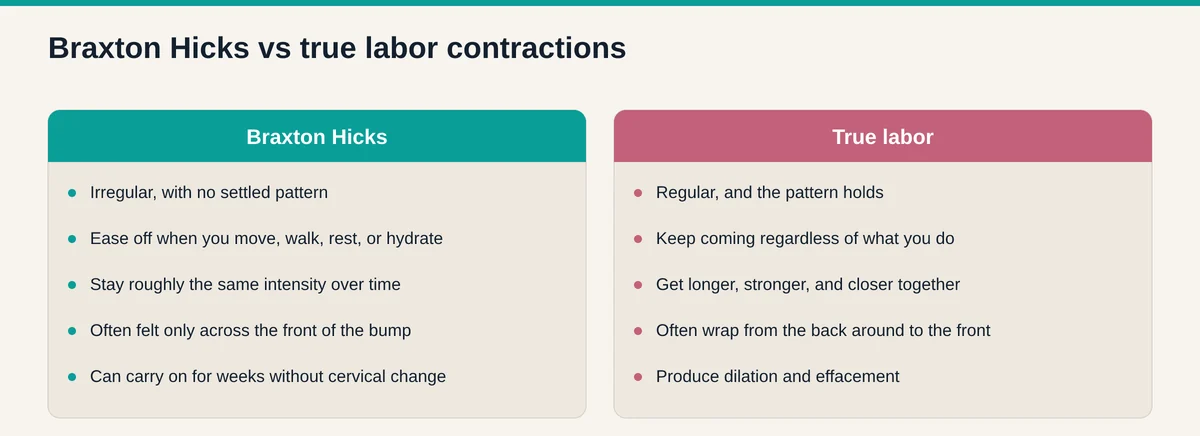
Braxton Hicks typically feel like:
- A tightening or hardening across the front of the belly
- Pressure rather than pain, though they can be genuinely uncomfortable
- Localized to the abdomen, often one area more than another
- Short: usually 15 to 30 seconds, sometimes up to a couple of minutes
- Something you can talk, walk, or watch television through
Real labor contractions typically feel like:
- A wave that builds, peaks, and fades
- Pain that often starts in the lower back and wraps around to the front
- Deep pelvic pressure that intensifies with each one
- Longer as they progress: 30 seconds early on, building toward 60 to 90 seconds
- Something that stops you mid-sentence at the peak
The "wraps around from the back" description is one of the more useful discriminators people report, though back-dominant labor is not universal and its absence does not rule labor out.
The Position, Movement, and Hydration Tests
This is the practical part. Braxton Hicks are responsive to what you do. Labor contractions are not.
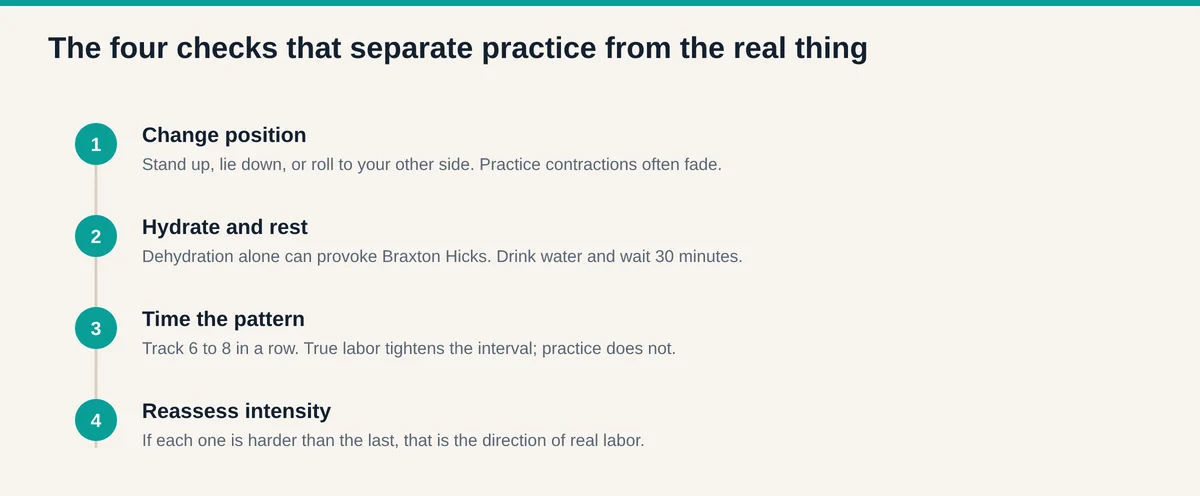
Change position. If you have been on your feet, lie down on your left side. If you have been sitting or lying still, get up and walk. Braxton Hicks often stop within 10 to 20 minutes of a position change. True labor contractions usually continue, and walking often makes them stronger rather than weaker.
Drink water. Mild dehydration can trigger irritable uterine activity. Drink two to three large glasses of water and wait 30 to 60 minutes. A surprising number of "am I in labor" episodes settle after hydration alone.
Take a warm bath or shower. Warm water relaxes smooth muscle and frequently quiets Braxton Hicks. If contractions survive 20 to 30 minutes in a warm bath and keep their rhythm, that is meaningful.
Empty your bladder. A full bladder can provoke uterine irritability, especially late in pregnancy.
Rest and eat something. Fatigue and low blood sugar both contribute to irritable contractions.
If contractions persist through all of the above and keep tightening their spacing, treat that as early labor rather than practice.
The Numbers: Pattern Comparison
Here is the side-by-side that matters most, because the pattern is more diagnostic than the sensation.
Braxton Hicks:
- Frequency: irregular, unpredictable. 3 in ten minutes, then nothing for two hours
- Duration: usually 15–30 seconds, inconsistent from one to the next
- Intensity: stays roughly the same or fades over time
- Spacing trend: does not shorten in any consistent direction
- Response to activity: usually stops with rest, hydration, or position change
- Location: front of the abdomen, often localized
True labor contractions:
- Frequency: increasingly regular. 10 minutes, then 8, then 6, then 5
- Duration: lengthening, from about 30 seconds toward 60–90 seconds
- Intensity: clearly increasing hour over hour
- Spacing trend: consistently shortening
- Response to activity: continues or intensifies with walking
- Location: often lower back radiating to the front, with pelvic pressure
The single most reliable marker is progression. Labor contractions get longer, stronger, and closer together. Braxton Hicks do not follow that trajectory, no matter how uncomfortable they are.
If you are going to time anything, time it properly. Our guide on how to time contractions correctly covers the start-to-start method and the 5-1-1 rule, and explains why counting the gaps between contractions is the most common timing mistake.
When "Practice" Contractions Are Actually Prodromal Labor
There is a frustrating middle category that does not fit either box neatly.
Prodromal labor produces contractions that are regular, sometimes 5 to 15 minutes apart, and can be genuinely painful. They may go on for hours, occasionally for several nights in a row. They pass every "this feels real" test except one: they do not progress, and they stall out rather than tightening into an active pattern.
Prodromal labor is not the same as false labor, and it is not nothing. It often does produce some cervical change, particularly effacement, and it may be doing preparatory work such as helping the baby rotate into a better position. It is more common when the baby is in a posterior position.
The distinguishing feature is time. Braxton Hicks fade within an hour or two. Prodromal labor can run four to eight hours or longer and then simply stop, often at night, and often restarting the following evening.
If you are having repeated prodromal episodes, it is worth calling your provider during business hours, not because it is an emergency but because exhaustion is a real risk and there are practical strategies. Our article on when labor actually starts goes deeper into where the line sits between prodromal and active labor.
Red Flags That Mean Call Regardless
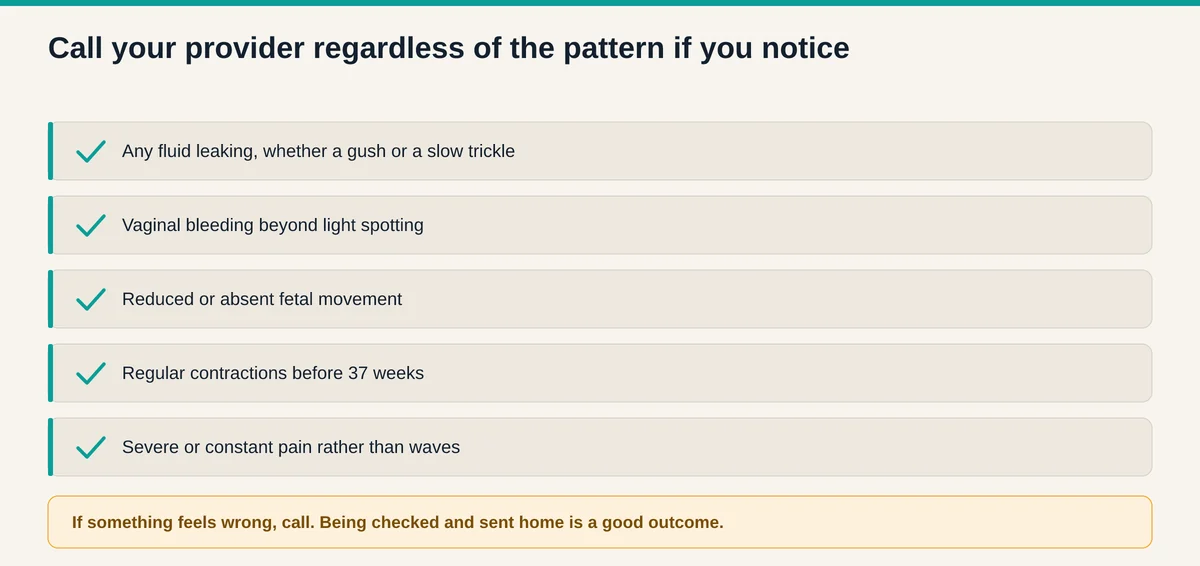
The Braxton Hicks question becomes irrelevant if any of the following are present. Call your provider or go in, regardless of what the contraction pattern looks like:
- Any vaginal bleeding beyond a small amount of blood-tinged mucus. Bright red bleeding or soaking a pad needs immediate evaluation
- Fluid leaking, whether a gush or a persistent trickle. See our guide on water breaking and when to call for how to tell amniotic fluid from urine or discharge
- Reduced fetal movement. This is never something to time and observe. Call now
- Regular contractions before 37 weeks. Preterm labor is the one scenario where the standard "wait and see if it settles" advice does not apply. Six or more contractions in an hour before 37 weeks warrants a call
- Severe headache, visual changes, upper abdominal pain, or sudden swelling, which can signal preeclampsia
- Constant pain with no relaxation between contractions, or a rigid, board-like abdomen
- A prior cesarean with strong or unusual pain
Triage staff would far rather assess you and send you home than have you talk yourself out of coming in. Being sent home is a normal, expected outcome, not a failure.
The Bottom Line
Braxton Hicks are irregular, usually shorter, and they respond to rest, hydration, and movement. Real labor contractions ignore all of that and get progressively longer, stronger, and closer together. Give yourself an hour of observation with a position change and some water before deciding, and time contractions from the start of one to the start of the next rather than counting gaps. Any bleeding, fluid leak, reduced fetal movement, or regular contractions before 37 weeks means call regardless. This is educational information, not medical advice, and your provider knows your specific pregnancy.
Estimate your personal labor window, or read our breakdown of 7 signs labor is coming in the next 48 hours for the fuller picture.