VBAC: How Labor Timing Works After a Previous Cesarean
Most people with one prior low-transverse cesarean are candidates for a trial of labor. Here is how success odds, timing, and the 39 to 41 week window work.
If you had a cesarean and want a vaginal birth this time, the timing question becomes more loaded than it is for other pregnancies. Waiting for labor to start on its own is genuinely worth something here, and the tools normally used to speed things up are used more cautiously.
Here is how the pieces fit together, and where the real decisions sit.
TOLAC and VBAC Are Not the Same Word
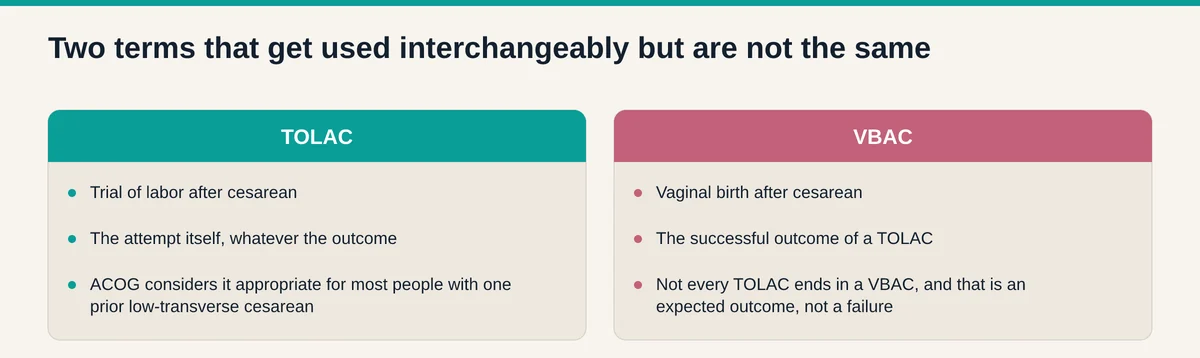
TOLAC stands for trial of labor after cesarean. It is the attempt: you plan to labor, and you and your provider see how it goes.
VBAC stands for vaginal birth after cesarean. It is the outcome: a TOLAC that ends in a vaginal delivery.
The distinction matters because every published "success rate" is really the share of TOLACs that become VBACs. A TOLAC that ends in a repeat cesarean is not a failure of planning. It is one of two expected outcomes, and the plan is built to handle both.
The alternative to TOLAC is a planned repeat cesarean, usually scheduled at 39 0/7 to 39 6/7 weeks in an uncomplicated pregnancy. Choosing between the two is a counseling conversation that should happen well before you are contracting.
Who Is Generally a Candidate
ACOG's guidance is that most patients with one prior low-transverse cesarean are candidates for TOLAC. Many patients with two prior low-transverse cesareans may also be candidates, though the counseling is more individualized.
The uterine incision type, not the skin incision, is what matters. A low-transverse incision in the lower uterine segment carries the lowest rupture risk. A classical (vertical) or T-shaped incision carries a substantially higher risk and is generally considered a contraindication to labor. If you do not know which you had, request the operative report from your prior delivery. It is a specific document and it is worth chasing down.
Other factors that typically rule TOLAC out include a prior uterine rupture, certain extensive uterine surgeries, and any standard obstetric contraindication to vaginal delivery such as placenta previa.
ACOG also advises that TOLAC take place where staff and facilities for emergency cesarean are available. In practice this is why some smaller hospitals do not offer it, and why "am I a candidate" and "does my hospital offer it" are two separate questions to ask.
What the Success Numbers Look Like
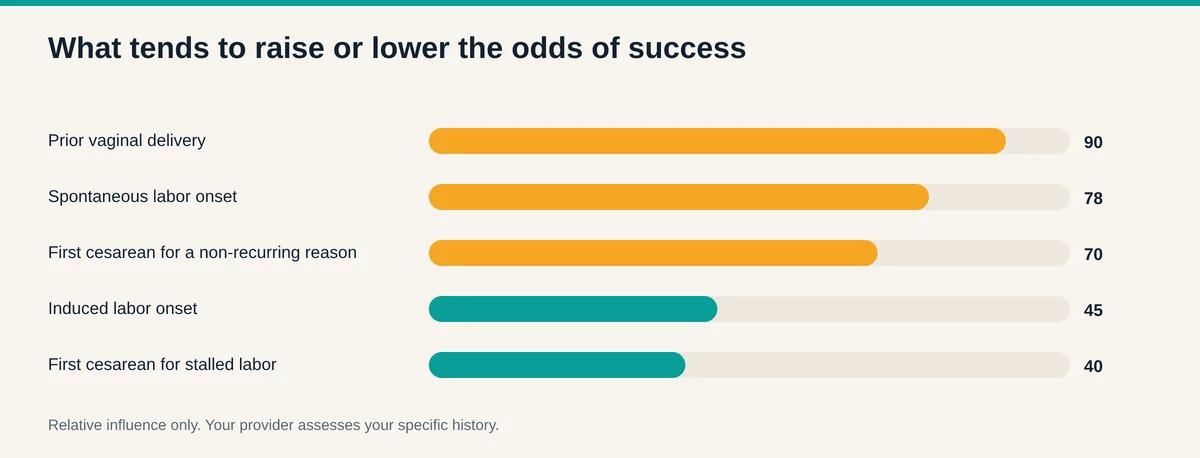
Published VBAC success rates commonly fall in the 60 to 80 percent range. That is a wide band because the population inside it varies enormously.
Factors associated with higher success:
- A prior vaginal delivery, especially a prior successful VBAC. This is generally the strongest positive predictor in the literature.
- A non-recurring indication for the first cesarean, such as breech presentation or a non-reassuring fetal heart tracing. Those reasons do not necessarily repeat.
- Spontaneous labor onset rather than induction.
- A favorable cervix on admission. Arriving already dilated and effaced is a meaningfully better starting position, and our post on cervical dilation and labor covers what those numbers describe.
Factors associated with lower success:
- A recurring indication, particularly labor arrest or failure to progress in the first cesarean.
- Induction or augmentation of labor.
- Higher maternal BMI and higher maternal age.
- Advancing gestational age past 40 weeks.
- A larger estimated fetal weight.
- A short interval between deliveries.
Several validated prediction models exist that combine these inputs into an individualized estimate, and many practices use one during counseling. Ask whether yours does. A personalized number is far more useful to you than the 60 to 80 percent band.
Why Spontaneous Onset Matters More Here
For a typical pregnancy, whether labor starts on its own or is induced changes the experience and modestly changes the cesarean rate. Our post comparing induction and spontaneous labor covers that general picture.
For VBAC, spontaneous onset carries extra weight for two reasons.
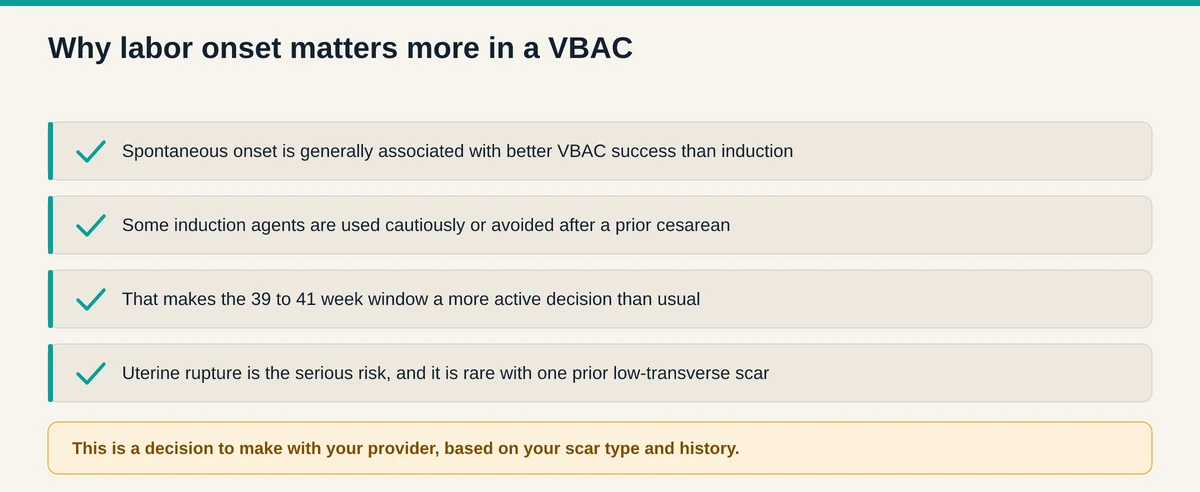
First, success odds. Spontaneous labor is consistently associated with higher VBAC success than induced labor across the published literature. A cervix that has ripened on its own is signaling readiness in a way that no external agent fully reproduces.
Second, rupture risk. Induction and augmentation, particularly with prostaglandins, are associated with somewhat higher rates of uterine rupture in patients with a prior cesarean than spontaneous labor is. The absolute risk stays low, but the direction of the effect is consistent enough to shape practice.
So the calculus tilts toward waiting. Not indefinitely, and not at any cost, but with more patience than you might see in a first pregnancy.
Uterine Rupture: Rare, and Taken Very Seriously
This is the risk that drives the entire structure of VBAC care.
Uterine rupture is a separation of the prior uterine scar during labor. With one prior low-transverse incision, the commonly cited risk is well under 1 percent, generally reported in the range of roughly 0.5 to 0.9 percent. With a prior classical incision the risk is several times higher, which is why labor is not offered.
Two things are true at once. It is uncommon, and when it happens it is an emergency for both you and the baby, requiring immediate delivery. That combination is why TOLAC involves continuous fetal monitoring, an anesthesia and surgical team within reach, and a low threshold for moving to the operating room.
For context, a planned repeat cesarean is not risk-free either. It carries surgical risks and raises the risk of abnormal placentation in future pregnancies, which is one reason the number of children you hope to have belongs in this conversation.
Epidural analgesia is not a contraindication in TOLAC and does not meaningfully mask the signs of rupture. If you want one, you can have one.
Why Providers Are Careful With Induction Agents
If induction becomes necessary during a TOLAC, the method matters.
Misoprostol is not used for cervical ripening or induction at term in patients with a prior cesarean or major uterine surgery, because of the associated rupture risk. This is one of the more firmly held positions in the guidance.
Mechanical ripening, such as a transcervical Foley balloon, and oxytocin are the methods more commonly used, with careful titration and continuous monitoring. Some providers use other prostaglandin agents more selectively, and practice varies.
None of this means induction is off the table. It means the menu is shorter and the pace is slower. If your provider proposes induction for a medical reason, ask which agent, why that one, and how it changes your individual success estimate.
How the 39 to 41 Week Window Is Usually Managed
In an uncomplicated pregnancy planning a TOLAC, the common approach is to allow spontaneous labor and to hold a backup date for a repeat cesarean somewhere in the 40 to 41 week range, with the exact timing individualized.
The tension is real. Waiting longer gives spontaneous labor more chances to start, which favors VBAC. But VBAC success declines modestly past 40 weeks, and the general considerations that apply to any post-dates pregnancy still apply here.
One note on the evidence: the ARRIVE trial, which is often cited to support elective induction at 39 weeks, enrolled low-risk first-time mothers and did not include patients with a prior cesarean. Its conclusions do not transfer directly to VBAC planning, and it should not be quoted at you as though they do.
Practical questions worth asking at your 36 to 37 week visit:
- What is my individualized VBAC success estimate, and what is it based on?
- How long past my due date are you comfortable waiting?
- Under what circumstances would you recommend induction rather than a repeat cesarean?
- What is the plan if my water breaks but contractions do not start?
The Bottom Line
Most people with one prior low-transverse cesarean can reasonably attempt labor, with VBAC success typically reported in the 60 to 80 percent range and uterine rupture risk well under 1 percent. Spontaneous labor onset improves success odds and carries lower rupture risk than induction, which is why the 39 to 41 week window is usually managed with patience and a held backup date rather than an early induction. Get your operative report, ask for an individualized estimate, and confirm your hospital offers TOLAC. This is educational information, not medical advice, and your obstetric provider is the one who can apply it to your history.
You can estimate your week-by-week odds of spontaneous labor for a general sense of timing, though the model reflects general-population data and does not adjust for a prior cesarean.