Hospital Bag Checklist: What to Pack and What to Skip
Most hospital bag lists are twice as long as they need to be. Here is what to pack in three bags, what the hospital already supplies, and what people wish they had brought.

The standard hospital bag list circulating online has somewhere between 60 and 90 items on it. You will use maybe half. The other half either duplicates something the hospital hands you for free or sits in a bag on the floor of a room where you have very little floor space to begin with.
The useful version of this list is shorter, more specific, and organized around when you actually need each thing. Policies differ by hospital, so one phone call to your labor and delivery unit will settle most of the questions below faster than any article can.
Pack Three Bags, Not One
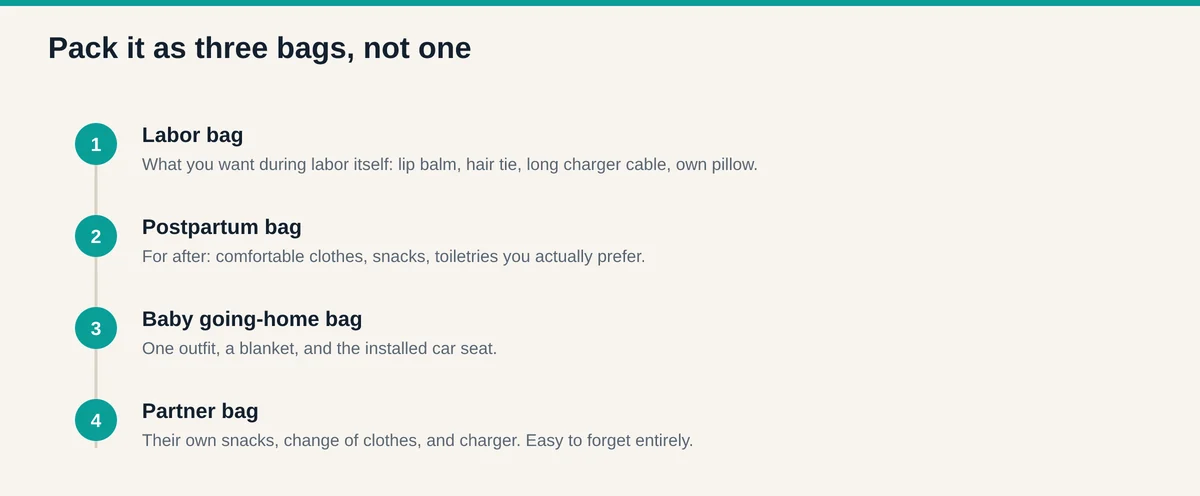
A single large suitcase is the most common packing mistake. Postpartum rooms are small, and during labor you do not want your partner digging through 40 items to find lip balm.
Split it up:
- The labor bag. Small, light, goes into the room with you. Contains only what you might want during labor itself.
- The postpartum bag. Everything for the 24 to 72 hours after delivery. This can stay in the car and get retrieved once you are moved to a recovery room.
- The baby's going-home bag. Genuinely tiny. One outfit, one blanket, one hat.
The car seat is a separate category, and it does not live in a bag. More on that below.
What the Hospital Almost Certainly Gives You
In most US hospitals, the following are stocked in your room or handed to you on arrival, and packing them is wasted space:
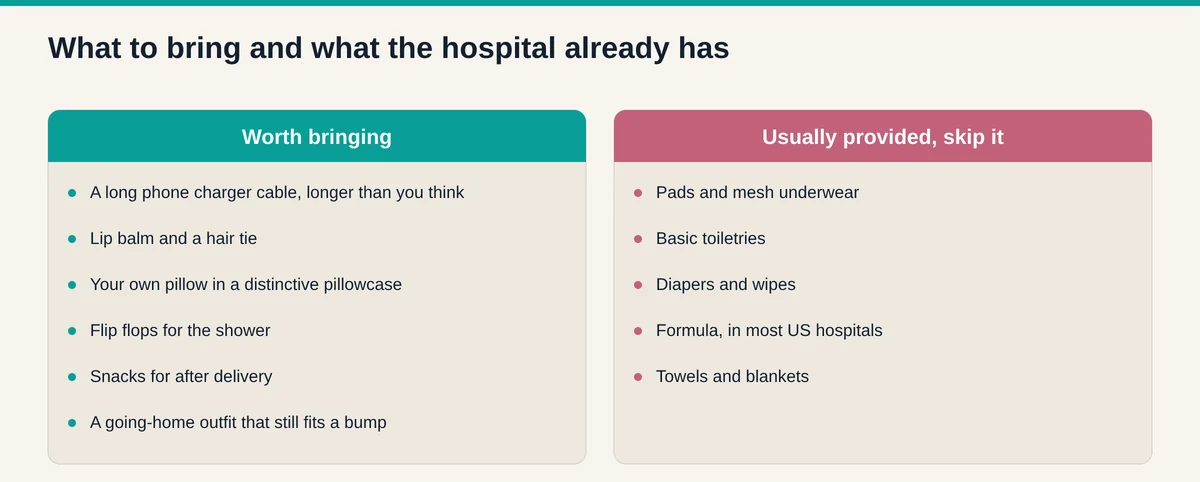
- Maternity pads. The industrial hospital ones are larger and more absorbent than anything you would buy. Take the extras home.
- Mesh underwear. Yes, the famous ones. Ask for more. They are free and disposable.
- Perineal ice packs and peri bottle. Standard postpartum supplies in nearly every unit.
- Basic toiletries. Soap, shampoo, toothbrush, toothpaste, comb, and often deodorant.
- Gowns, robes, and towels. You are welcome to wear your own, but you do not have to bring any.
- Diapers, wipes, and swaddle blankets for the baby. For the entire stay.
- Formula, if you use it. Most US hospitals stock ready-to-feed newborn bottles.
- Breast pump access and a lactation consultant. Usually a hospital-grade pump in the room on request.
What varies more: whether your hospital allows you to eat during labor, whether it provides nipple cream, whether partners get meals, and whether there is a fridge or a pull-out bed in the room. Those four questions are worth asking at a prenatal visit around 34 to 36 weeks.
Bag One: Labor and Delivery
Labor is not the time you want to be rummaging. Keep this bag under about 10 items.
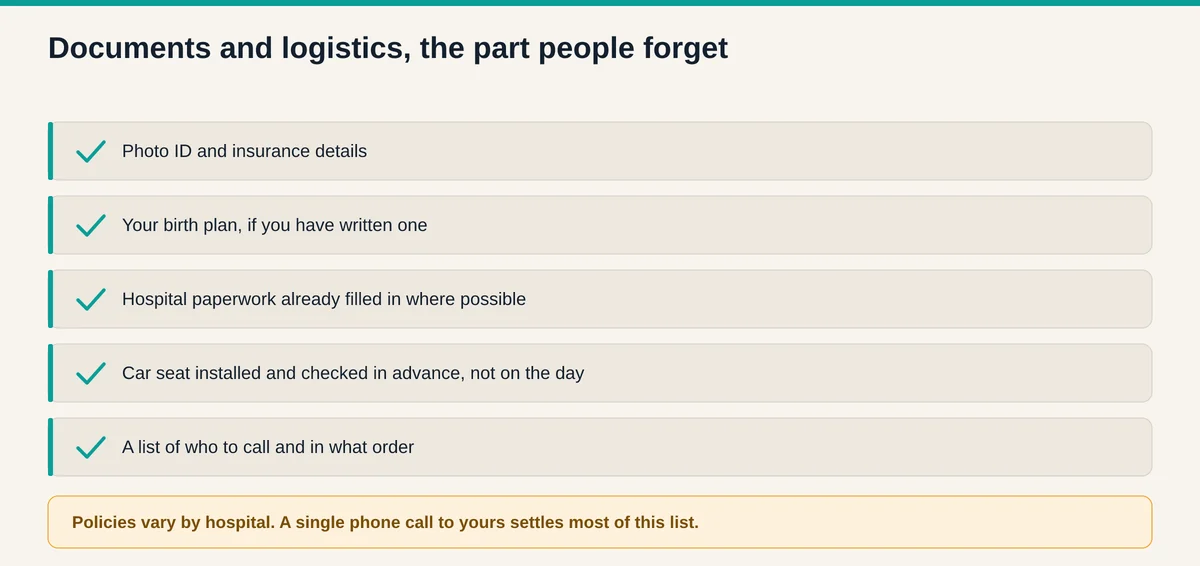
- Photo ID and insurance card. These come out first at check-in.
- A long phone charging cable. Ten feet, not three. Hospital outlets are rarely near the bed, and a short cable means your phone charges on a counter across the room.
- Lip balm. The single most frequently mentioned item in "wish I had brought" lists. Breathing through contractions, plus dry hospital air, plus limited fluids, means chapped lips within hours.
- A hair tie or two, plus a claw clip. Bring more than one. They vanish.
- Your own pillow in a patterned or colored pillowcase. White cases get swept into hospital laundry and never come back.
- Flip flops or slides. For the shower and for walking the halls in early labor.
- A robe or oversized cardigan. Useful if you want to walk around, and warmer than a hospital gown.
- Headphones or a small speaker. For music, a playlist, a hypnobirthing track, or just something other than monitor beeping.
- Hard candy or lozenges. Many units restrict food during active labor but allow ice chips and hard candy. Ask yours.
- A one-page birth plan, printed. One page. Nurses read one page.
Skip the diffuser, the fairy lights, the labor gown you bought online, and the extensive massage tool kit unless you have specifically practiced with them. Most people do not touch any of it.
Bag Two: Postpartum, For You
This is the bag that matters most, because the postpartum stay is longer than the labor for many people. Typical stays run about 24 to 48 hours after a vaginal birth and 48 to 96 hours after a cesarean.
- Two or three pairs of high-waisted, dark cotton underwear. For after you tire of the mesh. High-waisted matters enormously if you have a cesarean incision.
- A nursing bra or a soft, stretchy bralette. Skip underwire.
- Loose, dark, front-opening pajamas or a nursing nightgown. Front-opening is the operative word for feeding and skin-to-skin.
- Your own toiletries if hospital soap bothers your skin. Plus a hairbrush, dry shampoo, and any face products that make you feel human.
- Snacks for after delivery. This is the item people are most emphatic about. Delivery frequently happens in the middle of the night, hospital kitchens close, and you may be genuinely ravenous at 3 a.m. with nothing available but graham crackers. Pack real food: protein bars, nuts, jerky, dried fruit, electrolyte drinks.
- A phone, a charger, and something to read or watch. There is more sitting and waiting than most people anticipate.
- Any prescription medications you take, in their original bottles, plus your glasses or contacts and case.
- A going-home outfit that fits a body that still looks about six months pregnant. This one catches people off guard. Your uterus takes weeks to involute. Bring the loosest thing you own: a maternity dress, joggers, or the leggings you have been wearing all trimester.
Bag Three: Baby and Going Home
Newborn packing lists are wildly inflated. The hospital supplies the diapers, wipes, and blankets. You need:
- One or two going-home outfits, one in newborn size and one in 0 to 3 months, because birth weight is hard to predict.
- A hat and a pair of socks or booties, depending on season.
- One swaddle or receiving blanket of your own, mostly for photographs and the car.
- A car seat, installed.
That is genuinely most of it. Everything else the baby needs during the stay is in the room already.
The Car Seat Is Not Optional, and It Is Not Last-Minute
Hospitals in the US will not discharge a newborn without a car seat, and staff typically want to see it before you leave. Install it well before you go into labor. The National Highway Traffic Safety Administration has estimated that a majority of car seats are misused in some way, most commonly a loose install or a chest clip positioned too low.
Practical points:
- Install rear-facing, at the angle indicated by the seat's own indicator.
- The seat should move less than one inch side to side at the belt path.
- The chest clip sits at armpit level.
- Many fire departments and health systems offer free installation checks. Call ahead, since not all locations do them, and appointments book out.
Give this a full week of lead time. Reading the manual, adjusting the recline, and rechecking the harness height takes longer than anyone expects.
The Partner's Bag, Which Nobody Packs
The support person is frequently the least prepared occupant of the room. A labor can run 12 to 20 hours for a first-time parent, and hospital cafeterias keep short hours.
- Change of clothes, plus a hoodie. Delivery rooms run cold.
- Toothbrush, deodorant, and contact lens supplies.
- Their own phone charger. Sharing one cable causes arguments.
- Snacks and a refillable water bottle.
- A pillow and a blanket if they plan to sleep over. The pull-out chair is not comfortable and is rarely made up with bedding.
- Cash or a card for parking, vending machines, and coffee.
Documents and Paperwork
- Photo ID and insurance card for both of you.
- Your hospital pre-registration confirmation, if your hospital offers it. Pre-registering online at 34 to 36 weeks means less paperwork while contracting.
- Your pediatrician's name and phone number. The hospital asks for it within a day of delivery.
- A birth plan, if you have one.
- Any advance directive or specific documents your provider has asked you to bring.
Birth certificate paperwork and Social Security applications are typically handled by hospital staff who come to your room. You do not need to bring forms.
When to Have It Packed By
Aim to be fully packed by 36 weeks, with the car seat installed by 37 weeks.
The reasoning is arithmetic. Roughly 10 percent of births occur before 37 weeks, and among the rest, labor can begin at any point across a several-week window. Research on the natural length of pregnancy, including Jukic and colleagues in 2013, found around a five-week spread in gestation length among healthy spontaneous pregnancies. There is no date you can circle and pack the night before. You can see how the odds shift across each week using the labor probability calculator, or read the week-by-week labor statistics for the underlying numbers.
Keep the labor bag by the door and the postpartum bag in the car boot from 37 weeks. If you start noticing the signs that labor is close, you want to be thinking about breathing, not luggage. For the rest of the third trimester timeline, including GBS testing and birth plans, see the third trimester preparation guide.
The Bottom Line
Pack light, pack in three parts, and let the hospital supply the pads, underwear, diapers, and basics it already stocks. The items people regret leaving behind are small and cheap: a long charger, lip balm, hair ties, real snacks, their own pillow, and clothes that fit a postpartum body. Call your labor and delivery unit to confirm what they provide, since policies vary meaningfully between hospitals. This article is general educational information, not medical advice, so follow your own provider's guidance on timing and preparation.