Cervical Length: What the Measurement Predicts
Cervical length is one of the genuinely predictive measurements in obstetrics. A short cervix shifts the probability of preterm birth. It does not decide the outcome.
Most measurements in late pregnancy are worse at predicting the future than people assume. Cervical dilation at a 38-week appointment tells you almost nothing about when labor will start. Fundal height, the shape of your bump, whether the baby has dropped: all weak signals.
Cervical length in the second trimester is the exception. It is one of the few numbers in obstetrics with a demonstrated, dose-dependent relationship to an outcome that matters. That makes it worth understanding properly, including the part where it still does not tell you what will happen to you.
What Is Being Measured
The cervix is the firm, tubular lower segment of the uterus. Before labor, its job is to stay long and closed. Cervical length on ultrasound is the distance from the internal os, the top of the canal where it meets the uterus, to the external os at the vaginal end.
The measurement is taken in millimeters. In the mid-second trimester, a typical cervix in a singleton pregnancy measures somewhere in the mid-30s to around 40 mm, with a fair amount of normal spread around that.
Sonographers also look at funneling, which is a wedge-shaped dilation of the internal os while the lower canal stays closed. Funneling is a sign that shortening is happening from the top down, and it usually prompts a careful look at the remaining closed length, which is the number that carries the predictive weight.
Why Transvaginal, and Why It Matters
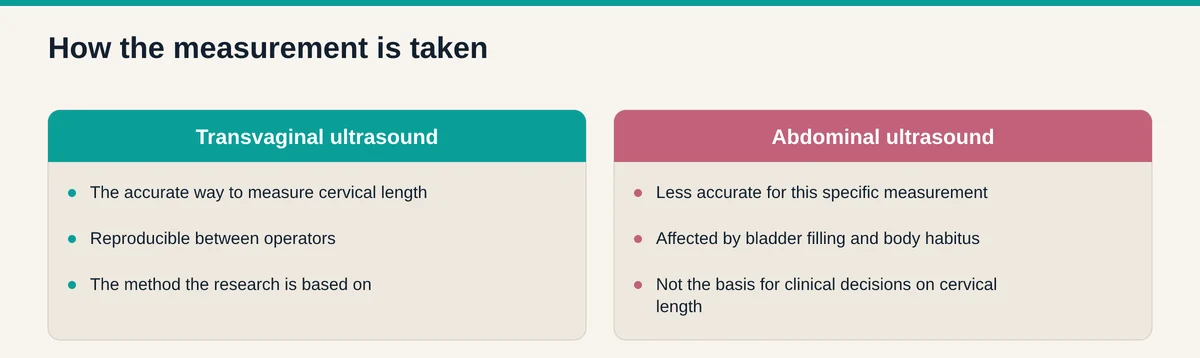
Cervical length can be attempted abdominally, but transvaginal ultrasound is the standard for a reason: it is substantially more accurate and more reproducible.
Abdominal imaging of the cervix runs into several problems at once. It usually requires a full bladder, and a full bladder compresses the cervix and makes it look artificially longer. The fetal head sits directly in front of the cervix and casts an acoustic shadow. Distance from the probe to the target degrades resolution. The result is a measurement that can miss a genuinely short cervix.
The transvaginal exam places the probe close to the tissue being imaged, with an empty bladder. It is generally quick and not painful, and it is safe in pregnancy, including when the cervix is short. If a shortened cervix is suspected on an abdominal view, the usual next step is a transvaginal measurement to confirm.
Good technique matters: the bladder empty, minimal probe pressure, and typically several measurements taken over a few minutes with the shortest reasonable one recorded, because the cervix can shorten dynamically during the exam.
Who Gets Screened, and When
Cervical length is most informative between roughly 16 and 24 weeks, and the common single-measurement point is at the anatomy scan around 18 to 22 weeks.
Practice varies, and ACOG guidance has acknowledged more than one reasonable approach:
- Universal screening in singleton pregnancies, where every patient gets a cervical length at the anatomy scan.
- Risk-based screening, where transvaginal measurement is reserved for people with a history of spontaneous preterm birth or other risk factors, often as a series of measurements every one to four weeks across the 16 to 24 week window.
If you have had a previous spontaneous preterm birth, serial measurement is standard in most settings, because the combination of that history and a shortening cervix is what most strongly changes management.
Measuring cervical length in a person who is already contracting is a different question with a different purpose, and so is measuring it at term. A short cervix at term is a normal part of getting ready, not a warning sign.
The Numbers That Get Used
These are the reference points you are most likely to hear. They are population thresholds, not personal verdicts.
- Around 35 to 40 mm: a typical mid-trimester measurement in a singleton pregnancy. Broadly reassuring.
- 26 to 29 mm: intermediate. Often prompts a repeat measurement rather than an intervention.
- 25 mm or less before 24 weeks: the definition of a short cervix used by most guidelines, and the threshold that triggers a management discussion.
- 20 mm or less: the level at which vaginal progesterone is most consistently offered in singleton pregnancies without a prior preterm birth.
- Under 15 mm: uncommon, and associated with the highest risk in the published series.
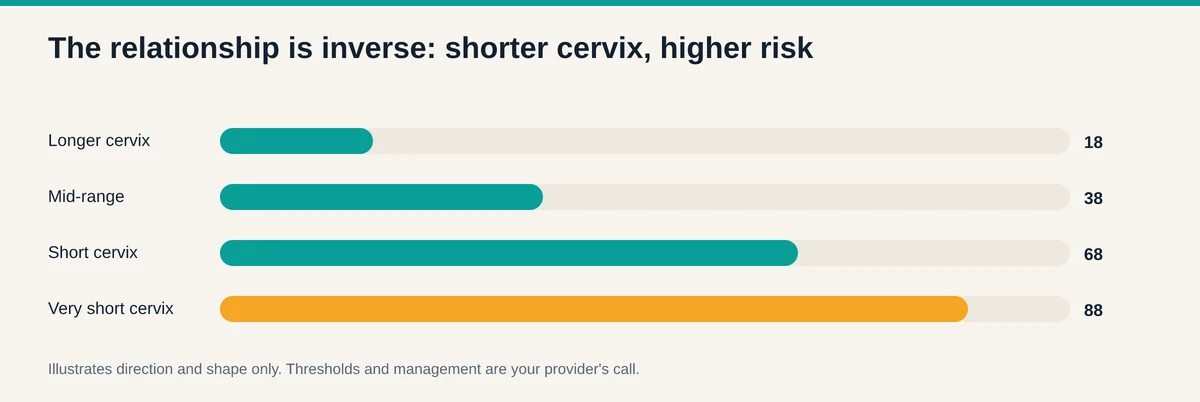
The relationship underneath these cutoffs is continuous. The foundational work here is Iams and colleagues, published in the New England Journal of Medicine in 1996, which established that the risk of spontaneous preterm delivery rises steadily as cervical length falls, with no natural break point. The thresholds exist because clinicians need somewhere to act, not because the biology changes at 25 mm.
What a Short Cervix Leads To Clinically
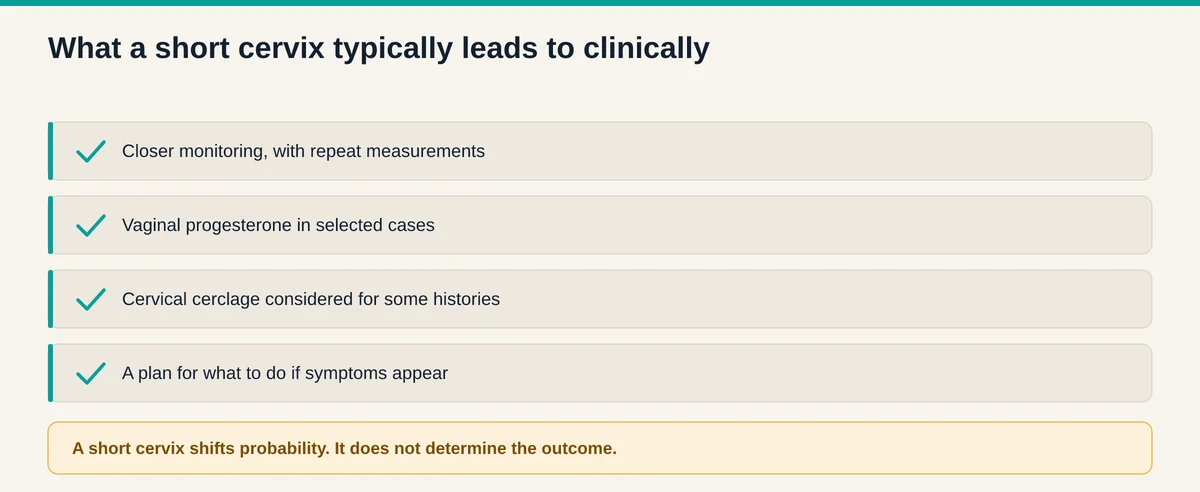
Finding a short cervix opens a conversation, not a protocol. What follows depends on the length, the gestational age, whether it is a singleton or twins, and your obstetric history.
Vaginal progesterone is the most common first step for a short cervix in a singleton pregnancy. Multiple randomized trials and meta-analyses have found it reduces the rate of preterm birth in this group. It is typically started once the short cervix is identified and continued into the mid-third trimester.
Cerclage, a stitch placed to reinforce the cervix, is used in more selected situations. The clearest case is a short cervix before 24 weeks in someone who has already had a spontaneous preterm birth. It is also used based on history alone in cervical insufficiency, and occasionally based on physical exam findings. Cerclage is not routinely recommended for a short cervix with no prior preterm birth, and it is not usually offered in twins on the basis of length alone.
Closer monitoring is often the whole plan, especially in the intermediate range: repeat measurements, clear instructions about what symptoms to report, and a lower threshold for evaluation.
Activity restriction and bed rest are no longer generally recommended on the evidence, which has not shown benefit and does show real harms. If someone suggests it, it is fair to ask what it is expected to accomplish.
A note on injectable 17-hydroxyprogesterone caproate: it was widely used for a period based on prior preterm birth history, and its availability and role changed after later trial results. This is a specific thing to ask your provider about rather than to assume from older material online.
Shifting Probability, Not Determining Outcome
Here is the framing that matters most, and it is the same framing that runs through everything on this site.
Cervical length is a good screening test in one direction and a mediocre one in the other. A normal-length cervix in the mid-trimester is genuinely reassuring: it has a high negative predictive value, meaning most people with a normal measurement will not deliver preterm. A short cervix is different. It raises risk meaningfully, but its positive predictive value in a general population is modest, because preterm birth is uncommon to begin with. Most people who get a short-cervix result go on to deliver at term.
That is not a reason to ignore the result. It is a reason to hear it as "your odds have moved" rather than "this is going to happen." Being told your cervix is 22 mm at 20 weeks is a call to act on the things that can be acted on, not a prediction of your delivery date.
The same logic governs the other end of pregnancy. Labor timing is a distribution, not an appointment. Term spans several weeks, individual gestation length varies substantially between healthy pregnancies, and the labor probability calculator exists to express that as probability across weeks rather than as a single date. For the same idea applied to the number on your chart, see due date accuracy, and for how those probabilities distribute across the final weeks, labor week by week statistics.
What This Does Not Predict
Cervical length in the second trimester is not a countdown clock, and it is not related to several things people expect it to be:
- It does not predict how fast labor will progress once it starts. That is a separate process, covered in cervical dilation and labor progress.
- It does not predict whether you will need a cesarean.
- It does not tell you anything useful about labor onset if measured at 38 weeks, when a shortening cervix is simply normal preparation.
- A single normal measurement does not rule out preterm birth entirely, which is why symptoms still matter regardless of what the scan showed.
Preterm labor symptoms, including regular contractions before 37 weeks, pelvic pressure, low back ache, fluid leakage, or bleeding, deserve a call to your provider no matter what your cervical length was.
The Bottom Line
Cervical length measured transvaginally in the mid-second trimester is one of the few genuinely predictive numbers in pregnancy, with risk rising continuously as length falls and 25 mm serving as the usual action threshold. A short cervix opens options that appear to help, mainly vaginal progesterone and, in selected cases, cerclage. But it shifts probability rather than settling the outcome, and most people who hear the phrase go on to deliver at term. This is general information, not medical advice: your own measurement belongs in a conversation with your provider.